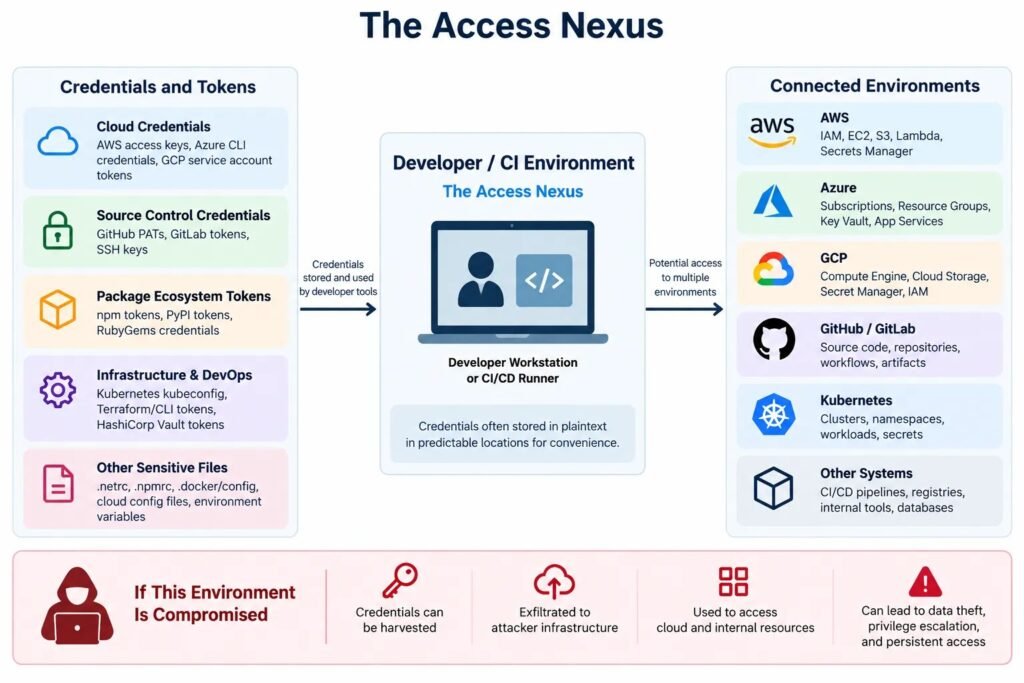
A routine package update is no longer just a routine package update. According to a new analysis from Qualys, attackers have spent the past year refining a pattern in which credential-stealing malware is tucked inside trusted software packages and developer tools, letting malicious code run on developer laptops and automated build systems before an application has even started. Once that code runs, the keys to an organization’s entire cloud environment can be only a few steps away.
Not One Campaign, But a Pattern
Qualys stresses that this isn’t the story of a single piece of malware — it’s a recurring tactic playing out across several distinct campaigns. The trend traces back to Shai-Hulud, a worm-like package threat that emerged in September 2025, with later operations expanding the same basic playbook into additional programming ecosystems and even security tooling itself.
The common thread, Qualys says, is what happens after attackers obtain working credentials: they can reach into cloud storage, map out infrastructure, exfiltrate data, or quietly establish long-term access — turning what looks like a contained software incident into a full cloud compromise. As Qualys put it in a report shared with Cyber Security News, developer environments and cloud infrastructure need to be treated as one connected attack surface rather than two separate security problems.
Why the Moment of Installation Is So Dangerous
The decisive moment in these attacks is almost always package installation itself. Modern package managers can automatically run scripts during setup, and those scripts inherit the same files, environment variables, and credentials available to the developer or the build job running them. Normal application-level defenses typically haven’t even engaged yet by the time that script executes — meaning the theft can be over before traditional protections get a chance to react.
Developer machines are an especially attractive target precisely because they tend to be credential-rich: cloud access keys, source repository tokens, package-publishing credentials, and private keys frequently sit on the same system used for day-to-day coding. Attacks against SAP-related packages have illustrated how stealing those secrets can expose systems well beyond the original software project — even when the compromised code never makes it anywhere near a production environment.
From a Worm to a Destructive Backdoor
Shai-Hulud’s evolution shows how quickly these campaigns can escalate. The malware initially searched infected systems for cloud credentials and uploaded whatever it found to public GitHub repositories it created under the victim’s own account. A variant that appeared in November added backdoor capabilities and destructive behavior that triggered if credential theft failed outright — raising the stakes of a single compromised dependency considerably.
By May 2026, a variant researchers call Mini Shai-Hulud had moved to scripts that execute before installation even finishes, with Qualys documenting a single wave on May 19 that compromised 639 package versions across 323 separate packages. Because the credential theft happens so early in the process, simply canceling an installation partway through doesn’t guarantee safety — the payload may have already harvested tokens, keys, and other secrets by that point.
The Problem Extends Beyond npm
Other campaigns have gone after the build environment more directly. One operation distributed malicious Ruby gems and Go modules disguised as ordinary developer utilities; these tools harvested secrets, weakened package verification checks, intercepted commands, and in some cases planted an attacker-controlled key to preserve long-term access. A separate campaign compromised trusted scanning tools and libraries used widely across the industry.
A breach affecting European Commission cloud infrastructure in April 2026 illustrated just how far the damage can spread: within a 48-hour window, related attacks hit npm, PyPI, and Docker Hub simultaneously. In a separate May campaign, 14 packages impersonating legitimate search libraries stole cloud and pipeline secrets, which attackers then used to publish further malicious updates — turning a single compromised developer account into a distribution channel for even more credential theft.
Recovering From — and Preventing — These Attacks
Qualys notes that removing the offending package is only the first step in recovery, not the last. Organizations also need to:
- Identify every credential the affected machine or build system could have accessed, and rotate or revoke all of it
- Review cloud activity logs for the entire window of potential exposure, not just the moment of discovery
- Pin dependency versions through lockfiles and verify that build pipelines actually preserve them
- Disable automatic installation scripts where possible, allowing only scripts that have been reviewed and are genuinely necessary
- Scope build-job permissions tightly — a job that only compiles code shouldn’t also be able to deploy it
- Favor short-lived credentials over permanent keys, and restrict cloud policies to prevent unauthorized administrator creation or disabled logging
- Protect cloud audit logs from tampering and monitor them for unusual access patterns, newly created resources, or unexpected permission changes
- Restrict access to cloud metadata services for build systems that don’t need them, and require newer, more secure metadata-service protocols where supported
The overarching lesson, according to Qualys, is that developer security and cloud incident response can no longer be treated as separate disciplines. A thorough response has to follow the entire attack path — from the moment a malicious script runs on a laptop, all the way through to whatever that stolen credential eventually unlocked in the cloud.
Leave a Reply
You must be logged in to post a comment.