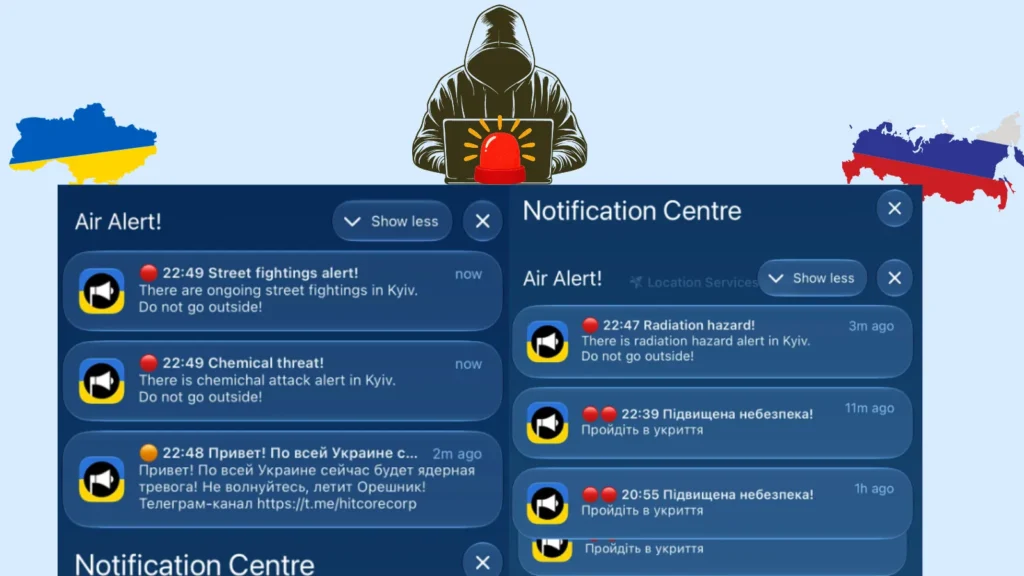
Late on November 1 and into the early hours of November 2, 2026, civilians in both Ukraine and Russia found themselves on the receiving end of a wave of fabricated emergency alerts, after attackers compromised mobile apps that millions of people rely on for early warning of airstrikes and other threats. The fake notifications warned of dangerous radiation levels, chemical attacks, and even incoming nuclear strikes — messages designed to cause maximum panic in two countries already living under wartime alert fatigue.
Ukraine’s Air Alert App Hit First
The first reports centered on Ukraine’s widely used Air Alert app, which began pushing false notifications late Sunday evening. Some messages claimed dangerously elevated radiation readings in Kyiv; others warned of chemical threats and street-level fighting. According to Associated Press reporting carried by ITV News, the fake alerts varied in quality — some were written in English riddled with spelling and grammar mistakes, while others blended Russian and Ukrainian in ways that suggested more than one source or template was involved.
Ukraine’s Air Force moved quickly to reassure the public that there was no actual radiation threat. The app’s operators, who developed the service through a partnership between Ukraine’s Ministry of Digital Transformation and the security company Ajax Systems, confirmed that unauthorized parties had tampered with the notification system. Their response was to disable push notifications entirely and temporarily suspend the app’s operation while they investigated, while urging users not to click any links contained in suspicious alerts and to rely on other official channels in the meantime. Air Force spokesman Yurii Ihnat was explicit that the breach never touched military command-and-control systems, since the public alert app operates on entirely separate infrastructure. Service was reportedly restored by the following morning.
Russia’s Emergency App Hit Hours Later
Hours after the Ukrainian incident became public, Russia’s Emergencies Ministry disclosed what it described as a large-scale cyberattack against its own mobile alerting application, which attackers likewise used to distribute fabricated public warnings. According to reporting from the Kyiv Independent, the fake Russian alerts went even further than their Ukrainian counterparts, claiming that nuclear warheads had already been launched across the country and instructing people to shelter in basements and stockpile three weeks’ worth of food.
Euronews reported that Russian officials said they were working to patch the underlying issue and restore normal app functionality, while emphasizing that other channels — including SMS alerts, broadcast warnings, sirens, and loudspeaker systems — continued to function normally throughout the incident. As with the Ukrainian breach, Russian authorities did not publicly name a suspected attacker.
Attribution Remains Unclear
It’s tempting to read the near-simultaneous timing of these two incidents as proof of a single coordinated operation, but the public record doesn’t currently support that conclusion. Ukraine’s Center for Strategic Communications has pointed the finger at Russia for the attack on its Air Alert app, though that claim hasn’t been independently verified. At the same time, nothing in the available reporting establishes that the Russian app breach was a retaliatory move, or that both incidents were carried out by the same group using the same techniques.
Equally notable is what remains unknown on the technical side. No credible report has disclosed how the attackers actually gained access to either app’s backend — whether through stolen credentials, a software vulnerability, or something else entirely. That means claims pointing to a specific flaw or exploitation method would be getting ahead of the evidence.
A Pattern of Targeting Ukrainian Digital Infrastructure
These incidents don’t exist in isolation. They follow a string of previously reported intrusions targeting Ukrainian digital services during the war, including Russian state-linked actors maintaining long-term access inside telecom operator Kyivstar’s network, and criminal charges filed against six Russian nationals over attacks on Ukrainian government systems. None of that prior activity has been definitively linked to this week’s app breaches, but it underscores how consistently civilian-facing digital infrastructure has become a target in this conflict.
Why Trust in Alerting Systems Matters
The practical fallout from both incidents was less about technical damage and more about eroded trust in a critical channel. When an app millions of people depend on to know whether to seek shelter starts sending contradictory or outright false information, the psychological and logistical cost can rival that of a real attack. Ukrainian authorities urged residents to cross-check digital alerts against official statements and physical warning systems like sirens while recovery efforts continued — a reminder that redundancy across multiple, independently operated alert channels isn’t just good engineering practice, it’s a public safety requirement. For any organization running emergency notification infrastructure, especially one operating in or near an active conflict zone, this episode is a case study in why authentication, rate-limiting, and anomaly detection on alert-issuing systems deserve the same priority as the alerts themselves.
Leave a Reply
You must be logged in to post a comment.