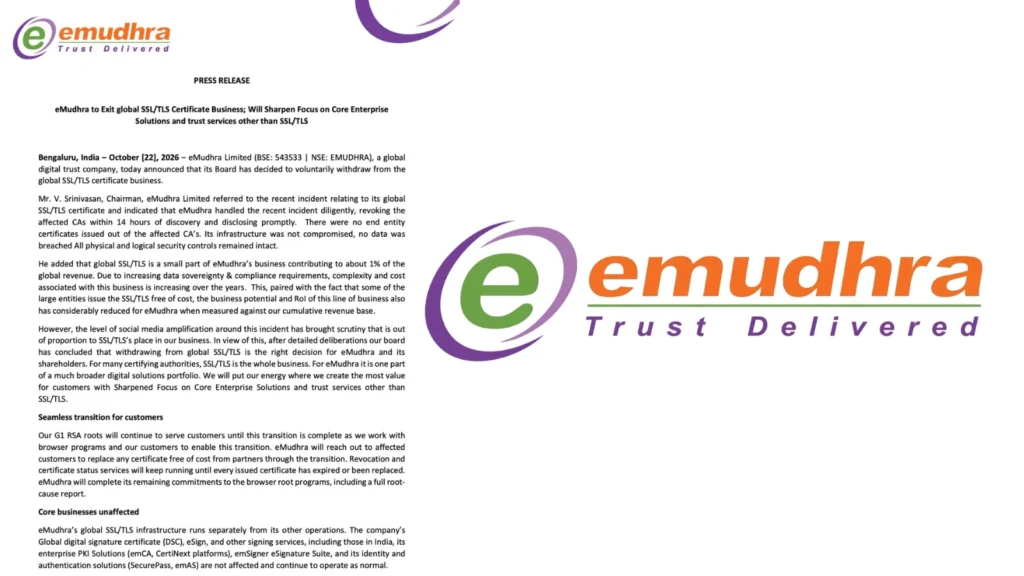
eMudhra Limited, an Indian digital trust and certificate authority provider, has announced it will exit the global SSL/TLS certificate business entirely. The move follows the discovery that eight of its intermediate certificate authority certificates were issued using private keys weak enough for an outside researcher to recover almost instantly, a flaw that traces back to a key-generation ceremony eMudhra ran more than a year earlier.
A Key Weakness Fifteen Months in the Making
According to eMudhra’s own preliminary account, the problem originated in a key-generation ceremony held on April 30, 2025. A flawed script used during a key wrap and unwrap step generated a second, unintended set of weak keys alongside the correct ones. Because the labels on the weak keys resembled those of the legitimate ones, staff later used the wrong keys when generating certificate signing requests for eight intermediate CAs. The affected keys used the P-384 elliptic curve, but instead of the astronomically large random values P-384 is supposed to produce, the private key values came out under 256, making them trivial to reconstruct from the corresponding public key.
India’s national CERT, CERT-In, was explicit that the flaw sat in how the keys were generated, not in any weakness of the P-384 algorithm itself. Of the eight compromised intermediates, six supported general TLS certificate issuance and two were used for code signing. eMudhra has said none of the affected intermediates directly issued end-entity certificates, the kind that websites and applications actually present to browsers, which somewhat limits the blast radius.
From Discovery to Revocation in Hours
The weakness came to light on October 17, 2026, when a researcher using the handle Wayne demonstrated proof of control over all eight private keys. Mozilla independently reproduced the key recovery, confirming the generation flaw was real and exploitable. Google and Mozilla moved the same day to block the affected TLS keys and began the process of removing trust in the emSign ECC Root CA – G3 to protect browsers and clients that don’t reliably check intermediate certificate revocation status in real time.
eMudhra Chairman V. Srinivasan said the company revoked the affected certificates within 14 hours of the disclosure. CERT-In subsequently stated that, as of its October 21 update, public evidence had not confirmed any actual malicious exploitation of the weak keys, though the window during which a sophisticated attacker could have forged certificates was real regardless of whether anyone is known to have used it.
Why Exit the Business Entirely?
eMudhra’s decision to abandon global SSL/TLS issuance rather than simply remediate the incident reflects as much business calculation as security concern. The company says the global certificate segment accounts for roughly 1% of its total revenue, a figure dwarfed by the compliance overhead, data-sovereignty requirements, and intensifying price competition from free certificate authorities that have steadily eroded margins in commercial TLS issuance for years. Srinivasan also pushed back on what he characterized as social media criticism disproportionate to the size of the affected business line, while acknowledging the incident raised legitimate questions about the company’s certificate issuance controls.
The Migration Ahead
eMudhra estimates approximately 30,000 certificates, separate from the eight compromised intermediates themselves, will need to migrate away from its global SSL/TLS infrastructure as part of the wind-down. The company says it will keep its G1 RSA root certificates operating to serve existing customers during the transition, offer replacement certificates through partners at no additional cost, and maintain revocation and status-checking services until all affected certificates either expire naturally or are replaced.
CERT-In’s advisory, tracked as CIAD-2026-0050, urges administrators not to assume the issue is confined to web browsers. It specifically recommends reviewing certificate bundles embedded in applications, containers, and network appliances, locations where an expired trust relationship can quietly break functionality long after browsers have already adjusted. Chrome’s root-store change affecting the emSign root is expected to reach most devices by October 27, 2026.
What Organizations Relying on eMudhra Certificates Should Do
- Inventory every system, application, container, and network device that references an eMudhra-issued or emSign-rooted certificate, not just public-facing websites.
- Replace certificates proactively through eMudhra’s partner migration path rather than waiting for a browser trust change to break production services.
- Update browsers and trust stores on managed devices to ensure the upcoming root-store changes are reflected promptly.
- Treat this as a reminder to track certificate issuer concentration risk across your infrastructure, since a single CA’s operational failure can cascade into unplanned migration work.
Leave a Reply
You must be logged in to post a comment.