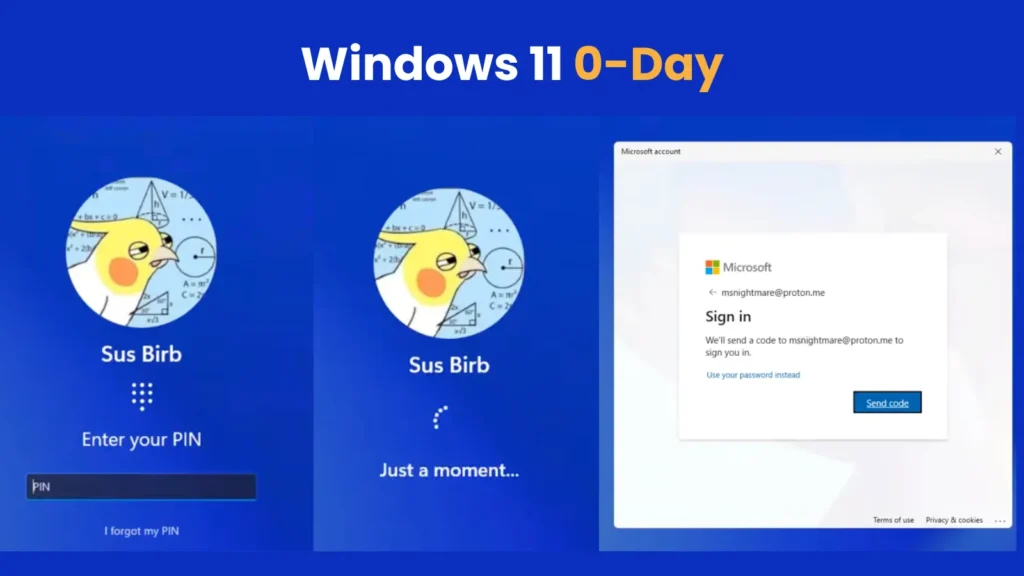
A newly disclosed Windows 11 vulnerability, nicknamed FastUnlock, lets someone with physical access to a locked but running PC bypass parts of the sign-in screen and execute code without ever entering a password. The flaw lives in Narrator, the screen reader Microsoft builds into every copy of Windows for accessibility, and researchers say it can undermine protections that users and administrators generally assume BitLocker provides once a device is locked.
It’s an important distinction, though: FastUnlock does not break BitLocker’s disk encryption, and it hasn’t been shown to let an attacker decrypt a drive on a powered-off machine. What it does is exploit the window between “the drive is unlocked and Windows is running” and “the user has actually signed back in” — a gap that most people reasonably assume is secured by the lock screen alone.
Five Minutes From Discovery to Breach
The flaw was reported by a researcher using the handle Nightmare Eclipse, who tested it against Windows 11 version 26H2 with November 2026 security updates fully installed. According to the researcher, it took roughly five minutes to go from identifying the bug to successfully breaching a test machine — though that figure reflects a single documented test run rather than a benchmark across different hardware and configurations. Windows 10 was not tested.
The attack requires two things: physical access to the device, and at least one local account tied to an online Microsoft account. From there, it involves the account-recovery screen, where Narrator is able to interact with interface elements that are supposed to be unreachable before a user signs in. The underlying issue isn’t that Windows offers an accessibility tool at the lock screen — that’s a legitimate and necessary feature. The problem is that Narrator, in this configuration, can reach beyond the lock screen into functionality that should be gated behind authentication.
Code Execution, But Not (Yet) Full Takeover
Security vendor ThreatLocker independently tested FastUnlock and confirmed it can run code under WsiAccount, a special Windows account used at the lock screen that does not carry administrator privileges. That’s a meaningful finding — it proves an attacker at the keyboard can execute software without ever signing in — but it stops short of demonstrating a full takeover of the signed-in user’s session, an escalation to administrator rights, or unrestricted access to every file on the drive.
How FastUnlock Differs From Other Recent Bypasses
Cyber Security News has previously covered two other Windows BitLocker-adjacent flaws disclosed during November’s Patch Tuesday cycle — tracked as CVE-2026-97015 and CVE-2026-119832 — and those should not be confused with FastUnlock, which remains a separate, unpatched issue with no assigned CVE as of November 20. FastUnlock is also distinct from an earlier-reported Windows Recovery Environment flaw called YellowKey, which attacked BitLocker protections before Windows even finished booting. FastUnlock instead targets the later stage, after the drive is already unlocked and the operating system is running.
That timing distinction is the whole story with BitLocker. The feature is built to protect data at rest — on a drive that hasn’t yet been unlocked. Once Windows has booted and the system drive is accessible, it’s the lock screen and Windows account permissions, not BitLocker, that stand between an attacker and the machine.
What Organizations Can Do in the Meantime
- Pair the device’s TPM with a startup PIN — separate from the regular Windows sign-in PIN — for devices that face a real risk of physical access by untrusted parties.
- Favor shutdown or properly configured hibernation over sleep for laptops that travel or may be left unattended; Microsoft notes that sleep keeps data in memory and skips the BitLocker startup PIN check on wake.
- Limit physical access to exposed or high-risk devices until Microsoft issues specific guidance or a fix.
- Keep an eye out for an official advisory — no CVE or patch timeline has been published yet.
No real-world attacks exploiting FastUnlock have been publicly reported so far. That’s reassuring, but researchers caution it shouldn’t be read as a reason to treat an unattended, merely locked laptop as being as safe as one that’s been fully shut down.
Leave a Reply
You must be logged in to post a comment.