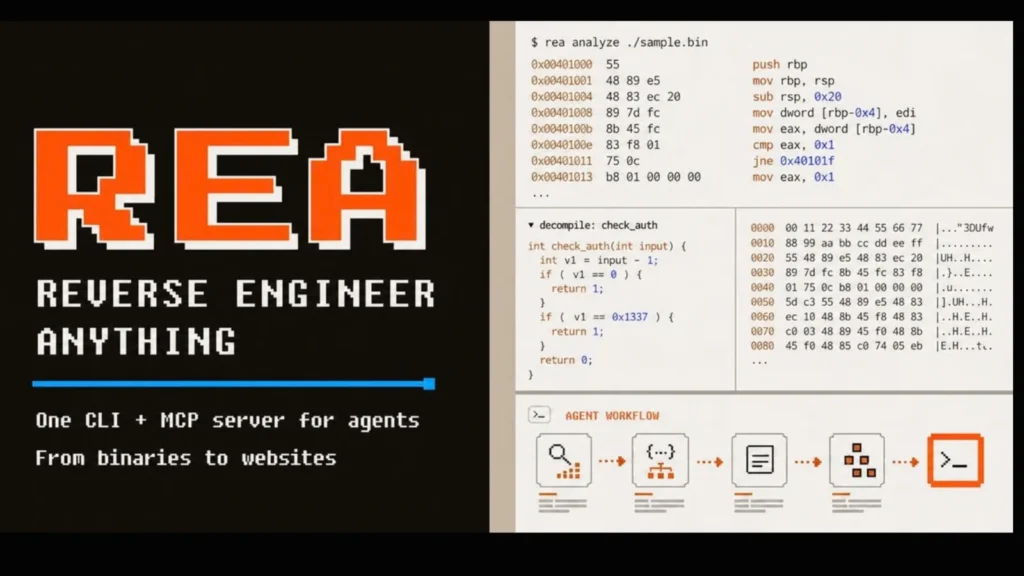
A new open-source project called Reverse Engineer Anything, or REA, connects AI coding agents with established software-analysis tools including Ghidra, IDA Pro, and Hopper. The project is designed to let researchers ask questions about programs, follow relevant code paths, and receive explanations supported by pseudocode, instructions, symbols, strings, and references.
REA is not a replacement for a disassembler or for expert analysis. It acts as an orchestration layer between an agent and the tools that inspect software without source code. The approach may help analysts move more quickly from a behavioral question to the functions and data that support an answer, while keeping the underlying evidence available for review.
A bridge between agents and analysis engines
The project uses the Model Context Protocol to expose local analysis capabilities to supported agents. An agent can request inspection of a target, evaluate returned findings, ask follow-up questions, and potentially write or test an implementation derived from the observed behavior.
For native binaries, REA can obtain decompiled pseudocode, assembly, symbols, strings, call relationships, and cross-references from an installed analysis provider. Deep inspection requires Ghidra, IDA Pro, or Hopper, so the agent is building on mature tooling rather than inferring a binary’s operation from filenames or surface clues.
The scope extends beyond native executables. JavaScript and Electron analysis can map modules, imports, routes, source maps, and communication between renderer, preload, and main processes. Static .NET workflows expose metadata, intermediate-language instructions, and declared native dependencies. The project also describes coverage for Android packages, firmware, websites, and selected runtime activity.
Installation and supported workflows
Users with a supported Node.js and npm environment can begin through the project’s setup command. The installer prompts for agent choices, shows proposed changes, backs up existing configuration, and registers the local server. An agent restart is required after setup.
Listed integrations include Claude Code, Cursor, Codex, Gemini CLI, and Grok Build. Other applications capable of connecting to local MCP servers can be configured manually. Researchers who prefer repeatable automation can also use terminal commands rather than an interactive agent conversation.
Project examples suggest the value of grounding. In one DX-Ball reconstruction, a recovered sound-positioning calculation reportedly passed 3,205 comparisons with the original x86 behavior and reproduced all 63 bytes of the compiled function. Another example followed Notion clipboard handling across several Electron process boundaries. These are demonstrations reported by the project, however, not a guarantee that arbitrary software can be reconstructed completely or correctly.
Security and privacy boundaries still matter
Although REA analyzes targets locally, results passed to an AI agent may be handled according to the model provider’s data policies. Teams working with confidential software, unreleased products, customer artifacts, or regulated data should determine exactly what leaves the workstation before enabling an integration.
Analysts must also distinguish static inspection from runtime capture. Reading JavaScript, .NET metadata, or binary structures does not necessarily execute the target. Runtime workflows, by contrast, may launch or interact with software under the researcher’s permissions. Suspicious samples should be placed in an isolated analysis environment with restricted credentials, networking, shared folders, and clipboard access.
- Verify important agent claims directly in the disassembler, debugger, or captured execution evidence.
- Keep proprietary artifacts within approved model and data-handling boundaries.
- Use disposable, segmented environments for malware or untrusted applications.
- Record tool versions, hashes, prompts, and analyst decisions so conclusions can be reproduced.
Acceleration does not remove analyst responsibility
Agent-guided exploration can reduce the time spent navigating large codebases and translating between representations. It can also produce plausible but incorrect explanations if evidence is incomplete, symbols are misleading, or decompilation obscures important behavior.
REA’s most useful design principle is therefore not the breadth implied by its name, but its emphasis on inspectable support and stated limits. Used carefully, it can help researchers form hypotheses and locate relevant code faster. Authorization, safe execution, validation, and final judgment remain human responsibilities.
Leave a Reply
You must be logged in to post a comment.