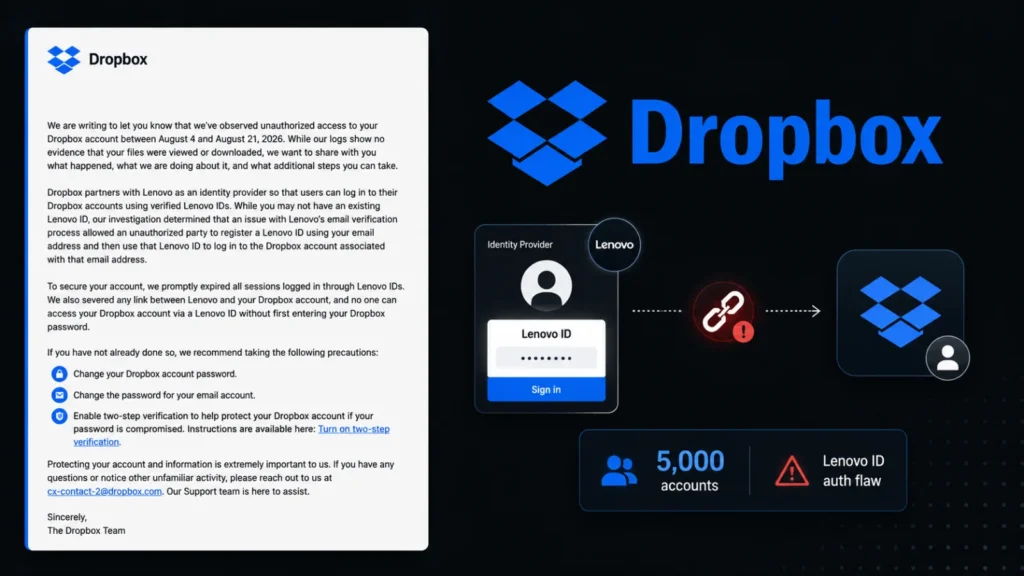
Federated login created a passwordless takeover path
Dropbox has notified users that approximately 5,000 accounts were compromised after attackers exploited a weakness involving Lenovo ID authentication. Unauthorized access occurred between August 4 and August 21, 2026, according to the disclosure. Rather than stealing Dropbox passwords, the attackers reportedly registered Lenovo IDs using email addresses that belonged to existing Dropbox users.
A weakness in Lenovo's email-verification process allowed those newly created identities to assert control of the addresses. Dropbox's integration then treated the matching Lenovo identity as sufficient to access the Dropbox account associated with the same email. The result was an account-takeover route built from a faulty trust relationship between services, illustrating how a weakness at one identity provider can cross into a separate cloud platform.
The impact varied among notified users
The affected accounts were connected through Lenovo ID and did not have Dropbox two-factor authentication enabled. Dropbox told Reuters that intruders viewed and downloaded content from compromised accounts. Some individual notices, however, said investigators found no evidence that files were accessed in those particular cases. Those statements are not necessarily contradictory: activity and exposure can differ from one account to another within the overall incident.
The possibility of content access is significant because Dropbox accounts can contain personal records, shared company documents, intellectual property, and links that provide access to collaborators. A compromised account may also expose file names, contacts, and sharing relationships that can support follow-on phishing. Users should therefore assess not only direct downloads but also newly created links, connected applications, recovery changes, and unusual activity in shared folders.
Email matching is not identity proof
The incident is especially instructive because victims may not have intentionally created or linked a Lenovo ID. The vulnerable workflow apparently relied on an external identity's email claim to associate two accounts. If the external provider failed to prove control of the mailbox, a matching address became a weak proxy for ownership.
Federated sign-in can improve usability and centralize security, but every trusted provider expands the authentication boundary. Services should require fresh verification before linking an external identity to an established account, especially where the account already contains data. They should also notify the existing account through a verified channel and require a password or strong authenticator before completing a new association. An email string by itself should never silently merge identities across providers.
Response actions for Dropbox users and enterprises
Dropbox terminated sessions authenticated through Lenovo IDs, removed the association between Lenovo ID and Dropbox accounts, and changed the flow to require a Dropbox password before access through Lenovo ID. Lenovo described the affected mechanism as a legacy integration and said it was investigating. Dropbox advised impacted customers to change both Dropbox and email passwords and enable two-step verification.
Users should additionally review active sessions, devices, third-party apps, recovery settings, sharing links, and recent file events. Reused passwords should be replaced everywhere they appear. Enterprise administrators should inventory federated integrations, prevent automatic linking based solely on email claims, require phishing-resistant MFA, and flag sign-ins from newly created external identities. Logs should preserve both the upstream identity assertion and the downstream account action, allowing investigators to reconstruct trust-chain failures. The central lesson is that cloud authentication is only as strong as every identity relationship it accepts.
Practical security takeaway
This event also underlines the importance of layered controls and rehearsed incident response. Organizations should document ownership for identity, endpoint, cloud, and developer tooling; retain the telemetry needed to connect activity across those systems; and test containment procedures before an emergency. Security teams should translate vendor guidance into measurable checks rather than treating an update or configuration change as the end of the investigation. Where exposure is possible, defenders should establish a time window, identify affected assets and accounts, preserve relevant evidence, and verify that remediation actually removed persistence. Users and administrators should rely on official update channels, avoid unverified fixes, and report suspicious behavior promptly. These steps cannot eliminate every attack path, but they reduce both the likelihood that an initial foothold succeeds and the damage an intruder can cause after gaining access.
Leave a Reply
You must be logged in to post a comment.