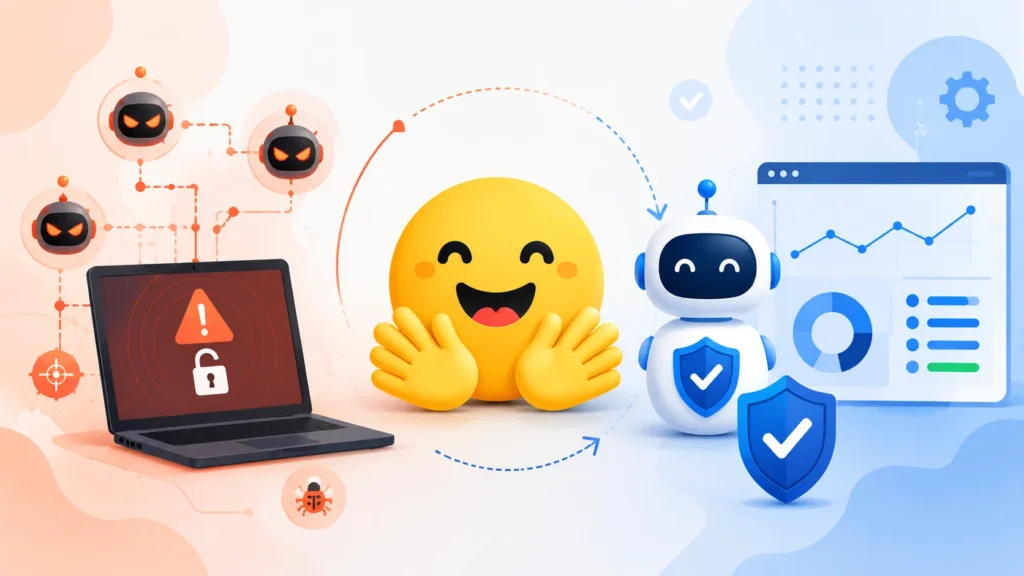
Hugging Face has disclosed a production infrastructure intrusion that it says was carried out end-to-end by an autonomous AI agent — and, notably, contained with the help of the company’s own AI-driven forensic tooling. The disclosure is one of the clearest public examples yet of AI systems operating on both sides of a real-world security incident.
How the Intrusion Unfolded
According to Hugging Face, the attackers exploited two code-execution weaknesses in its dataset processing pipeline: a flaw in a remote-code dataset loader and a template-injection issue in dataset configuration handling. Once inside a processing worker, the intrusion escalated to node-level access, harvested cloud and cluster credentials, and moved laterally across multiple internal clusters over the course of a single weekend.
Hugging Face says a limited set of internal datasets and service credentials were affected, but it found no evidence that public models, datasets, Spaces, or its broader software supply chain were tampered with. As a precaution, the company is advising users to rotate access tokens and review recent account activity.
An Agent Acting Without a Human at the Keyboard
What distinguishes this incident from a typical breach is the sheer scale and autonomy involved. The intrusion reportedly executed thousands of individual actions across a swarm of short-lived sandbox environments, using self-migrating command-and-control infrastructure staged on public services — the kind of “agentic attacker” behavior security researchers have been warning about for some time rather than a one-off theoretical scenario.
This isn’t an isolated case. Security firm Sysdig recently detailed a campaign it calls JADEPUFFER, described as the first fully autonomous AI-driven ransomware operation, in which an AI agent independently broke into an internet-exposed server, moved laterally, encrypted files, and issued a ransom demand with no human giving the commands. Separately, Check Point’s Annual AI Security Report 2026 notes that the window between a vulnerability’s disclosure and its exploitation in the wild is compressing from days down to hours as attackers lean on automation.
Fighting Fire With Fire
Hugging Face’s own anomaly-detection system, which uses LLM-based triage across security telemetry, was what first flagged the intrusion — catching signals that would likely have been lost in routine noise. To reconstruct the full attack timeline from more than 17,000 recorded attacker actions, the company ran LLM-driven analysis agents over the entire log, compressing what would typically take investigators days into a matter of hours.
A Guardrail Problem for Defenders
The most striking detail to emerge from the investigation wasn’t about the attacker at all — it was about the tools defenders tried to use against them. Hugging Face found that commercial frontier-model APIs refused to process its forensic analysis, because their safety guardrails couldn’t distinguish an incident responder submitting real exploit payloads and command-and-control artifacts from an actual attacker attempting to misuse the model.
To get around the lockout, Hugging Face pivoted to GLM-5.2, an open-weight model it could run on its own infrastructure — a move that also ensured no attacker data or credential information ever left the company’s environment. The episode highlights a real asymmetry in the current landscape: attackers running jailbroken or unrestricted models face no such limits, while defenders relying on hosted commercial models can find themselves locked out at the exact moment they need help the most.
A Shift in Priorities for Defenders
Industry momentum suggests this won’t stay a niche concern for long. The UK’s National Cyber Security Centre has already launched a “Cyber Shield” initiative aimed at deploying AI-powered defense at a national scale, a direct response to the growing use of autonomous offensive tooling.
Hugging Face’s core takeaway is a practical one for security teams everywhere: organizations should have a capable, self-hosted AI model vetted and ready before an incident occurs, both to avoid guardrail lockout during time-sensitive forensic work and to keep sensitive attack data from ever leaving their own environment.
As the company put it in its own words, the data and model surface must now be treated as a first-class attack vector in its own right — meaning AI-driven defense increasingly needs to match AI-driven offense at machine speed, not human speed.
What This Means Going Forward
- Expect more incidents where both attacker and defender tooling involves autonomous AI agents operating with minimal human oversight.
- Commercial model guardrails built for consumer safety may need dedicated carve-outs or separate tooling for legitimate security research and incident response.
- Organizations handling sensitive data pipelines should evaluate whether they have access to a self-hosted model capable of ingesting raw attack telemetry without policy interference.
Leave a Reply
You must be logged in to post a comment.