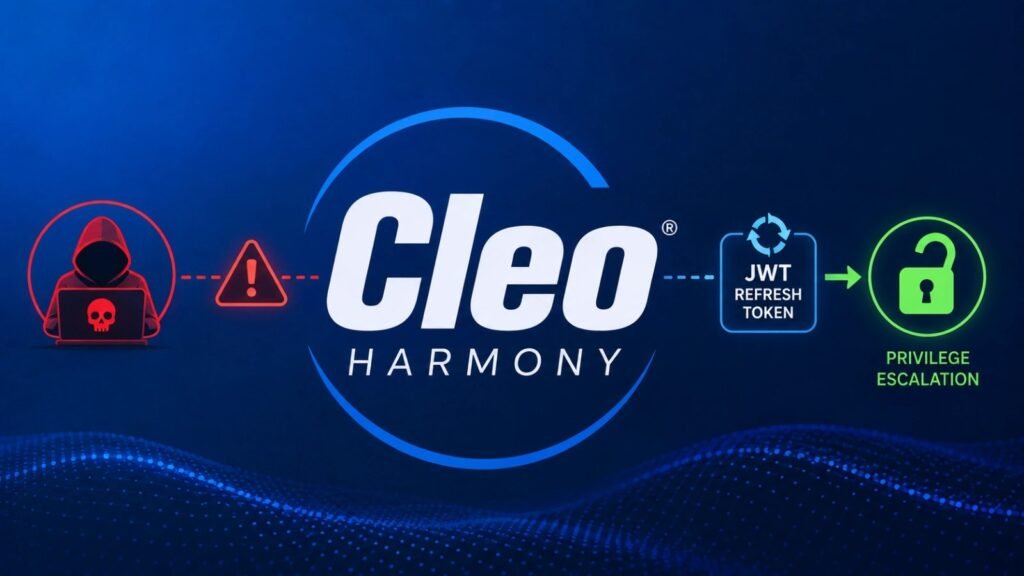
A newly disclosed vulnerability in Cleo Harmony, one of the more widely deployed managed file transfer and B2B integration platforms in enterprise environments, gives remote attackers a way to escalate their privileges without needing valid credentials to start. Tracked as CVE-2026-84115 and rated 8.3 (High) on the CVSS scale, the flaw affects every Harmony build up to version 5.8.1.10 — and a working proof-of-concept exploit is already circulating publicly, sharply narrowing the window organizations have to respond.
A Flaw Hiding in the Token Refresh Logic
The vulnerability sits inside Harmony’s JWT Refresh Token Handler, specifically in how the platform processes requests to its /api/connections endpoint. At issue is the way the application reads the Bearer argument passed in HTTP authorization headers: by crafting a manipulated Bearer token, an attacker can trick Harmony into granting session privileges that were never authorized for that user.
Analysts classify the underlying weakness as CWE-269, Improper Privilege Management — a category that covers cases where an application fails to correctly enforce role-based access boundaries during sensitive operations like refreshing an authentication token. In Harmony’s case, the token-refresh workflow simply doesn’t verify that the elevated permissions being granted actually match what the original session was entitled to.
Why Remote Exploitability Changes the Calculus
What makes CVE-2026-84115 particularly urgent is that it can be triggered entirely over the network through crafted HTTP requests. There’s no need for local system access, physical proximity to the server, or, in some exploitation paths, even valid starting credentials. Combined with a public proof-of-concept already in circulation, that means opportunistic attackers can scan the internet for exposed Harmony instances and attempt privilege escalation with comparatively little skill or setup.
A successful exploit hands the attacker administrative-level control over the platform. Because Harmony sits at the center of file transfer and integration workflows connecting a business to its partners, banks, and internal systems, that level of access doesn’t stay contained — it exposes sensitive transferred files and gives an attacker room to manipulate the very data pipelines the platform was deployed to secure. Security researchers have drawn parallels to token-manipulation tactics cataloged under the MITRE ATT&CK authentication-bypass techniques, where forged or replayed bearer tokens let attackers sidestep validation logic to gain persistent footholds or pivot into connected environments.
A Platform With a History Worth Remembering
This isn’t Cleo’s first brush with a high-impact flaw. The vendor’s Harmony, VLTrader, and Cleo Communications products found themselves at the center of the Termite/Cl0p campaigns in late 2024, when the actively exploited file-upload vulnerability tracked as CVE-2024-50623 was weaponized against dozens of organizations before a patch was widely adopted. That episode is a reminder of how quickly attackers move once a Cleo vulnerability becomes public knowledge, and why security teams are being urged to treat this latest disclosure with the same seriousness rather than filing it away as routine patch-Tuesday reading.
What Defenders Should Do Now
Cleo has already shipped a fix. Version 5.8.1.11 corrects the flawed privilege-management logic inside the JWT Refresh Token Handler, and upgrading remains the only reliable way to close the hole before broader exploitation takes hold. Recommended steps include:
- Upgrade all Cleo Harmony instances to version 5.8.1.11 or later immediately, prioritizing any deployment reachable from the internet
- Where an immediate upgrade isn’t possible, enforce strict input validation on API requests hitting the
/api/connectionsendpoint - Deploy WAF rules tuned to detect malformed or suspicious Bearer token patterns in authorization headers
- Audit access logs for anomalous authentication activity, unexpected privilege changes, or repeated requests to the connections endpoint
- Review any downstream systems integrated with Harmony for signs of unauthorized access, given the platform’s role as a hub for file transfer and partner connectivity
Given that a public exploit already exists and the vulnerability requires no privileged starting point, organizations running unpatched Harmony deployments should treat this as an urgent, not routine, update — the gap between disclosure and mass exploitation has been shrinking with each Cleo advisory, and this one is unlikely to be an exception.
Leave a Reply
You must be logged in to post a comment.