Malware-as-a-Service Keeps Getting Cheaper
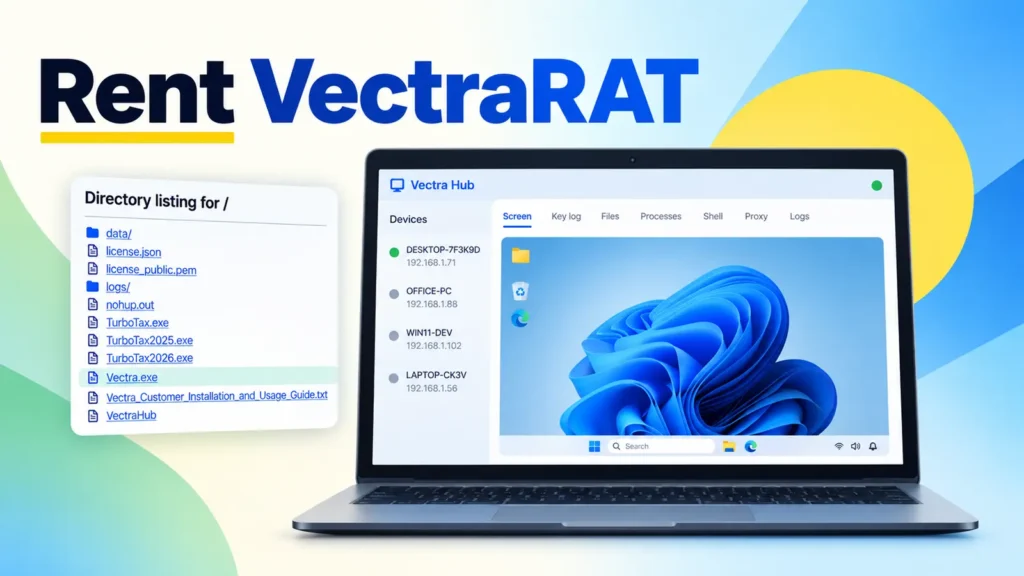
A newly documented remote access trojan called VectraRAT is being rented out to cybercriminals for as little as $250 a month, offering paying customers deep, persistent control over infected Windows machines without requiring any development skills or infrastructure of their own. The subscription model reflects a broader trend in the cybercrime economy, where sophisticated capability is increasingly available to buy rather than build.
Researchers at SOCRadar’s Threat Research Unit uncovered the platform after an exposed online directory revealed malware samples, server files, license records, and operator logs, an investigation that began June 23 and eventually expanded to more than ten related servers.
Built as a Product, Not Repackaged Code
What sets VectraRAT apart from many forum-sold tools is that its components, the Linux-based control server, Windows implant, management panel, and communication protocol, appear to have been engineered together as a cohesive platform rather than assembled from leaked or recycled malware code. The developer, operating under the handle Vectra and previously known as Nyxel, retains the source code entirely and instead rents access to the control server, implant builder, and a support channel, functioning much like a legitimate software-as-a-service business.
That purpose-built design doesn’t make the malware invisible, but it can complicate detection efforts tuned to recognize the telltale signatures of more common, previously catalogued RAT families.
What the Implant Can Do
Once installed on a victim’s machine, VectraRAT gives its operator a substantial toolkit for surveillance and control. It can open a hidden desktop invisible to the victim, log keystrokes, launch Command Prompt or PowerShell sessions, transfer files in both directions, and repurpose the infected machine as a network proxy. On first connection, it also automatically harvests browser-stored credentials, network configuration details, and local files that might contain API keys or database connection strings.
Perhaps most concerning is a built-in privilege-escalation feature that can elevate the malware’s access level without triggering the Windows User Account Control prompt users are trained to notice, abusing trusted system processes to operate with fewer restrictions and greater freedom to reach protected data or stage additional malware.
Delivered Through Fake Verification Pages
Buyers of VectraRAT have been observed distributing it through two main channels: the Amadey malware loader and ClickFix-style lure pages impersonating TurboTax. In a typical ClickFix attack, a fraudulent CAPTCHA or identity-verification page instructs the visitor to open the Windows Run dialog and paste in a command, transforming what looks like routine browser friction into direct malware execution, entirely by the victim’s own hand.
Operators can also update the implant’s callback address after it’s already been installed, which reduces the need to rebuild and redistribute infected files every time hosting infrastructure changes or gets taken down.
Real Victims, Real Businesses
This isn’t a theoretical threat. Researchers recorded 38 genuine victim sessions in less than a week of monitoring, with clear evidence of file theft from compromised business systems. Of the victim machines where operating system data was available, 48 percent were running corporate Windows editions, including Enterprise and Windows Server 2025, indicating that VectraRAT’s rental customers are not limiting themselves to casual home-user targets.
The malware communicates over a custom TCP-based protocol on a non-standard port rather than blending into normal web traffic, with its administrative panel and support services running on separate ports entirely, architectural choices that suggest a deliberately engineered command infrastructure rather than an improvised one.
How Organizations Can Respond
Because ClickFix-style delivery relies entirely on tricking users into executing commands themselves, the most effective defense starts with a simple principle: no legitimate website will ever instruct a visitor to open the Run dialog, Command Prompt, Terminal, or PowerShell to paste a “verification” command. Beyond user awareness, security teams should:
- Block known VectraRAT infrastructure and hunt for the associated network and host indicators across the environment.
- Investigate unexpected child processes launched by Windows auto-elevation utilities, a pattern consistent with the malware’s UAC-bypass behavior.
- Monitor for unusually long-lived outbound connections that don’t match recognizable application traffic patterns.
- Watch for PowerShell or Command Prompt execution occurring shortly after a clipboard paste event, a strong signal of ClickFix-style delivery in progress.
VectraRAT illustrates just how low the barrier to entry has fallen for meaningful cybercrime capability. A modest monthly subscription now buys a criminal client polished enough to blend into a legitimate business’s Windows fleet, steal credentials, and maintain long-term access, no coding required.
Leave a Reply
You must be logged in to post a comment.