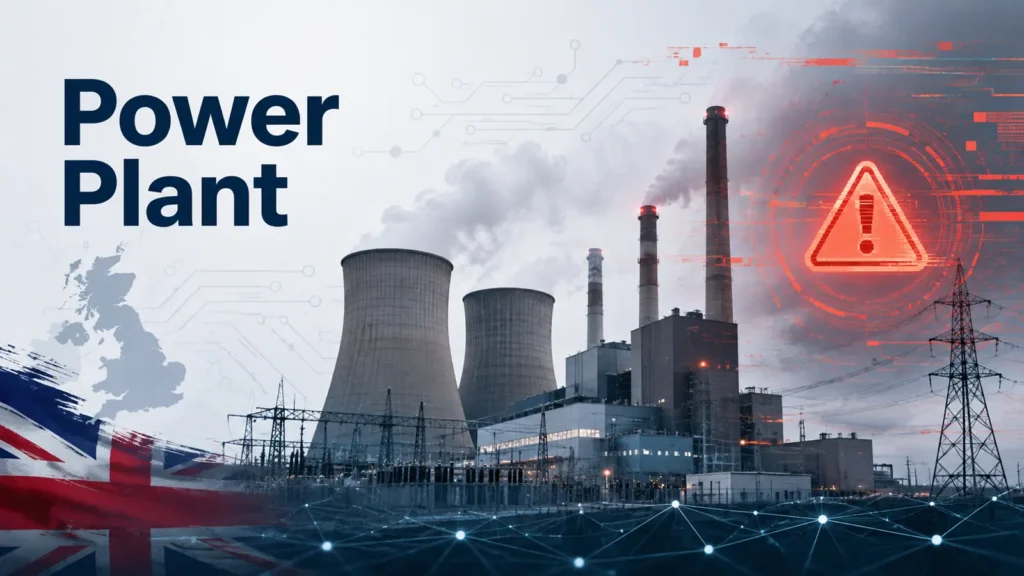
A cyber incident reportedly forced a small power plant in the United Kingdom to suspend operations for about four days in July, highlighting how even modest energy facilities can face lengthy and complex recovery work. The shutdown did not interrupt electricity service to customers, and officials said the wider national power system continued to operate normally.
The UK Department for Energy Security and Net Zero confirmed that a small-scale generator experienced a cyber incident, but it did not identify the operator or location. Media reports connected the disruption to Iran-linked hackers. However, no British government agency or the National Cyber Security Centre has publicly attributed the activity to Iran or to a named threat group.
Confirmed disruption, limited technical evidence
The affected facility was described as an approximately 15-megawatt gas-fired peaking plant. Peaking plants are used when electricity demand rises or other supply becomes constrained. The site’s capacity is minor compared with a large power station, which is why Energy Minister Michael Shanks said the incident did not threaten national energy security.
What is known publicly is narrower than some early accounts suggest. There is no confirmed malware family, initial access route, exploited vulnerability or evidence that attackers directly manipulated industrial controllers. Narratives involving phishing, an engineer’s workstation, lateral movement and operational-control activity have not been substantiated with public forensic evidence.
Threat intelligence analysts assessing the case said the record supports a real operational interruption and a reported connection to Iran, but not a proven attacker, method or technical scope. The distinction matters: geopolitical context and similarities to other campaigns can guide investigation, but they are not sufficient for confident attribution.
Why a small plant can take days to restore
A four-day outage does not necessarily mean an attacker controlled machinery for that entire period. Industrial recovery requires operators to establish that equipment can return to service safely. Teams may have to verify controller logic, engineering configurations, safety functions, remote-access paths and approved settings before restarting physical processes.
This makes recovery in operational technology environments different from simply reimaging an office laptop. Even when the initial intrusion affects business IT or a supporting workstation, operators may halt generation as a precaution until they can trust the systems that monitor and manage equipment. The duration therefore illustrates a resilience problem even though the plant’s absence did not materially affect the grid.
Exposure and access controls deserve attention
The incident arrives amid wider warnings about attacks on internet-accessible industrial devices and weakly protected remote-management services. Energy operators can reduce that risk by focusing on basic but consequential controls:
- Remove controllers and engineering interfaces from direct internet exposure.
- Route necessary remote support through secured gateways or VPNs with named accounts and phishing-resistant multifactor authentication.
- Separate corporate IT from operational networks and strictly limit allowed communication paths.
- Monitor vendor and maintenance access, including when accounts are used and what changes follow.
- Keep tested offline copies of controller programs, HMI projects and known-good configurations.
Smaller generators need the same attention to visibility and recovery planning as larger sites. A single 15-megawatt outage may be absorbed by the national system, yet the owner can still face operational cost, safety checks and a difficult investigation. A coordinated campaign affecting multiple small sites could also create a more significant aggregate problem.
Exercises should include engineers, IT staff, safety personnel and external suppliers, because restoring trust may require decisions across all four groups. Clear records of approved logic and configuration changes can shorten that process.
Until authorities release further evidence, specific claims about an Iranian group, a phishing lure or manipulated industrial controls should be treated as unconfirmed. The practical lesson is firmer: reduce external exposure, tightly govern privileged access, monitor engineering activity and rehearse recovery before an incident makes those plans necessary.
Leave a Reply
You must be logged in to post a comment.