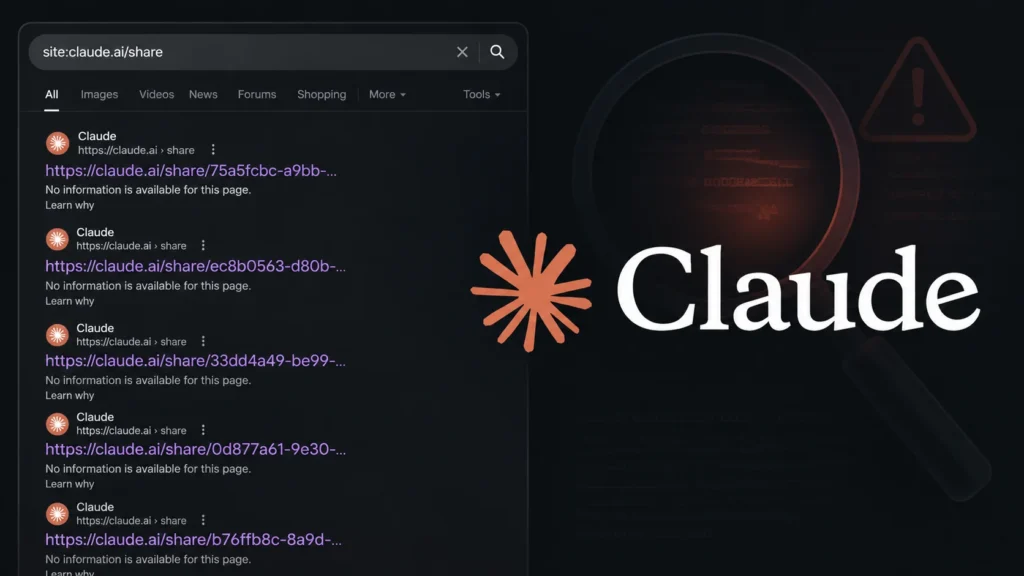
A privacy scare hit Anthropic’s Claude AI over the weekend after users discovered that shared conversation links — meant to be sent privately from one person to another — were showing up in ordinary Google searches. The discovery, first reported in a Reddit thread, renewed concerns about how AI chat platforms handle the “share” features that have become standard across the industry.
How the Exposure Happened
Claude’s share function generates a public URL for a conversation so a user can forward it to someone else — a common convenience feature found across most major AI chatbots. According to the Reddit report, the pages behind those links were missing proper noindex directives, the tag that tells search engines not to crawl and list a page. Once a share link was posted anywhere public — a forum, a social media post, even an accidental copy-paste — search engine crawlers picked it up and indexed the full conversation.
That meant anyone could run a targeted search, such as site:claude.ai/share, and browse conversations that were never intended for a public audience. Reports indicated the exposed material included legal strategy discussions from lawyers, proprietary source code and debugging sessions from engineers, and a range of personal, sensitive exchanges submitted by everyday users.
Not the First Time This Has Happened
The incident closely mirrors an earlier controversy involving OpenAI’s ChatGPT, where shared conversation links were similarly discoverable through search engines before the company adjusted its indexing behavior. The recurrence across two major AI platforms suggests that “shareable by default, private by assumption” is a pattern that keeps tripping up product teams as chatbot features mature faster than their privacy safeguards.
Quiet Cleanup, No Public Statement
By the following Sunday, the affected Claude share pages had largely dropped out of Google’s search index. It’s not clear whether that happened because Google deindexed the pages after the issue drew attention, or because Anthropic pushed a backend fix — the company had not issued a public statement as the story circulated. Security researchers cautioned that disappearing from search results doesn’t mean the underlying pages are gone: anyone who had previously bookmarked or saved a share URL could likely still open it unless Anthropic revokes access on the server side.
What Claude Users Should Do
Because shared AI conversations frequently contain far more than casual questions — contract drafts, proprietary code, internal business data, and personal disclosures — the exposure risk goes beyond simple embarrassment into potential intellectual property leakage and compliance headaches for regulated industries. Security professionals are recommending that Claude users take a few precautions:
- Review every active shared conversation in Claude’s settings.
- Delete any share links that are no longer needed.
- Avoid posting share links in public channels, forums, or social media.
- Treat any shared AI conversation as potentially public by default, regardless of platform assurances.
A Recurring Lesson for AI Product Design
The underlying issue is a familiar one in web security: convenience features built for casual sharing often lack the same scrutiny applied to core account security. Until AI platforms consistently apply search-engine exclusion tags, authentication gates, or automatically expiring links to shared content, users are effectively responsible for treating every share link as a public document. As AI assistants increasingly handle sensitive legal, medical, financial, and proprietary technical work, the gap between “shareable” and “secure” is one vendors will need to close permanently rather than patch reactively after each new incident.
How This Compares Across the AI Industry
The pattern is becoming familiar enough that it’s worth treating as a category of risk rather than an isolated slip-up. Nearly every major conversational AI product now ships some version of a public share link, and each one effectively creates a webpage that lives outside the platform’s normal authentication perimeter. Unless a vendor actively excludes those pages from search indexing and expires them by default, the pages behave exactly like any other unlisted but technically public URL on the internet — discoverable the moment a link leaks anywhere a crawler can reach it.
For organizations that have encouraged employees to use Claude or similar tools for drafting, coding, or analysis, this incident is a useful prompt to revisit internal guidance on what can be pasted into a chat in the first place. Even with a fix in place, the safest assumption for any AI share feature going forward is that a link, once created, should be treated with the same handling rules as an unencrypted email attachment: reviewed before sending, revoked when no longer needed, and never assumed private just because no one has stumbled across it yet.
Leave a Reply
You must be logged in to post a comment.