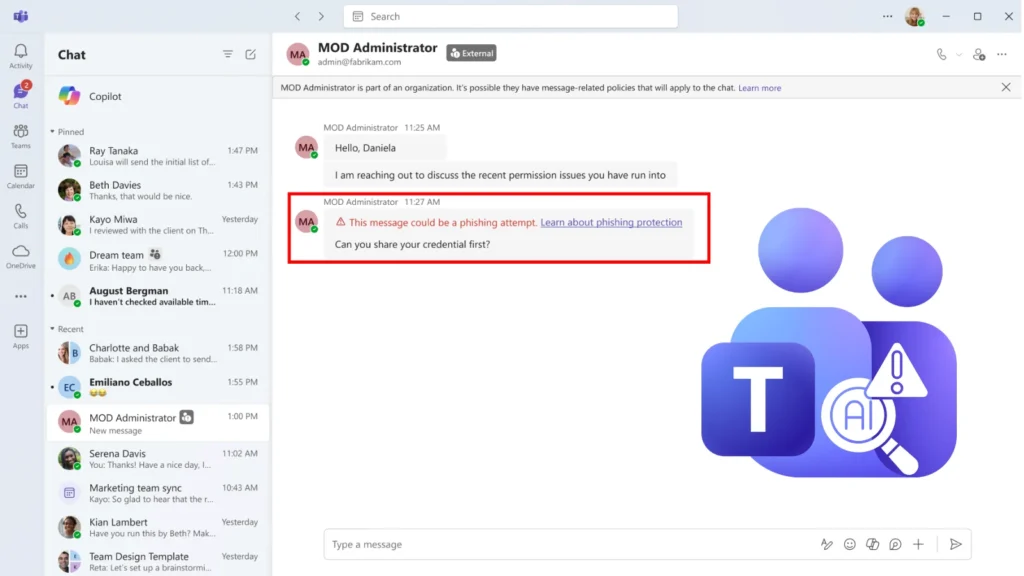
Microsoft is preparing to give Teams a new way to spot phishing attempts that don’t rely on a malicious link or a booby-trapped attachment at all. According to Message Center notice MC1519866, published on October 21, 2026, the company will add an AI-driven detection capability that evaluates the context of a conversation itself — the tone, the claims being made, and the kind of request being pushed — to flag impersonation and social-engineering attempts as they happen.
Why Conversation Context Matters
Traditional phishing defenses look for recognizable red flags: a suspicious URL, a file with a dangerous extension, a sender domain that doesn’t match what it claims to be. But a growing share of real-world attacks skip all of that. Instead, an attacker poses as IT support or a trusted administrator, opens a seemingly ordinary conversation, manufactures a sense of urgency around an account problem, and then simply asks the target to hand over a password or approve a remote-access request. There is no link to scan and no attachment to sandbox — just a persuasive message.
Microsoft’s new capability is explicitly built to catch that pattern. Its support documentation describes analysis aimed at identifying phishing, impersonation, social engineering, and generally deceptive intent within chats — both one-on-one and group conversations — when they involve a new external contact. The example Microsoft shared alongside the announcement is telling: an external account labeled “MOD Administrator” opens with a story about permission problems before asking, “Can you share your credential first?” Teams would surface a warning flagging the exchange as a possible phishing attempt, even though the message contains nothing a traditional scanner would catch.
Rollout Timeline and Scope
Per the roadmap entry associated with the feature (tracked as entry 575288), the capability is slated to reach Android, iOS, Mac, desktop, and web clients on the worldwide standard cloud. Microsoft’s Targeted Release ring is expected to begin receiving the feature in early November and finish by mid-November 2026, with broader worldwide general availability following in a phased rollout starting in early December and wrapping up by mid-December — notably later than some earlier internal projections suggested.
The protection is focused primarily on first-contact conversations with external accounts, the scenario where impersonation attempts are most common and most effective, since the target has no prior relationship with the sender to draw on for comparison. Microsoft also notes a regional nuance: in China, Teams mobile users may additionally receive protection for conversations happening within their own organization, a decision apparently shaped by fraud patterns Microsoft has observed specifically in that market.
A Quiet Start, Then Visible Warnings
Organizations shouldn’t expect every flagged conversation to immediately trigger a visible banner. Microsoft says detection may initially operate silently while the system’s accuracy is validated internally, with user-facing warnings appearing only once that quality bar has been met. That means IT teams rolling this out should treat the early weeks as a tuning period rather than a fully active control.
Microsoft has also moved to head off privacy concerns before they surface. The company states explicitly that the new detection system is intended for security purposes only — not for advertising, employee productivity monitoring, or generating conversation summaries — and that customer message content analyzed for phishing detection isn’t retained for model training or other secondary uses. Organizations should note, however, that this statement is specific to the phishing-detection feature and shouldn’t be read as a broader change to how Teams otherwise retains and processes chat data.
Part of a Broader Pattern
This isn’t Microsoft’s first move against Teams-based social engineering. The platform has already been a repeated target for attackers impersonating IT help desk staff to push victims toward malware installs or remote-access tools, and separate campaigns have abused Microsoft’s own Quick Assist tool after first making contact through external Teams accounts. Those campaigns generally worked because the initial outreach looked mundane — exactly the gap this new AI layer is meant to close.
For security teams, the rollout is worth tracking closely rather than assuming it will be a silver bullet. Context-aware phishing detection is a meaningful upgrade over link-and-attachment scanning, but it will take real-world tuning to separate genuine impersonation attempts from ordinary, if unusually worded, business conversations — and attackers will inevitably adapt their scripts once they know AI is reading for intent rather than just scanning for payloads.
Leave a Reply
You must be logged in to post a comment.