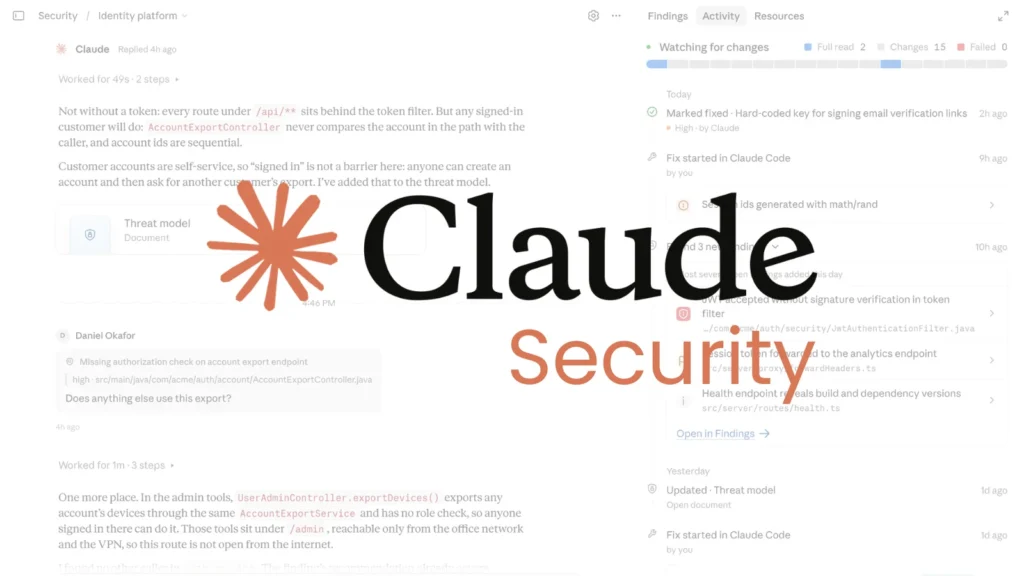
Anthropic has rolled out a significant update to Claude Security, its AI-driven code vulnerability scanning product, shifting it from a tool that scans on demand to one that continuously monitors connected repositories as code changes and automatically tracks whether previously flagged issues have actually been resolved. The update is currently in public beta for Claude Enterprise customers and does not require participation in Anthropic’s separate Cyber Verification Program.
From Manual Triggers to Continuous Coverage
Previously, using Claude Security meant someone on a security or engineering team had to actively initiate a scan of a given codebase. The new continuous model removes that bottleneck: once a project is connected, the service runs an initial deep scan to establish a security baseline, then automatically rechecks code as it changes. Rather than following a fixed schedule, rescans are triggered based on the risk and complexity of each change, meaning a routine documentation update won’t trigger the same scrutiny as a modification to an authentication flow.
Setup supports the Claude GitHub app, including GitHub Enterprise Server deployments, as well as access tokens for GitLab and other Git providers, giving teams flexibility in how they connect their existing source control infrastructure.
Thinking Across Repositories, Not Just Within One
One of the more technically interesting aspects of the update is multi-repository analysis. A single Claude Security project can span several repositories simultaneously, letting the tool trace how data actually flows between services rather than analyzing each codebase in isolation. Anthropic points to a common real-world gap as an example: a backend service that implicitly trusts a client to have already validated user input. That kind of cross-service assumption is notoriously hard for single-repo static analysis tools to catch, since the vulnerable logic and the trust assumption live in different codebases entirely.
Automatic Fix Verification
The update also introduces fix tracking, which checks whether code changes have actually resolved previously identified findings. Notably, this works even when the fix was made outside of Claude Code itself, meaning a developer can patch an issue using any editor or workflow and still have Claude Security recognize the resolution on its next pass. If a later scan detects that the same vulnerable pattern has reappeared, perhaps through a regression or a reverted change, the finding automatically reopens rather than staying marked as resolved.
Each finding Claude Security surfaces includes a severity rating calibrated to the project’s own threat model, an explanation of how an attacker could actually reach the vulnerable code path, and in some cases a visual diagram tracing that path through the application’s architecture.
Context-Aware Threat Modeling
Claude Security generates a threat model directly from a project’s code, which teams can review and adjust. Crucially, teams can also supply context the code itself wouldn’t reveal, such as deployment architecture, applicable compliance or security rules, and controls that are already in place elsewhere in the stack. Later scans incorporate that threat model when prioritizing findings, which can reduce noise around risks an organization has already mitigated through other means, though Anthropic cautions teams need to keep that supplied context accurate for the prioritization to remain trustworthy.
Integration and Governance Features
- An API for programmatically reading findings, managing projects, and resolving or reopening issues.
- Webhooks that push alerts when new findings are identified.
- An MCP connector that links into Claude.ai and Claude Code, letting engineers discuss a specific finding and work on a remediation inside an active Claude session.
- Role-based access controls so administrators can define who can view particular projects, review findings, or spin up new scanning projects.
Scale and Caveats
Anthropic says Claude Security has been in public beta since April and that thousands of organizations have used it to surface more than one million vulnerabilities in that span, though that figure comes directly from the company and hasn’t been independently verified. Anthropic’s own documentation, cited in coverage of the release, acknowledges that scan results can vary between runs and recommends that any proposed fix be reviewed by a human before being merged. The company is positioning the tool as a way to keep vulnerability management synchronized with a codebase’s actual current state, rather than a one-time snapshot that goes stale the moment new code ships, while still framing it as a complement to, not a replacement for, human security review.
Leave a Reply
You must be logged in to post a comment.