Personal AI agents — the kind of assistant software people now install on their own devices to handle email, scheduling, research, and coding help — are following the same path into the workplace that smartphones and personal cloud storage took over a decade ago. Employees are adopting them because they make work faster, often before IT or security teams have any visibility into what is happening. The practical result is a growing population of autonomous agents operating inside enterprise environments with access that nobody formally provisioned, reviewed, or can cleanly shut off.
Why “Bring Your Own Agent” Is Different From Bring Your Own Device
When an employee connects a personal AI agent to their work email, a cloud application, an internal tool, or a code repository, that agent typically operates using the employee’s own credentials or delegated permissions. That arrangement creates a specific problem for security teams: the agent’s activity can become difficult to distinguish from the employee’s own actions, even though the agent may behave in ways the employee never explicitly reviewed line by line, such as summarizing a confidential document, pulling data into a third-party service, or taking an automated action on the employee’s behalf.
There’s also a storage problem underneath the access problem. The credentials a personal agent uses to reach enterprise systems are frequently held inside the agent platform itself, which sits entirely outside the security team’s direct control. If that platform is compromised, or if the agent is simply misconfigured, the blast radius extends straight into whatever systems the employee’s account can reach — email, file storage, internal wikis, and potentially source code.
Identity Vendors Respond With “Blended Identity”
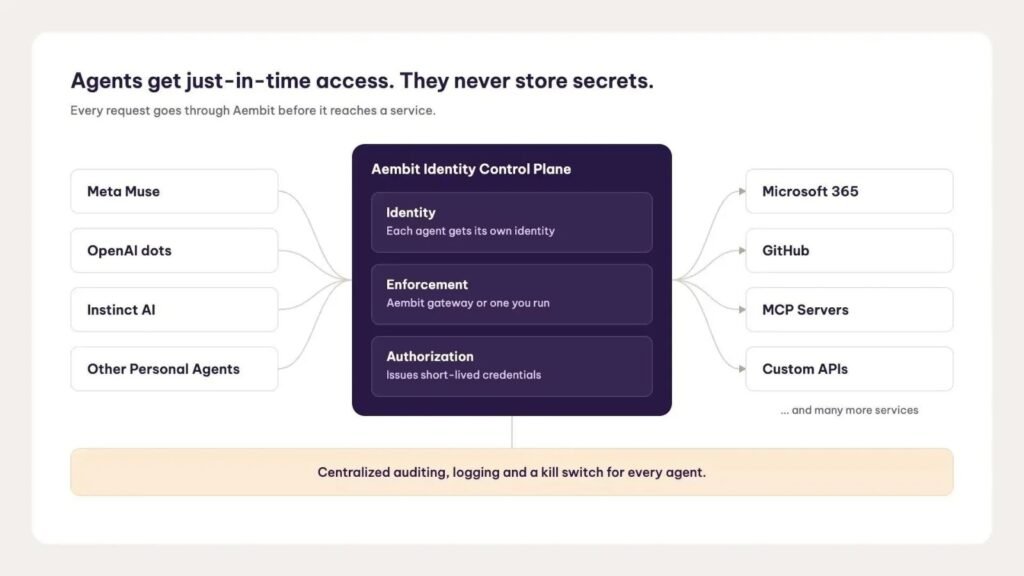
Identity security vendors are starting to respond to this gap with what amounts to a new access-control category purpose-built for agentic software. One recent example comes from Aembit, an identity control plane for AI agents and workloads, which has extended its platform to specifically cover personal agents reaching into enterprise environments — citing newer consumer-facing agents such as Meta’s Muse and OpenAI’s Dots as examples of the trend it is trying to get ahead of.
The core idea is what the company calls a “blended identity”: rather than treating an agent’s access as indistinguishable from the employee it represents, the system evaluates both the agent’s own distinct identity and the identity of the human behind it at the moment access is requested. In practice, that is meant to let security teams:
- Recognize and control a personal agent’s access separately from the employee’s own account, while still retaining the context of who that agent is acting for.
- Apply access policy dynamically at runtime, evaluating the agent, the underlying user, the resource being requested, and any relevant conditions before granting access.
- Issue short-lived, scoped credentials for approved requests instead of relying on long-lived, reusable secrets sitting inside an agent platform.
- Centrally log which agent requested access, on whose behalf, to what resource, and under which policy — giving security teams an actual audit trail for agent-driven activity.
- Revoke a specific agent’s access independently, without disabling the employee’s own account or interrupting their unrelated work.
A Broader Shift, Not Just One Vendor’s Pitch
This kind of tooling is arriving at a moment when the population of agents touching enterprise systems is diversifying fast, spanning everything from built-in assistants in productivity suites to coding agents and custom internal automations. Vendors in this space generally frame the challenge the same way: as personal agents, platform-embedded copilots, and bespoke internal bots all accumulate standing access to sensitive systems, the old assumption that “a login equals a human” stops holding up, and audit trails built around that assumption stop being trustworthy.
The underlying architecture matters here too. Rather than forcing organizations to rip out existing infrastructure, most of these identity-governance approaches are designed to sit alongside whatever gateways or enforcement points a company already has deployed, applying policy either through a dedicated gateway or through integration with existing ones — while keeping the actual identity, policy, and audit data centralized in one place.
What Security Teams Should Be Doing Now
Whether or not an organization adopts a dedicated agent-identity platform, the underlying hygiene questions are worth answering immediately:
- Inventory which personal AI agents employees have already connected to corporate email, cloud storage, SaaS tools, or code repositories.
- Determine whether those agents are using long-lived, reusable credentials, and if so, treat that as a priority finding rather than a routine configuration detail.
- Establish logging that can distinguish agent-driven actions from direct human actions wherever technically possible.
- Build a tested process for revoking an agent’s access on its own, without having to lock an employee out of their own account to do it.
Personal AI agents are not going away, and banning them outright tends to just push usage further underground. The more durable path — and the one the identity security industry is now building toward — is giving every agent a distinct, governable identity before it becomes the easiest way into the network that nobody was watching.
Leave a Reply
You must be logged in to post a comment.