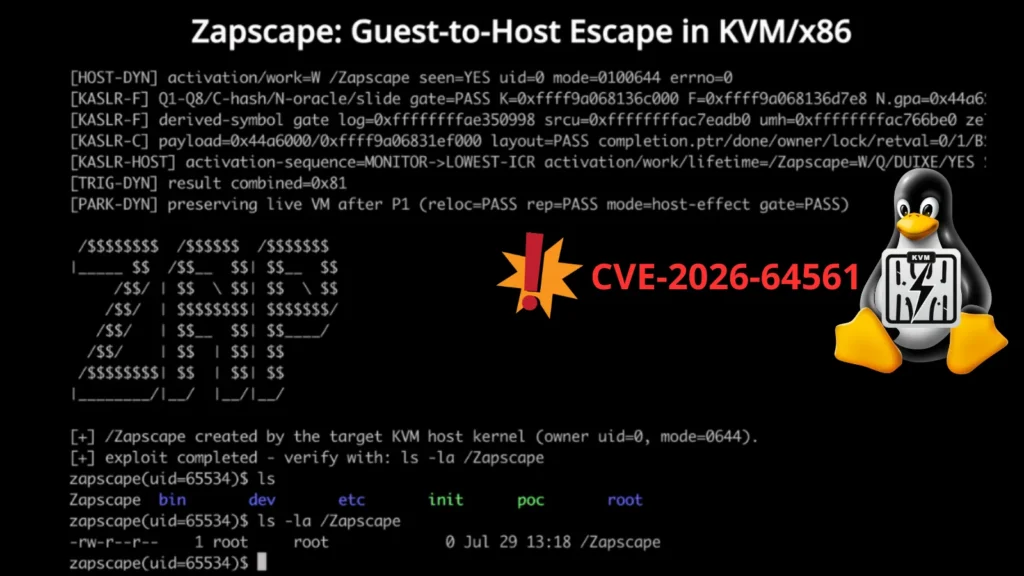
A newly patched Linux kernel vulnerability shows just how much damage a single misbehaving virtual machine can do if the hypervisor separating it from its host isn’t airtight. The flaw, tracked as CVE-2026-64561 and named Zapscape by the researcher who found it, allows a malicious guest running under KVM on x86 systems to break out of its virtual machine and gain root-level control of the physical server underneath it, a scenario that should be architecturally impossible.
Where the Bug Lives
Zapscape was discovered by security researcher Hyunwoo Kim, who goes by V4bel, inside KVM’s shadow memory management unit, or shadow MMU, the component responsible for translating memory addresses when nested virtualization is in use. Nested virtualization, which lets one virtual machine run another virtual machine inside itself, is a common and useful feature for testing environments and certain cloud service offerings, but it also meaningfully expands the attack surface available to a hostile guest.
At its core, Zapscape is a use-after-free bug in the recursive “zap” path KVM uses when it reclaims shadow pages, structures used internally to manage nested memory translations. In plain terms, KVM can free one of these memory structures and then, under specific conditions, continue trying to use it anyway. A malicious guest can deliberately trigger that unsafe sequence from inside the virtual machine it controls.
From Guest Bug to Host Root
Triggering the flaw corrupts memory inside the host kernel itself, which breaks the isolation boundary that’s supposed to keep a guest strictly separated from the physical machine it runs on. In a successful exploitation chain, an attacker who already has kernel-level control inside a first-layer (L1) guest can leverage that corruption to execute commands directly on the KVM host, as root. In a shared cloud environment, where a single physical server routinely hosts virtual machines belonging to many different customers, that means one compromised or malicious tenant could put every other tenant on the same hardware at risk, alongside the provider’s own infrastructure.
Proof-of-Concept Already Public
A proof-of-concept exploit has already been published on GitHub, demonstrating the escape chain inside a controlled QEMU TCG testing environment and successfully producing a root-owned file on the host system. The researcher who published it was careful to note that it is not a plug-and-play cloud attack tool as released, and some adaptation would be required to target a real production environment. Security teams, however, generally treat the public availability of any working proof-of-concept as a strong signal to patch urgently, since the harder work of initial discovery and exploitation has already been done for potential attackers.
Who’s Most Exposed
The underlying flawed code was introduced back in 2020, meaning the vulnerable path has existed in the kernel for roughly six years before being fixed. Risk is concentrated most heavily in environments where nested virtualization is exposed to untrusted users, a configuration common across infrastructure-as-a-service platforms. Exploitation generally requires guest root access, which is often trivial for a customer to obtain inside their own rented virtual machine. Intel-based systems carry an additional prerequisite, requiring both four-level and five-level Extended Page Table (EPT) page-walk support to be exposed to the first-layer guest; AMD systems are not documented as sharing that specific condition.
The Fix and Recommended Actions
The vulnerability was resolved upstream in Linux kernel commit 2abd5287f083, merged on July 21, 2026. The patch reorders validation logic in the shadow MMU fault path so that KVM explicitly checks whether a root page has become invalid after making MMU pages available; if the page was already reclaimed, KVM now retries the fault instead of continuing to operate on a stale, freed structure.
- Administrators should install a vendor kernel build containing the upstream fix and reboot affected KVM hosts as soon as practical.
- Where immediate patching isn’t possible, disable nested virtualization for untrusted guests wherever operationally feasible.
- Restrict and audit access to
/dev/kvmon multi-tenant systems. - Review host configurations to identify any multi-tenant or shared systems still exposing nested virtualization to guest users, and monitor vendor advisories for backported fixes.
Zapscape is a pointed reminder that hypervisor patch management deserves the same urgency as any other critical infrastructure vulnerability. A single flaw in the layer that’s supposed to separate tenants from each other, and from the host, can undermine isolation guarantees across an entire server, no matter how well individual guests are otherwise secured.
Leave a Reply
You must be logged in to post a comment.