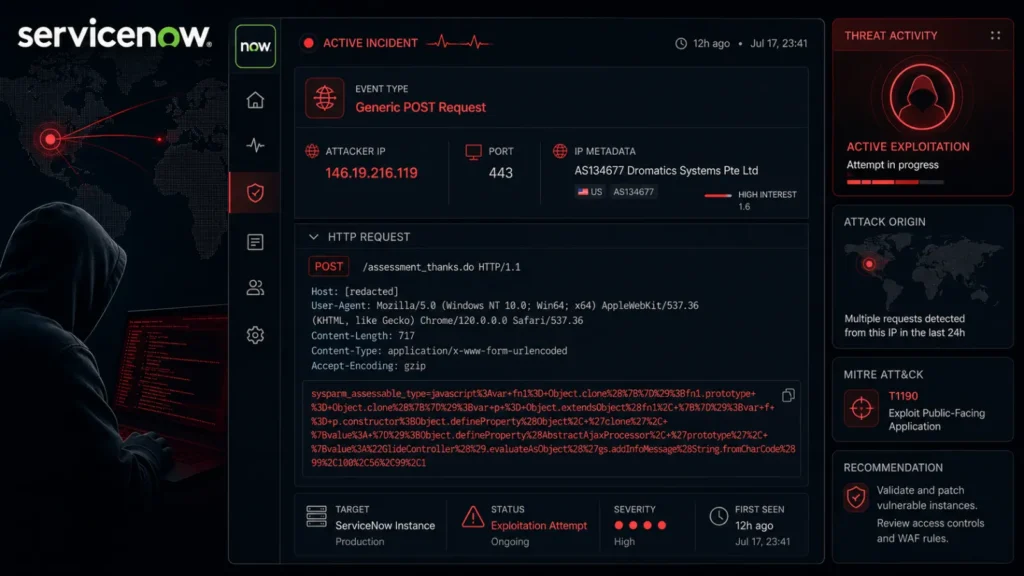
A severe vulnerability in the ServiceNow AI Platform is now under active attack, according to new research that has prompted the company to push emergency guidance to customers. Tracked as CVE-2026-6875, the flaw allows attackers who have never logged in to the platform to break out of ServiceNow’s scripting sandbox and run their own code on affected instances.
A Sandbox Escape That Needs No Login
What makes this bug particularly dangerous is the “pre-authentication” label attached to it. Most serious ServiceNow exploits assume an attacker already holds valid credentials. This one doesn’t. Researchers at Searchlight Cyber’s Assetnote team, who discovered and reported the issue to ServiceNow back in April 2026, found that attacker-supplied input could reach a server-side GlideRecord query and trigger unintended JavaScript evaluation, apparently through the platform’s public-facing /assessment_thanks.do endpoint.
In practice, that means an outsider with no account on a target’s ServiceNow instance could reach a script-execution point and, from there, attempt to escape the sandbox that is supposed to keep untrusted scripts contained.
What a Successful Exploit Could Hand an Attacker
Searchlight Cyber has warned that a working exploit chain could let intruders:
- Read sensitive data stored inside the ServiceNow platform
- Create new administrative accounts for persistent access
- Potentially execute commands through connected MID Servers or proxy infrastructure
That combination — data theft plus the ability to mint your own admin account — is what pushes this from “notable bug” to “patch immediately” territory for security teams.
Exploitation Confirmed in the Wild
ServiceNow’s advisory initially said the company had no evidence of active exploitation. That changed quickly. Threat-intelligence firm Defused has since reported telemetry showing exploitation attempts began not long after the vulnerability became public, and has stated plainly that the flaw is being abused in real attacks. For defenders, that timeline is the key takeaway: the window between disclosure and weaponization was short.
Fixes Are Available — But Only Help If Applied
ServiceNow has already rolled out updates to its own hosted instances, and released patches for customers who run self-managed deployments. The company is also recommending that organizations turn on a feature called Guarded Script, which restricts the kinds of JavaScript constructs — variable declarations, control-flow statements, function declarations, assignments, and chained statements — that can execute inside the sandbox, making a repeat of this kind of escape harder to pull off even if a similar bug surfaces later.
Organizations running self-hosted ServiceNow environments that haven’t yet applied the update are effectively running exposed infrastructure at this point, given confirmed in-the-wild activity.
What Security Teams Should Check Right Now
Beyond patching, incident responders are being urged to look for specific signs of probing or compromise, including:
- Requests targeting the
/assessment_thanks.doendpoint - Unusual parameters tied to
sysparm_assessable_type - Unexpected creation of administrative accounts
- Abnormal or unauthorized script execution activity
- Suspicious actions routed through MID Servers
The Bigger Pattern
CVE-2026-6875 is a reminder of a recurring theme in enterprise SaaS security: when unauthenticated input is allowed to reach powerful server-side query and scripting functions, the blast radius of a single bug can be enormous. Platforms like ServiceNow sit at the center of IT workflows for large organizations, which makes them an attractive target — and makes patching delays especially costly. Given that exploitation is already underway, security teams should treat outstanding ServiceNow updates as one of the highest-priority items on this week’s patch list.
Leave a Reply
You must be logged in to post a comment.