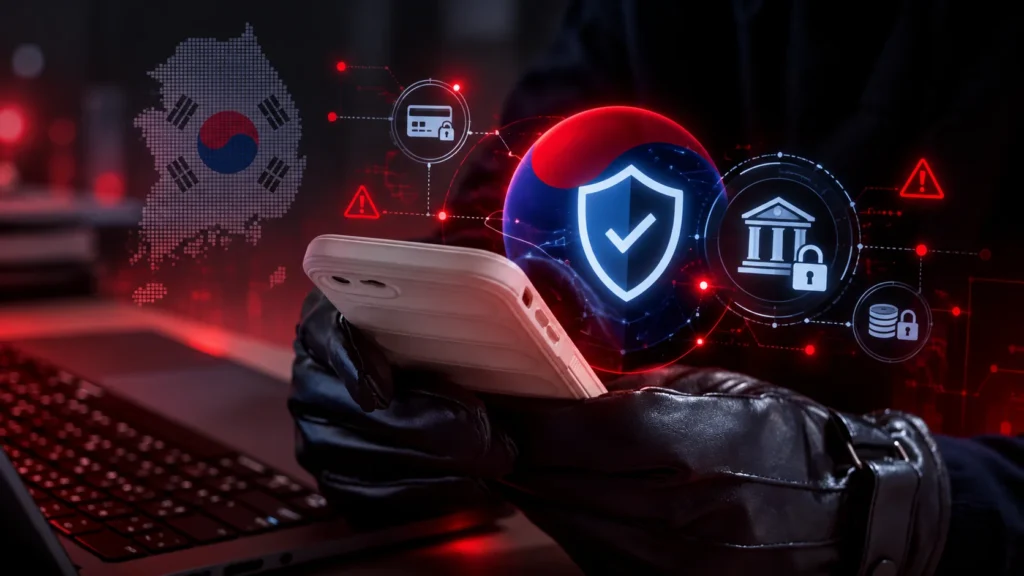
South Korea has ordered a sweeping investigation into a series of breaches across its financial sector after banks, lenders and finance companies disclosed the exposure of sensitive personal information. President Lee Jae Myung directed officials to examine the incidents in full and develop stronger safeguards, elevating what had appeared to be separate company-level events into a national cybersecurity priority.
The response follows disclosures from several institutions in the opening days of October. Although the reported victim counts and affected systems vary widely, the incidents share an uncomfortable theme: business-support platforms outside the core banking environment can still contain valuable identity and credit data. Authorities are now investigating whether the attacks are related and whether automation or artificial intelligence assisted the intruders.
Multiple Institutions Report Exposed Personal Data
Shinhan Bank reported the largest breach among the major banks, affecting roughly 25,000 customers. The exposed records included names, telephone numbers, annual income and loan limits. Some files also contained resident registration numbers, making the incident more serious because those identifiers can support identity fraud and highly convincing social-engineering attacks.
KB Kookmin Bank and Hana Bank announced smaller but still sensitive exposures. KB said information belonging to 119 customers leaked through a mobile work-support system used by employees. Hana identified abnormal access to an operations-support system involving 89 customers. The affected Hana records reportedly included names, national identification numbers, addresses, email addresses, phone numbers and employer details.
Other organizations also reported incidents. Yegaram Savings Bank said approximately 40,000 customers were affected, while Hyundai Capital disclosed exposure involving 146 housing-loan agents. BNK Busan Bank separately reported information linked to 11 outsourced workers. These numbers refer to different populations and should not be combined into a single confirmed victim total.
AI Clues Do Not Yet Prove a Unified Campaign
Local reporting cited traces of an AI-based automation tool in the Shinhan investigation, while another report said several attacks used common IP addresses. Those clues may help investigators connect infrastructure or methods, but they do not yet establish that one threat actor conducted every intrusion. Nor do they show that an autonomous AI system independently carried out the compromises.
No complete public attack chain has been released. Authorities have not identified a common vulnerability, named malware family or definitive set of indicators spanning all affected institutions. The known access points also appear to include loan-agent websites and internal employee-support tools rather than only public online-banking applications. That distinction matters for both attribution and remediation.
Support Systems Create a Wider Attack Surface
KB and Hana reportedly said the affected environments were separated from their internet and mobile banking services, and that the incidents did not expose customer transaction data. Segmentation may have limited the immediate financial impact, but it did not prevent the loss of information that criminals can use for follow-on fraud.
The pattern is a reminder that security programs must cover the entire financial-services ecosystem, including:
- employee portals and mobile work-support applications;
- loan-agent, contractor and outsourced-service platforms;
- operations systems holding identity and credit information;
- third-party connections with access to customer records; and
- logs capable of linking unusual access across separate environments.
Systems considered secondary to the main banking platform can receive less monitoring and slower security investment, even when they store highly sensitive records. Attackers can exploit that imbalance, targeting a weaker application to obtain data suitable for impersonation, phishing or loan fraud without ever entering the core transaction network.
What Authorities and Financial Firms Need to Establish
Police began examining the incidents on October 2, and financial authorities ordered broader checks at banks and card companies. The most urgent questions are whether the same infrastructure appears in multiple breaches, how attackers first gained access, whether compromised third parties created shared exposure, and what role automation played after entry.
Affected firms should preserve authentication, web, endpoint and administrative logs before retention windows erase useful evidence. They should also review privileged access to support systems, rotate potentially exposed credentials, validate network separation and notify people whose identification data may be misused. Monitoring should extend beyond direct account theft to targeted phishing and fraudulent credit applications.
For customers, the disclosures warrant extra caution around messages that reference real loan details, employers or contact information. Accurate personal data can make a fraudulent call or email appear legitimate. Requests to disclose passwords, one-time codes or transfer funds should be verified through an institution’s official channel rather than through contact details supplied in the message.
The investigation may eventually show several unrelated breaches rather than one coordinated operation. Even so, South Korea’s sector-wide response reflects the broader lesson: financial security depends on every system that collects, processes or supports sensitive customer information, not only the applications that move money.
Source: Cyber Security News.
Leave a Reply
You must be logged in to post a comment.