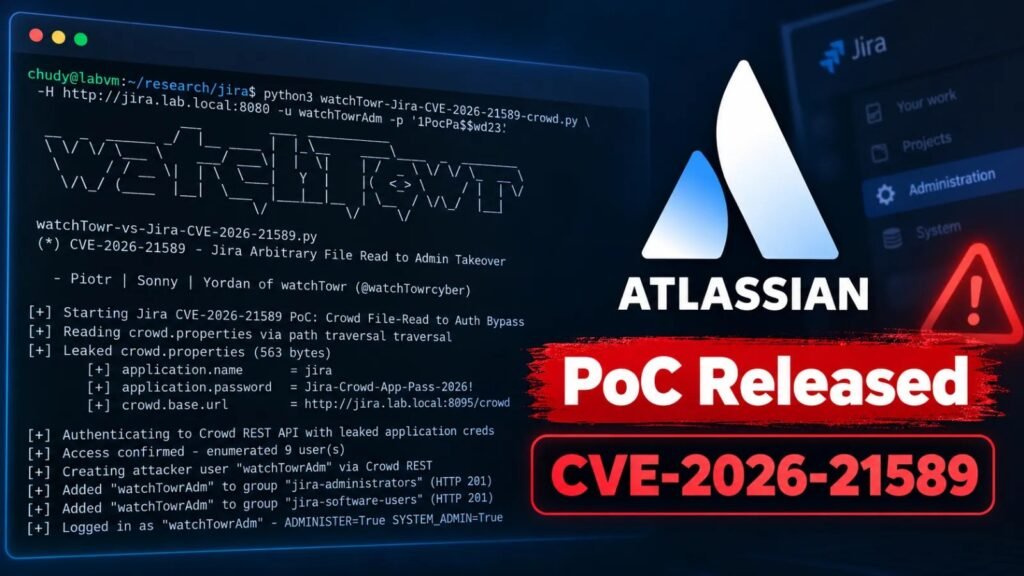
Atlassian customers running self-managed Data Center products have a new reason for urgency this week. Security researchers at watchTowr Labs have published technical analysis and working detection proof-of-concept code for CVE-2026-21589, a critical arbitrary file-read vulnerability that Atlassian disclosed in an out-of-band advisory on October 5, 2026. The flaw is remotely exploitable without any authentication, and because the underlying component is shared across Atlassian’s product line, it touches far more than just Jira.
A Shared Component, A Shared Problem
The root cause sits in Atlassian’s shared web-resource handling code, used across Jira Software, Jira Service Management, Confluence, Bitbucket, Bamboo, Crowd, Crucible, and Fisheye. According to watchTowr’s write-up, affected products convert double-colon sequences into forward slashes while processing certain requests — a quirk that, with a carefully constructed path, lets an attacker slip past the path validation meant to keep requests confined to safe directories. The practical result is directory traversal: an unauthenticated attacker can reach files inside the application server’s webroot that should never be reachable from the outside, including the normally protected WEB-INF directory.
watchTowr’s researchers were careful to note an important boundary: the bug does not necessarily let an attacker read arbitrary files anywhere on the host operating system, since access appears confined to the Tomcat application context rather than the full filesystem. That’s a meaningfully smaller blast radius than a true unrestricted file-read bug — but files living inside that application context routinely include configuration files, service tokens, and credentials, which is exactly what makes this flaw dangerous in practice. Researchers demonstrated the issue concretely against Jira by crafting a request to a downloadable resource path that returned the contents of Jira’s internal web.xml file, and confirmed that equivalent paths exist for both Confluence and Bitbucket, underscoring that this isn’t a Jira-only bug dressed up to look bigger.
From File Read to Full Jira Admin
The escalation path that has researchers most concerned involves organizations that connect their Atlassian products to Crowd, Atlassian’s identity-management product, for centralized authentication. In many such deployments, the connection settings — including the Crowd application name, application password, and server URL — are stored in a file called crowd.properties, sitting inside the very WEB-INF/classes directory this vulnerability exposes.
An attacker who extracts those credentials and can reach the organization’s Crowd service doesn’t need to exploit anything else in Jira directly. Instead, they can authenticate to Crowd’s own management interfaces using the stolen application credentials, enumerate existing users, create a new account, and add that account to the jira-administrators group — walking away with persistent, legitimate-looking Jira administrator access. Organizations that restrict Crowd access with IP allowlists have some natural protection here, while those with permissive internal network access to identity services, or with Crowd management interfaces reachable more broadly, face meaningfully higher risk.
Fixes Are Available — The Question Is Deployment Speed
Atlassian has shipped patched releases for the core affected products: Jira Software Data Center versions 9.12.40, 10.3.26, and 11.3.12; Jira Service Management Data Center versions 5.12.40, 10.3.26, and 11.3.12; Confluence Data Center versions 9.2.26 and 10.2.19; and Bitbucket Data Center versions 9.4.26, 10.2.8, and 10.5.1. Fixes are also available for Bamboo, Crowd, Crucible, and Fisheye, though specific version numbers for those products were not published alongside the advisory.
What Security Teams Should Do Now
With a working detection proof-of-concept now public — one watchTowr designed specifically to send safe, non-destructive requests rather than create accounts or alter target systems — the window between disclosure and mass scanning attempts is closing fast. Atlassian Data Center administrators should treat this as a same-week patching priority: upgrade affected products to the fixed releases listed above, restrict any public-facing access to Data Center applications wherever possible, and comb through web and application server logs for unusual resource-download requests that could indicate reconnaissance or exploitation attempts. Organizations using Crowd for authentication should go a step further and rotate Crowd application passwords as a precaution, then review Crowd’s administrator group memberships and audit logs for any newly created accounts that nobody on the team recognizes. watchTowr’s detection tooling, which supports Jira, Confluence, and Bitbucket, offers a fast way to check whether a given instance still appears vulnerable before attackers get there first.
Leave a Reply
You must be logged in to post a comment.