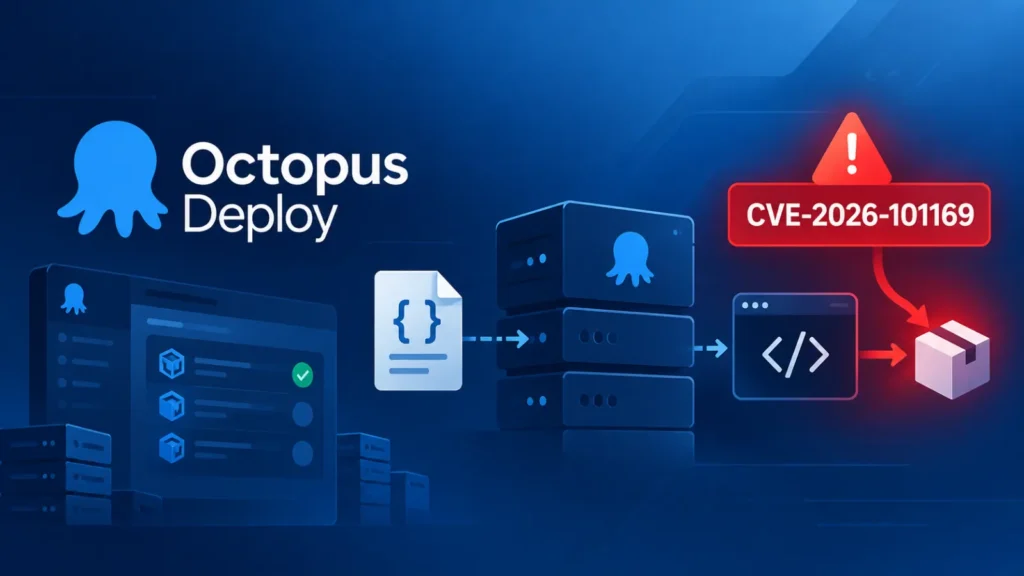
Octopus Deploy has patched a high-severity vulnerability that can turn legitimate project-level access into arbitrary code execution on an Octopus Server host. CVE-2026-101169 is caused by unsafe deserialization of attacker-controlled JSON associated with Environment and Project objects. It affects a long span of self-hosted releases on both Linux and Windows, and the vendor says there is no configuration-based mitigation.
The flaw is not an unauthenticated internet takeover. An attacker first needs a valid account and permission to edit an affected Environment or Project. That prerequisite still leaves a serious security boundary problem: delegated deployment access should not allow a user to run code inside the central automation service.
Crafted JSON reaches the server process
Octopus Server accepts structured data for the objects that organize applications, targets and deployment environments. According to the advisory, a user who can modify one of those objects can submit specially prepared JSON. When the server converts that data back into internal objects, the unsafe deserialization path can cause attacker-selected code to execute in the Octopus Server process.
The result depends on the account running the service and the resources available to it. In many organizations, a deployment controller has access to package repositories, infrastructure APIs, machine credentials, secrets, application settings and production targets. Code running in that context could therefore move beyond the Octopus host and interfere with the software delivery pipeline.
Likely threat scenarios include a malicious insider abusing delegated permissions, an attacker taking over a developer or administrator account, or a compromised integration token being used to alter project data. Even where the service account is tightly restricted, execution on the automation server could provide a durable position from which to steal deployment secrets or tamper with releases.
A wide range of versions is affected
The vulnerable population includes all Octopus Server 2019.4.x releases and every 2020.x through 2025.x release. Several 2026 feature branches also require specific minimum builds. Fixed versions are 2026.1.11781 or later, 2026.2.13441 or later, 2026.3.15829 or later and 2026.4.1619 or later.
Octopus Deploy recommends the current 2026.3 release, identified at disclosure as 2026.3.15863. Organizations that cannot take the newest build should install the patched release for their branch. Users on legacy versions from 2019.4 through 2025 need to move to at least 2026.1.11781. Octopus Cloud instances have already been updated by the provider and require no customer action.
Priorities for deployment and security teams
- Identify every self-hosted Octopus Server instance and record its exact build number.
- Upgrade promptly because Octopus Deploy has not provided a safe workaround for vulnerable releases.
- Review who can edit Environment and Project objects, removing permissions that are no longer required.
- Audit recent changes to those objects and investigate unexpected activity from privileged or delegated accounts.
- Rotate sensitive deployment credentials if evidence suggests an instance or authorized account was compromised.
Network restrictions and least-privilege service accounts remain useful layers, but neither removes the faulty deserialization path. Organizations should also assess what the Octopus process can reach after an upgrade, since excessive rights can magnify the impact of any future application flaw.
Security teams should coordinate the change with release engineers because an automation server upgrade can affect business-critical delivery workflows. Back up the database and configuration, validate the target build in a representative environment and confirm that agents and deployment targets reconnect normally. Afterward, retain logs from the vulnerable period so investigators can reconstruct suspicious object edits if new exploitation evidence emerges.
The vulnerability was found during internal testing on September 4, and fixes were issued on September 14 before the public advisory on September 29. Octopus Deploy said it had no evidence of public exploitation at disclosure. That absence should inform, but not delay, remediation given the value of deployment infrastructure and the lack of a workaround. Details were reported by Cyber Security News.
Leave a Reply
You must be logged in to post a comment.