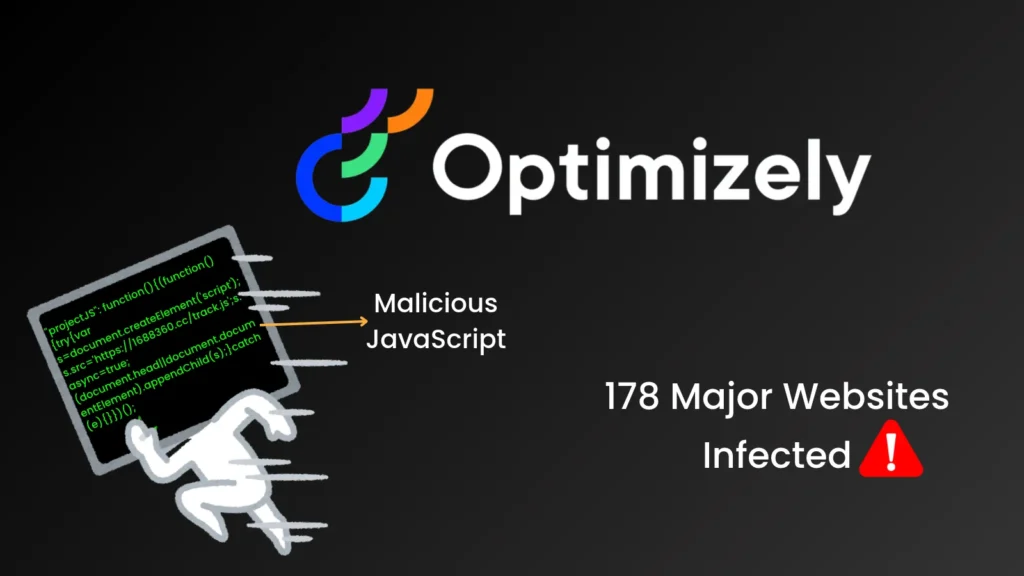
A single poisoned script hosted on a trusted platform was enough to turn 178 major websites into tools for stealing payment cards, cryptocurrency, and even hijacking iPhones. The campaign, uncovered on November 16, 2026, abused Optimizely’s widely used Web Experimentation service — the kind of third-party script that sites load on every single page without a second thought.
Among the affected organizations were some of the most visited sites on the internet, including Zoom, the BBC, CNN, Salesforce, GitLab, IKEA, HSBC, Equifax, Air France-KLM, Ledger, and Peacock. Security researcher Scott Helme of Report URI first spotted the malicious activity and confirmed that stolen cryptocurrency had already reached wallets controlled by the attackers.
A Trusted Snippet, Quietly Rewritten
Optimizely Web Experimentation works by having customers embed a JavaScript “snippet” pulled from Optimizely’s own content delivery network. That snippet includes an optional field called Project JavaScript, which Optimizely’s own documentation describes as code that runs first and can touch every experiment inside a project.
Whoever carried out this attack planted a small loader inside that field across many unrelated customer projects, without needing to alter anything else in the snippet. Because the file was still served from Optimizely’s own domain with Optimizely’s own certificate, browsers, security scanners, and web application firewalls all treated it as entirely legitimate traffic.
Investigators found the injected code in three different disguises. Most versions used a plain script tag pointing to an external domain. Others encoded the same destination in Base64 to dodge simple keyword searches. A third, more resilient variant embedded the entire malicious payload directly inside the snippet and executed it locally if the external domain happened to be blocked — meaning that simply blocking one bad domain was not always enough to stop the attack. In at least one case, a site that cleaned its snippet was quietly reinfected shortly afterward, a strong sign the attacker still had standing access to the compromised Optimizely projects.
One Script, Several Different Payloads
The injected code was not a simple one-trick skimmer — it behaved more like a modular toolkit. On the financial side, it scanned pages for cryptocurrency wallet addresses across Bitcoin, Ethereum, Solana, TRON, Litecoin, and several other chains, then silently swapped them for wallets under the attacker’s control, intercepting both what victims saw on screen and what they copied to their clipboard. Separately, it watched standard HTML payment forms for card numbers, expiry dates, and CVV codes, sending anything it captured to an external server. Payment fields hosted through providers like Stripe or Adyen were unaffected, since those run in isolated frames the script could not reach.
The same script also exfiltrated browsing cookies and took screenshots of the pages victims were viewing, giving the attackers a broader window into account sessions and activity beyond pure payment data.
A Separate Track Aimed at iPhones
Visitors using Apple mobile devices were routed down an entirely different path. The script fingerprinted the iOS version in use and, depending on the result, delivered one of two previously documented exploit chains — known in security circles as Coruna and DarkSword — capable of compromising iPhones and iPads running vulnerable software versions. Devices running the newest iOS release were only fingerprinted rather than attacked outright, suggesting the operators either lacked a working exploit for that version or were holding it back.
What Made Detection So Difficult
Because the malicious logic rode inside infrastructure that organizations explicitly trusted and had already approved, most conventional defenses had little chance of catching it. Report URI’s own analysis found that of the affected sites it was able to check, the majority had no Content Security Policy configured at all, and only a small fraction had a policy strict enough to block the payload outright. Sites that had weakened their CSP by allowing directives like ‘unsafe-eval’ or ‘strict-dynamic’ were just as exposed as those with no protection whatsoever.
Optimizely says it has since contained the incident, blocked the exploited pathway, stripped out the injected code, and reached out directly to affected customers. Security teams that rely on Optimizely Web Experimentation are strongly advised to audit every Project JavaScript field and custom experiment code for unfamiliar scripts, review who has access to make such changes, rotate any credentials or API tokens tied to their account, and treat payment card entries and sensitive cookie data from November 16 as potentially exposed. Keeping iOS devices updated to the latest available version remains the most effective defense against the mobile exploit chains used in this campaign.
Leave a Reply
You must be logged in to post a comment.