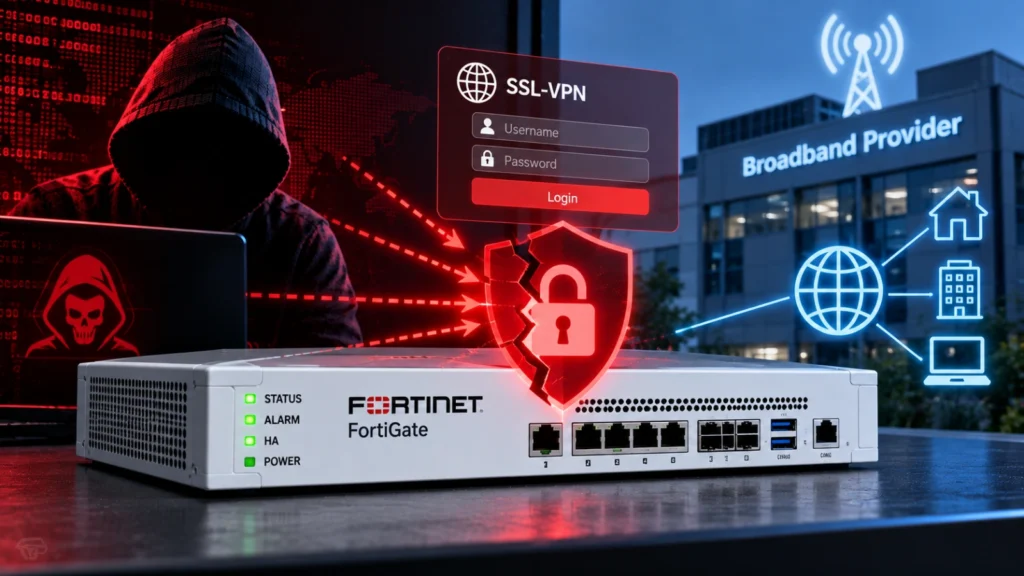
Evidence recovered from an exposed attacker-controlled staging server has shed light on a broad intrusion targeting 3BB, the consumer broadband brand operated by Thailand’s Triple T Broadband. The activity appears to have started with exploitation of a vulnerable FortiGate SSL-VPN device and then expanded into privilege escalation, credential collection and reconnaissance across internal systems.
The findings illustrate why internet-facing security appliances remain a favored initial-access route. A VPN gateway is intended to broker trusted remote access, so compromising it can place an attacker close to internal services while giving malicious traffic the appearance of legitimate administrative activity.
From edge access to a wider intrusion
Researchers linked the operation to exploitation of a critical SSL-VPN vulnerability. After establishing access, the attackers assembled tools and information useful for moving deeper into the environment. The exposed staging system provided an unusual view into their working material, including signs of credential theft and network discovery.
The campaign was not limited to proving that a FortiGate device could be breached. Its follow-on actions suggest an effort to understand the provider’s environment, obtain stronger privileges and identify additional systems worth accessing. That sequence turns an appliance flaw into a potentially organization-wide problem.
Broadband providers are especially sensitive targets because their infrastructure supports large numbers of customers and connects operational, administrative and customer-facing services. An intruder may pursue business data, network access, espionage opportunities or a platform for further attacks. The available evidence does not by itself establish every objective, but it shows preparation for sustained access rather than a one-off scan.
Why credentials matter after the initial exploit
Perimeter exploitation often receives the headline, yet credential theft can determine the long-term impact. Stolen accounts may let attackers return after a vulnerable gateway is patched, blend in with normal remote access or reach systems that the original exploit could not directly access.
That means responders should avoid defining the incident boundary as the firewall alone. Authentication logs, directory activity, privileged account use and connections from the compromised device all deserve review. Password resets should be coordinated with containment so attackers cannot immediately capture replacement credentials from a system they still control.
Defensive priorities for FortiGate operators
- Confirm the exact FortiOS releases in use and apply vendor fixes for relevant SSL-VPN vulnerabilities.
- Restrict administrative interfaces and disable internet-exposed services that are not operationally required.
- Search for unusual logins, configuration changes, newly created accounts and outbound connections from edge appliances.
- Review privileged credentials used on or through the device and rotate them where exposure is plausible.
- Correlate VPN activity with endpoint, identity and internal network telemetry to identify lateral movement.
Organizations should preserve appliance logs promptly because retention may be limited and a skilled intruder may attempt to remove traces. Configuration snapshots can reveal unauthorized policy changes, added administrators or altered authentication settings. Where compromise is suspected, rebuilding from a known-good image is safer than assuming an in-place update removes every modification.
Lessons for service-provider resilience
The incident demonstrates that edge-device patching must be paired with segmentation and visibility. A compromised VPN should not automatically provide broad access to management networks or credential stores. Administrative paths should require strong authentication, limited source networks and controls that remain observable outside the appliance itself.
Service providers should also rehearse how they will isolate a gateway without causing unnecessary customer disruption. Documented failover, offline configuration backups and emergency access procedures make rapid containment more practical during a real attack.
For defenders, the central takeaway is that exploitation of an SSL-VPN device is the beginning of the investigation, not the end. The most important question is what the attacker did with that foothold: which identities were exposed, which systems were contacted, and whether alternate persistence remains after the edge device is fixed.
Leave a Reply
You must be logged in to post a comment.