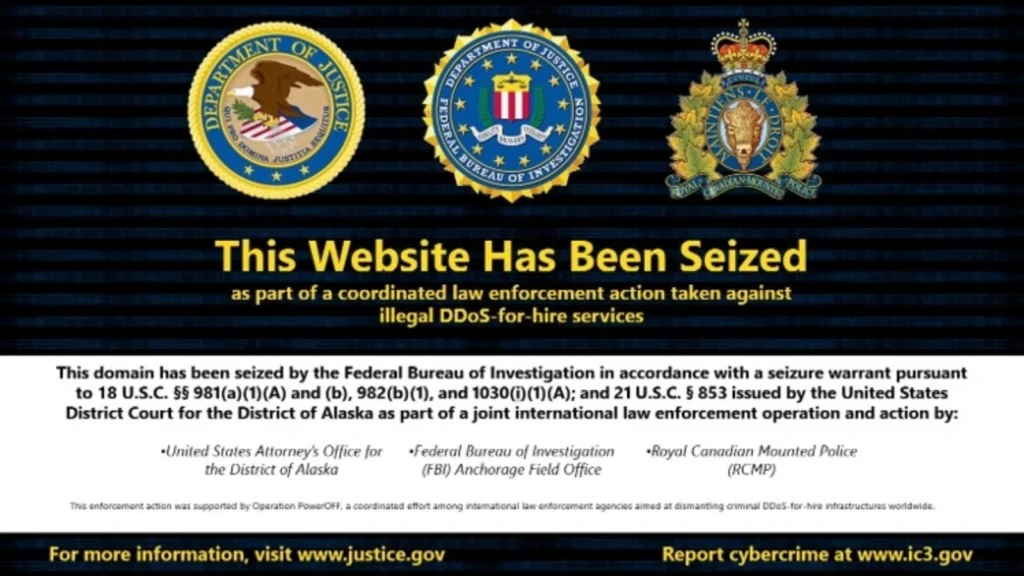
U.S. and Canadian law enforcement have disrupted NightmareStresser, a long-running service that allegedly sold customers the ability to launch distributed denial-of-service attacks. Acting under a court-authorized warrant, the FBI seized nightmare-stresser.com and nightmarestresser.org and replaced the sites with law-enforcement notices.
A seizure-warrant affidavit cited by the U.S. Department of Justice says the platform was responsible for hundreds of thousands of actual or attempted attacks against victims worldwide since 2022. The action removes prominent customer-facing infrastructure from a market designed to make large-scale disruption available to people who do not control their own botnet or possess advanced technical skills.
A commercial front for disruptive attacks
Services such as NightmareStresser are commonly called booters or stressers. They often claim to provide legitimate capacity testing, but commercial platforms can let a subscriber enter somebody else’s internet address and direct overwhelming volumes of traffic or requests at it. That flood consumes bandwidth, connections or server resources until real users cannot reach the target.
The consequences can extend well beyond a slow website. DDoS attacks may disrupt educational services, government portals, gaming platforms and financial systems. Congestion can also affect hosting providers or upstream networks that support multiple customers. Even a short outage can create incident-response costs, missed transactions and reputational damage.
By packaging attack methods behind an interface and subscription plan, booter operators separate customers from the technical work of building malware, compromising devices and maintaining infrastructure. That convenience expands the pool of offenders while giving investigators centralized domains, payments and account records to pursue.
Cross-border operation targets the service
The FBI’s Anchorage Field Office carried out the seizures with the Royal Canadian Mounted Police’s Federal Policing Northwest Region. The Justice Department said the operation was intended to dismantle infrastructure used against targets in Alaska, elsewhere in the United States and internationally. The announcement did not identify an arrest or a new charge specifically tied to this latest seizure.
The case forms part of Operation PowerOFF, a continuing multinational campaign against DDoS-for-hire services and their users. Europol’s European Cybercrime Centre and Joint Cybercrime Action Taskforce coordinate work involving authorities across North America, Europe, Asia, Australia and South America.
U.S. cases involving teams in Anchorage and Los Angeles have, over roughly eight years, charged 12 defendants accused of enabling booter services and seized more than 100 related domains. Repeated actions aim not only to remove infrastructure but also to challenge the belief that buying an attack through a website is anonymous or legally different from conducting one directly.
What a domain seizure achieves
Taking control of the domains can immediately interrupt sign-ups, account access, payments and attack management. It can also preserve evidence and force operators to spend time and money rebuilding their brand and customer base. Visitors now see a clear warning that the service is under investigation.
A seizure does not necessarily switch off every attack server or identify every participant. Operators may retain backend systems, register replacements or migrate to private channels. Customers may move to rival services. For that reason, investigators often combine domain action with payment analysis, hosting records, international cooperation and later prosecutions.
The Justice Department emphasizes that purchasing a booter attack can violate the Computer Fraud and Abuse Act. Consequences may include prosecution, device seizure, imprisonment and fines. The label attached to the service does not authorize a customer to test systems they do not own or have explicit permission to assess.
Defensive lessons for likely targets
- Maintain upstream DDoS mitigation that can absorb or filter traffic before it reaches local links.
- Baseline normal request rates and alert on sudden protocol, geography or connection anomalies.
- Keep an escalation path with internet providers, hosting partners and content-delivery networks.
- Test failover, rate limiting and incident communications before an outage occurs.
- Preserve logs and timestamps so providers and law enforcement can correlate malicious activity.
Organizations should not treat a takedown as a reason to relax controls. The same commercial model will continue under other names, and attack capacity can shift quickly between providers. NightmareStresser’s disruption is meaningful because it increases friction and exposes evidence, but resilient architecture and practiced response remain the most dependable protection for potential victims.
Leave a Reply
You must be logged in to post a comment.