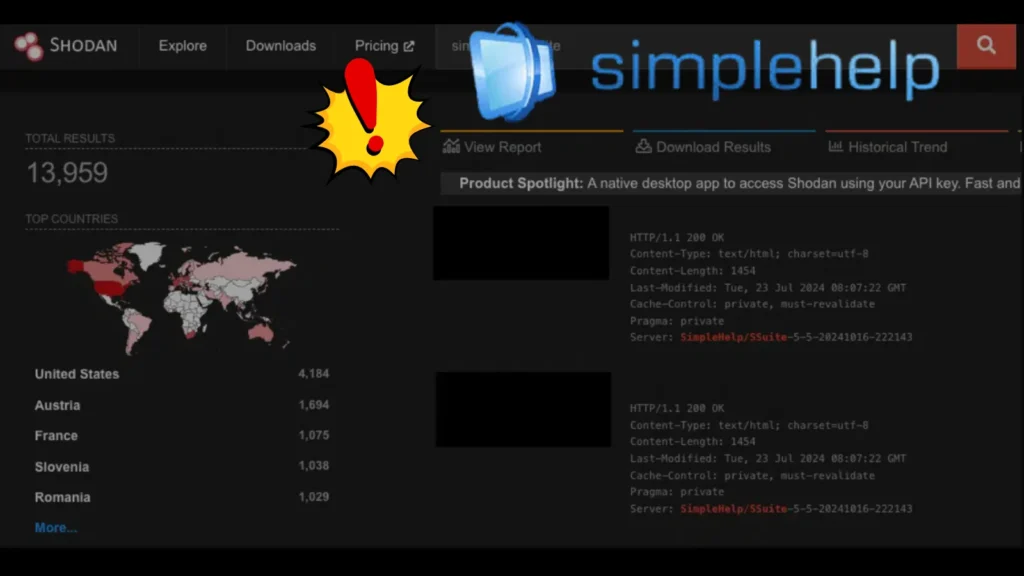
Nearly 14,000 internet-facing SimpleHelp servers are exposed following the public disclosure of a critical authentication bypass vulnerability tracked as CVE-2026-48558. The flaw raises serious concerns for enterprises using the widely-deployed remote monitoring and management (RMM) platform, particularly in environments using OpenID Connect (OIDC) for authentication.
Discovery and Research Background
The vulnerability was identified by Horizon3.ai through its autonomous research initiative “Sua Sponte,” which leverages AI-driven analysis to uncover exploitable flaws in enterprise software. The research team discovered that improper validation of identity provider assertions during the OIDC authentication process creates a pathway for unauthenticated attackers to register new technician accounts and log in without valid credentials.
The affected integrations include Microsoft Azure Active Directory and any other OIDC-compatible identity provider configured with SimpleHelp. This is a particularly common enterprise deployment pattern, making the scope of exposure substantial.
How the Attack Works
CVE-2026-48558 exploits a logic flaw in how SimpleHelp validates assertions returned by the OIDC identity provider during authentication flows. An unauthenticated attacker can manipulate this process to:
- Create a new “Technician” account with full platform privileges
- Log in to the SimpleHelp portal without possessing valid credentials
- Register their own authentication method during first login, effectively nullifying multi-factor authentication
- Access and manage all endpoints connected to the SimpleHelp deployment
The attack is exploitable in environments where OIDC authentication is enabled, a TechnicianGroup is linked to the OIDC provider, and group-authenticated logins are permitted. These conditions are standard in enterprise deployments, meaning a large portion of production SimpleHelp instances may be vulnerable.
Why This Is Especially Dangerous
SimpleHelp is a remote monitoring and management platform, which means compromised technician accounts grant attackers the ability to execute scripts, deploy software, and perform administrative actions on all managed endpoints across the organization. This is not a limited-scope vulnerability — it represents a potential gateway to an organization’s entire managed device inventory.
Furthermore, even environments that have invested in multi-factor authentication are not immune. The authentication bypass allows attackers to register their own MFA device during the illegitimate first login, sidestepping the protection entirely. This is a complete security architecture failure, not just a configuration weakness.
Scale of Exposure
Horizon3.ai’s research identified approximately 14,000 internet-facing SimpleHelp servers that are potentially exposed. This number represents instances accessible from the public internet without network-level restrictions, making them prime candidates for automated exploitation at scale. The actual number of vulnerable deployments is likely higher when accounting for internal deployments reachable via VPN or corporate networks.
Detection Guidance
Administrators should immediately audit their SimpleHelp environment for signs of compromise:
- Review all technician accounts for unfamiliar names, email addresses, or registration timestamps
- Analyze server logs for unexpected technician registrations or login events from unusual IP addresses
- Check for unauthorized configuration changes, particularly to OIDC settings or group mappings
- Review log files on the host system for suspicious command execution from technician sessions
Recommended Mitigations
Organizations should apply the available patch from SimpleHelp immediately. In environments where immediate patching is not feasible, restricting access to the SimpleHelp admin interface to known IP ranges provides a meaningful interim control. Organizations should also consider temporarily disabling OIDC authentication and reverting to local authentication methods until the patch can be applied, though this may impact operational workflows.
The disclosure of CVE-2026-48558 follows a pattern of RMM platform vulnerabilities being weaponized by threat actors, including ransomware groups that have historically exploited RMM tools as a launchpad for lateral movement and mass deployment of malicious payloads. The combination of broad enterprise adoption and privileged access makes SimpleHelp a high-priority target.
Leave a Reply
You must be logged in to post a comment.