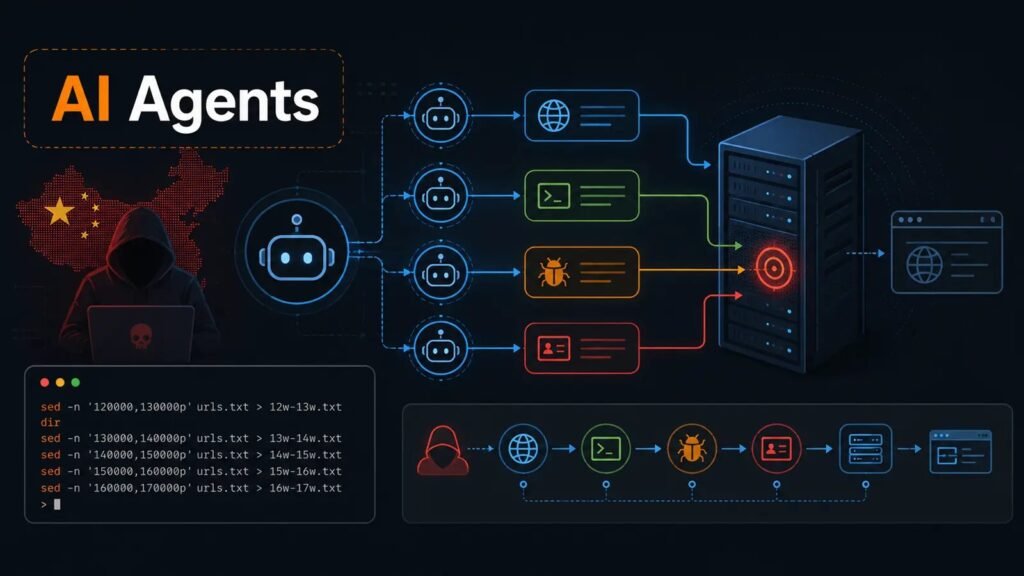
Cisco Talos researchers have documented a large-scale campaign in which a Chinese-speaking threat actor, tracked as UAT-10147, is using AI-assisted tooling to automate attacks against vulnerable web servers. The operation blends publicly available exploit code with AI-generated scripts and attack playbooks, allowing the group to move through reconnaissance, exploitation, and post-compromise stages with far less manual effort than traditional intrusion campaigns require.
A Campaign Built for Scale
According to Talos, the operators targeted an estimated 170,000 URLs spanning government, education, media, technology, and gaming sectors. That breadth points to an opportunistic, scale-driven approach rather than a narrowly targeted espionage operation — the group appears to be sweeping across the internet for any exposed, exploitable web application rather than pursuing a specific high-value target list.
What sets this campaign apart from the usual mass-scanning botnets is how AI tooling is woven into the workflow itself. Rather than relying purely on static exploit scripts, the operators are reported to use AI-generated code and structured “playbooks” that guide the attack process from initial vulnerability discovery through to exploitation and follow-on activity on compromised hosts.
How AI Compresses the Attack Timeline
Historically, turning a newly disclosed vulnerability into a working, scaled exploitation campaign required skilled operators to manually adapt proof-of-concept code, handle edge cases across different server configurations, and script the logistics of large-scale scanning. Talos’s findings suggest that generative AI tools are increasingly capable of automating large chunks of that process.
Talos summarized the effect plainly, noting that “the approach helped the group carry out complex intrusions at greater scale.” In practice, that means less time between a vulnerability becoming public and it being weaponized against a broad swath of internet-facing systems — a trend defenders have been anticipating as AI coding assistants become more capable and more widely accessible to threat actors as well as legitimate developers.
Reconnaissance, Exploitation, and Beyond
The campaign reportedly spans the full attack lifecycle rather than stopping at initial access. AI-assisted playbooks are used to guide reconnaissance against candidate targets, generate or adapt exploit payloads suited to the specific software and version detected, and support activity after a server has been compromised. This end-to-end automation reduces the operational overhead traditionally associated with running intrusion campaigns against tens of thousands of individual targets.
Because the targeting spans so many sectors and geographies, organizations running public-facing web applications and content management systems — regardless of size or perceived attractiveness as a target — should assume they may be swept up in this kind of automated scanning activity.
What Defenders Should Do
Talos’s research reinforces several defensive priorities that apply broadly to internet-facing infrastructure:
- Patch known vulnerabilities in web servers, content management systems, and plugins promptly, since automated tooling can weaponize disclosed flaws quickly
- Reduce the exposed attack surface by disabling unused features, admin panels, and legacy endpoints on public-facing servers
- Monitor for high-volume, automated-looking reconnaissance traffic and unusual request patterns against web applications
- Deploy web application firewalls and keep signature sets current against recently disclosed exploitation techniques
- Segment compromised-host response plans to account for AI-assisted post-exploitation activity that may move faster than manual intrusions
A Preview of Things to Come
Security researchers have warned for some time that generative AI would eventually be adopted by threat actors to lower the skill and time barriers involved in running intrusion campaigns. The UAT-10147 activity documented by Cisco Talos is one of the clearer illustrations yet of that shift already happening at scale, rather than remaining a theoretical concern. As AI coding tools continue to mature, defenders should expect the gap between vulnerability disclosure and mass exploitation to keep shrinking, making rapid patch management and proactive exposure reduction more critical than ever.
Leave a Reply
You must be logged in to post a comment.