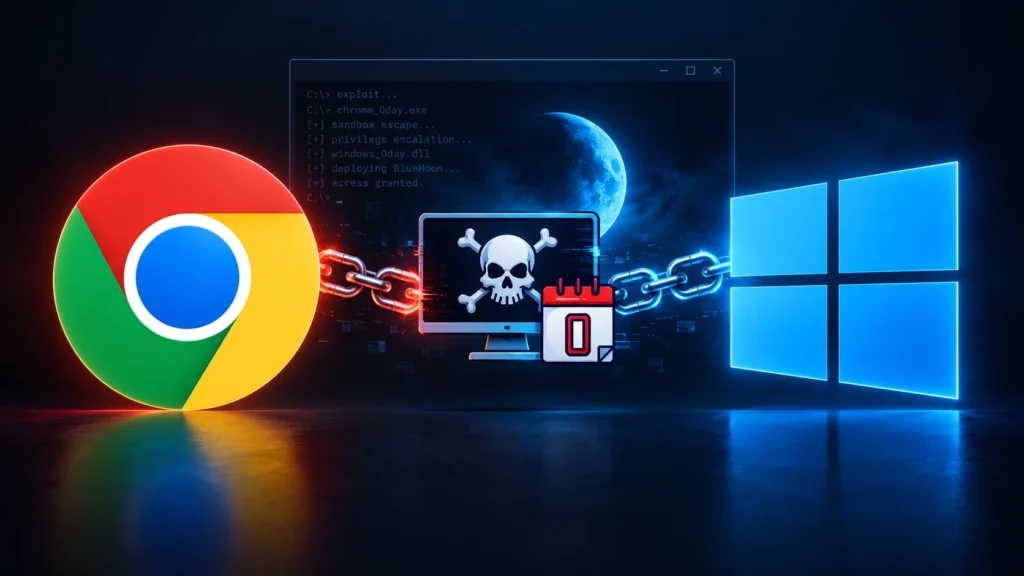
Several espionage-focused threat groups have adopted a new exploit kit that links browser and operating-system vulnerabilities to break out of Google Chrome and take control of Windows devices. The toolkit, named BlueMoon by Proofpoint researchers, has reportedly appeared in operations against government, defense, aerospace and commercial organizations since late August 2026.
At least four clusters have used the capability, with most showing a suspected connection to China. The rapid spread between groups is notable because reliable browser exploit chains are normally expensive, closely guarded assets. It may point to a shared supplier or digital-quartermaster model that distributes offensive tooling to several operators.
How the three-stage chain works
BlueMoon begins with CVE-2026-85046, a type-confusion issue in Chromium’s V8 JavaScript engine. By manipulating the just-in-time compiler, malicious page content can achieve code execution inside the browser renderer. A second V8 technique corrupts WebAssembly metadata, enabling the attacker to escape Chrome’s sandbox and replace compiled function bodies with shellcode.
The final stage targets Windows through CVE-2026-85880. The local privilege-escalation flaw abuses Advanced Local Procedure Call and Windows Notification Facility mechanisms to obtain kernel read-and-write access. Together, the stages turn a web lure into privileged execution without requiring the victim to install a conventional program.
The two browser weaknesses were described as patch-gap zero-days: corrections were visible in Chromium’s public source tree before they reached stable releases. That interval reportedly gave exploit developers about four weeks to study the changes and build working attacks. It is a reminder that transparent development can create a race between defenders rolling out updates and attackers reverse-engineering them.
Multiple groups, different payloads
APT31, also tracked as TA412 or Violet Typhoon, was the first observed user on August 28. Its phishing messages impersonated university interns and academic-conference outreach while targeting US nonprofits, mining companies and commodity traders. Successful attacks installed GemStone, a malicious browser extension masquerading as Google Gemini. The extension can record keystrokes, steal cookies, capture screenshots and issue arbitrary web requests.
A cluster labeled UNK_LateNight used defense procurement themes against US aerospace companies and delivered the ShadowPad backdoor through DLL side-loading. UNK_DoubleCheck abused a compromised Southeast Asian government email account to approach a Vietnamese manufacturer, while UNK_QuietRacket targeted government and financial organizations in Indonesia and Singapore with conference lures and DNS-over-HTTPS command traffic.
Signs of hurried development
Despite its sophistication, the kit contains operational rough edges. The Windows stage works only on older platforms such as Windows 10 and Windows Server 2019 or 2022. Delivery domains were often registered on the day they were used, and the default payload launches curl to retrieve an executable—behavior that can give endpoint monitoring products clear detection opportunities.
Researchers also found extensive diagnostic logs, verbose comments and a reference to a markdown handover file. Those artifacts are consistent with AI-assisted coding, although they do not prove how the toolkit was developed. References to Google’s v8CTF framework may reflect genuine exploit research or an attempt to frame prompts so that automated coding tools would produce offensive material.
What defenders should do now
Organizations should treat browser updates as urgent security work, particularly on systems still running older Windows builds. Chrome and other Chromium-based browsers should be upgraded as soon as stable fixes are available, with centralized reporting used to find devices that missed deployment.
- Hunt for unusual curl execution spawned by browser processes.
- Review newly installed browser extensions and enforce an approved-extension policy.
- Investigate same-day domains, suspicious conference lures and defense procurement messages.
- Accelerate migration from legacy Windows versions and restrict administrative privileges.
BlueMoon demonstrates that a technically advanced exploit chain does not need perfect operational security to be dangerous. Fast patching, browser controls and behavioral endpoint telemetry can still disrupt the attack before an espionage operator establishes durable access.
Leave a Reply
You must be logged in to post a comment.