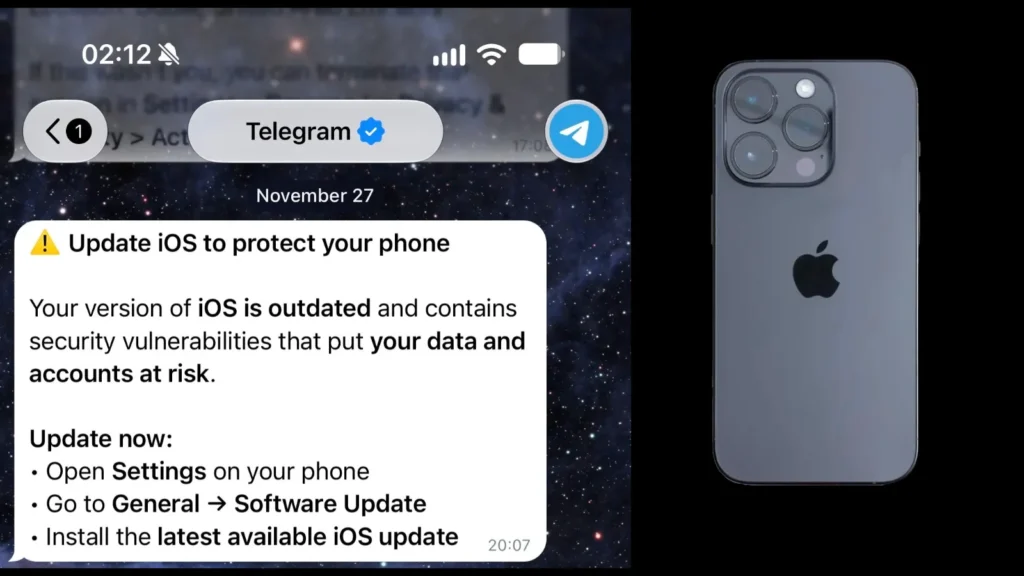
Durov Sounds the Alarm
Telegram founder Pavel Durov issued an unusually blunt warning on November 27, telling iPhone owners running older versions of iOS that they are being compromised “on a massive scale.” According to Durov, the danger does not require a victim to download a file, click a suspicious link in a message, or enter credentials on a fake login page. Simply loading a web page in Safari on a vulnerable, outdated handset can be enough to hand an attacker a foothold on the device.
Telegram pushed the alert directly to users it identified as running older iOS builds. Durov did not disclose how many devices had already been affected, which specific iOS versions triggered the warning, or whether the notice was tied to one identifiable campaign. Receiving the alert, Telegram clarified, does not mean the company has evidence that a particular recipient’s phone was actually breached — it is a precaution aimed at a population judged to be at elevated risk.
How a Website Alone Can Compromise a Phone
Attacks like the one Durov described do not need a fake login screen or a tricked-out download. If a page carries malicious code and the browser rendering it has the right combination of unpatched flaws, the exploit can begin executing the moment the page loads. Security researchers have already catalogued toolkits built around exactly this approach. One, known as Coruna, has been documented targeting iOS versions from 13.0 through 17.2.1. A separate kit examined by Google’s Threat Intelligence Group, nicknamed DarkSword, chained together six distinct vulnerabilities and was observed against iOS 18.4 through 18.7.
These version ranges describe campaigns researchers have already studied — they are not necessarily the same software flaws behind the surge Telegram is now flagging. What they illustrate is the mechanism: attackers link several bugs together to execute code inside the browser sandbox, break out of the restrictions meant to keep a website from touching the rest of the operating system, and reach data stored elsewhere on the phone.
Malicious Ads as the Delivery Mechanism
One way attackers get victims to visit a booby-trapped page without raising suspicion is online advertising. A campaign tracked by ad-fraud researchers at Confiant, dubbed MoldyRoost, linked more than 480 advertising domains to a single operation and reported targeting spanning more than 47 countries. Those numbers describe the campaign’s reach rather than a confirmed infection count, and Telegram’s warning did not name MoldyRoost specifically. Still, the pattern fits: a malicious ad routes a user to a landing page that silently fingerprints the visitor’s iOS version and serves an exploit chain tuned to it. No tap, download, or app install is required — if the device is vulnerable, compromise can happen during the page load itself.
Once inside, attackers in campaigns like this have gone after saved passwords, private messages, and cryptocurrency wallet recovery phrases. A stolen recovery phrase is particularly dangerous because it lets an attacker take full control of a crypto wallet without ever needing the account’s app password.
What iPhone Owners Should Do Now
The fix is straightforward, even if the threat sounds alarming: install the latest software update your device supports.
- Open Settings → General → Software Update directly on the device rather than following any link sent in a message, ad, or email.
- Apple’s own guidance recommends backing up the device, connecting it to power, and joining Wi-Fi before installing an update.
- Install whatever update is currently offered for your specific model — Apple’s November security release cycle delivered iOS 27.2.1 for compatible iPhones and a separate iOS 18.7.12 update for the iPhone XS, XS Max, and XR, so the “right” version varies by device.
- Turn on Automatic Updates afterward so future security fixes install overnight while the phone charges on Wi-Fi, closing the exposure window without relying on the user to remember.
The Bigger Picture
Browser-based exploit chains against fully updated, current-generation iPhones remain rare and expensive to develop. The pattern in cases like Coruna, DarkSword, and MoldyRoost is different: they target the much larger population of users who simply haven’t applied available updates, where known and already-patched vulnerabilities remain exploitable indefinitely. That makes Telegram’s warning less about a novel unstoppable threat and more about a persistent, avoidable gap — one that a routine software update closes.
Leave a Reply
You must be logged in to post a comment.