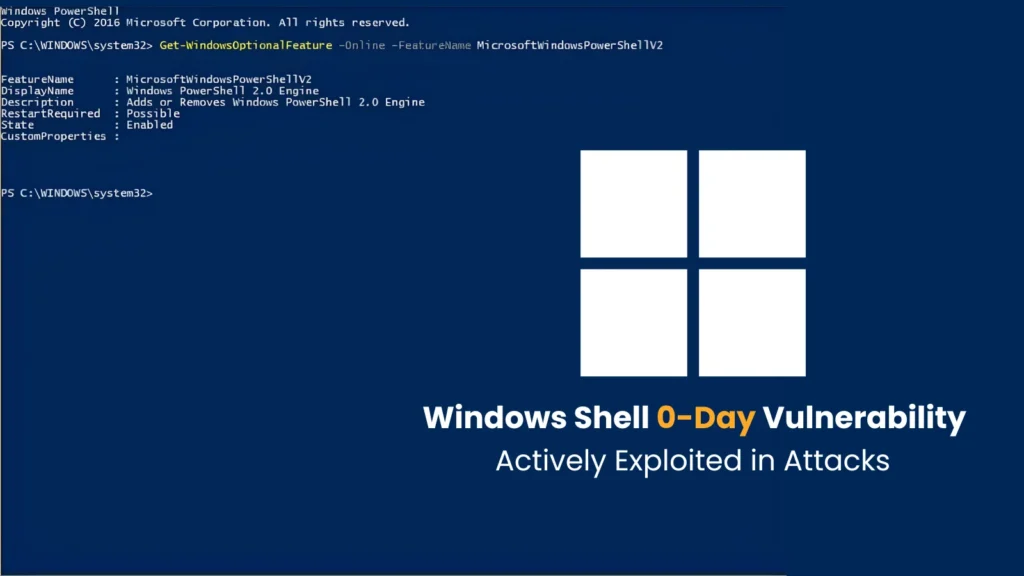
Microsoft has released a security update for a Windows Shell zero-day that attackers were already exploiting before a patch became available. The vulnerability, tracked as CVE-2026-96951, can help malicious files evade Mark of the Web protections, weakening one of Windows’ most visible safeguards for content downloaded from the internet.
The flaw received a CVSS score of 8.8 and an “Important” severity rating from Microsoft. More significantly for defenders, Microsoft’s assessment says exploitation has been detected. That shifts the issue from a theoretical weakness to an urgent patching priority, even though public information about the attacks remains limited.
How the security boundary can be bypassed
Mark of the Web records that a file originated outside the trusted local environment. Windows and applications can use that information to display warnings, open documents in a restricted mode, or apply additional checks before content runs. It is not a complete malware defense, but it provides valuable friction between delivery and execution.
CVE-2026-96951 involves Windows Shell handling special command elements incorrectly. A crafted file can exploit that command-injection condition to bypass the security feature. The published impact is a protection bypass rather than independent remote code execution, an important distinction: the flaw can remove a defensive barrier, but another malicious behavior or payload may still be needed to compromise the system.
The known delivery model also requires interaction. An attacker could send a prepared file through email, messaging, or another network channel, then convince the recipient to open it. This is therefore not described as a zero-click compromise. Social engineering remains part of the chain, and secure email controls and user caution still matter.
What remains unknown about the attacks
Microsoft has not publicly identified the threat actor, targeted organizations, geographic scope, or the precise file type involved. It has also not disclosed how widespread exploitation is. Those gaps make it unsafe to infer a specific campaign or industry focus from the advisory alone.
Researchers from Fujitsu, Anthropic and an independent contributor were credited in connection with the discovery. The advisory’s exploitation status, however, is the operational detail security teams should emphasize: a working technique has been used in real attacks, regardless of how much campaign telemetry is public.
Recommended defensive actions
Organizations should identify affected Windows systems through Microsoft’s Security Update Guide and deploy the October 2026 security updates after appropriate compatibility testing. Internet-facing systems and endpoints used by staff who routinely receive external files deserve particular attention, but broad endpoint coverage is important because the attack path can begin in ordinary user workflows.
- Prioritize the applicable Windows update and verify successful installation through endpoint or patch-management reporting.
- Review detections involving unexpected attachments, unusual child processes launched from document viewers, and suspicious shell activity.
- Keep email and messaging protections configured to inspect or quarantine risky file types.
- Remind users to verify unsolicited attachments, even when a file opens without the warning they normally expect.
- Use application control and least privilege to limit what a delivered payload can do after execution.
Defenders should not treat the absence of a download warning as evidence that a file is safe. Mark of the Web is one layer in a wider control set, and this vulnerability demonstrates why execution prevention, behavioral monitoring and identity protections need to remain effective when a single boundary fails.
Why rapid patching matters
Security-feature bypasses can be especially useful to attackers because they make familiar delivery techniques more reliable. Once details spread, other groups may reproduce the approach or combine it with commodity malware. Prompt updating reduces the time available for that follow-on activity.
The practical response is straightforward: patch quickly, hunt for suspicious file-driven execution, and maintain skepticism toward unexpected content. According to Cyber Security News, Microsoft’s exploitability guidance places detected exploitation at the highest update priority. Organizations should handle CVE-2026-96951 accordingly while watching for additional technical indicators from Microsoft and security researchers.
Leave a Reply
You must be logged in to post a comment.