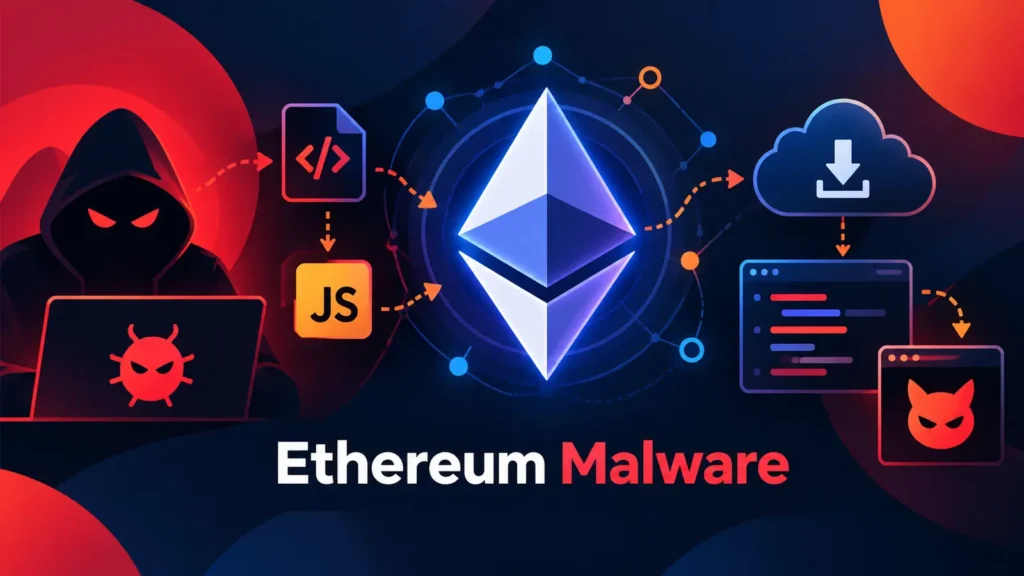
A North Korea-linked malware operation is using ordinary-looking Ethereum transfers as a resilient directory for its command infrastructure. Rather than placing executable code on the blockchain, the campaign encodes an IP address and port inside the recipient field of a transaction. Infected systems can inspect public blockchain data, decode the latest destination and reconnect even after defenders block an earlier server.
Researchers at Ransom-ISAC found the technique in September samples of XCTDH, a cross-platform campaign previously associated with fake developer recruitment. Victims are encouraged to run a poisoned repository, package or coding assignment. That first execution can lead to a remote access tool and a credential stealer on Windows, macOS and Linux.
Ethereum becomes a distributed signpost
Ransom-ISAC calls the technique HashHiding. The first four bytes of a transaction recipient address represent an IPv4 address, while the next two encode a network port. Other bytes carry a secondary endpoint and padding. Most observed signaling transactions moved no cryptocurrency; a small number transferred a negligible amount to an address that was not expected to be controlled by anyone.
The malware watches transfers from a designated operator wallet through public Ethereum access services. When it finds the relevant transaction in a recent block, it interprets the recipient address as connection instructions and contacts the decoded server. That server can return code used to restore later stages of the infection.
This design differs from attacks that store scripts or payloads in blockchain transaction data. Ethereum is the lookup mechanism, not the malware repository. Because the ledger is public and replicated, defenders cannot remove the signal. They can block known endpoints or access to specific public RPC services, but the operator can publish another address through a new transfer.
Multiple chains support the infection
The Ethereum channel is only one route. The initial loader checks TRON transactions, with Aptos as a fallback, for directions to encrypted JavaScript stored in BNB Smart Chain transactions. That older mechanism delivers code, while the Ethereum component provides a current recovery server. A hardcoded endpoint remains available as another option.
Researchers recorded 2,655 signaling transactions during a 90-day period and observed the encoded destination change four times. Some changes moved to a different address range, while another altered only the final octet of the server address. Small changes like that can evade narrowly written blocklists and demonstrate why defenders need behavioral detections.
The remote access component can execute commands, capture keystrokes and monitor clipboard contents. A separate stealer targets browser data, password managers, cloud credentials and cryptocurrency wallets; researchers counted 153 wallet targets. Stolen information is sent through a messaging bot interface. The report did not establish infection totals or the volume of data taken.
Detection requires more than blocking one server
- Investigate unexpected Ethereum, TRON, Aptos or BNB Smart Chain queries from developer workstations and Node.js processes.
- Correlate public blockchain lookups with immediate connections to uncommon external IP addresses.
- Review repositories and packages received through unsolicited recruitment conversations before executing them.
- Hunt for Node.js processes evaluating downloaded code, especially in development environments.
- Revoke exposed browser sessions, cloud keys, password-manager tokens and wallet credentials during incident response.
Removing a known command server is insufficient because the malware can discover its replacement from the blockchain. Responders should eradicate loaders and persistence, isolate affected hosts and treat developer credentials as potentially compromised. The campaign also shows how legitimate decentralized infrastructure can give attackers inexpensive resilience without deploying a complex smart contract.
Organizations can reduce exposure at the initial-access stage by isolating recruitment exercises from normal developer workstations. Unknown projects should run in disposable virtual machines without production credentials, password-manager access or authenticated browser sessions. Repository hooks, package scripts and configuration files deserve review before execution, even when a recruiter presents the task as routine technical screening.
The blockchain behavior and campaign details were documented by Ransom-ISAC and reported by Cyber Security News.
Leave a Reply
You must be logged in to post a comment.