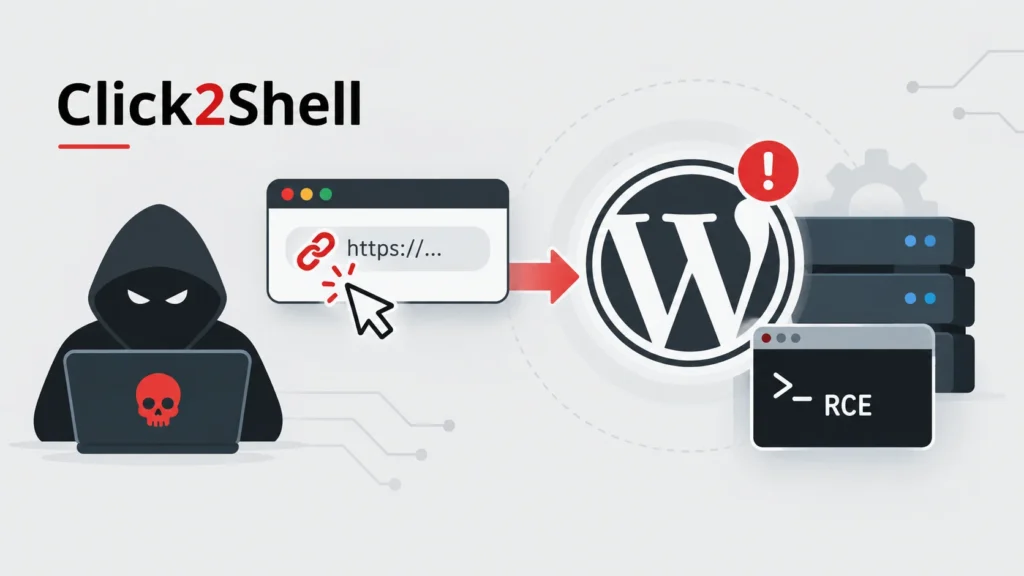
WordPress administrators have been urged to update after researchers described an attack chain that can convert a single malicious link into code execution on a vulnerable server. Dubbed Click2Shell, the technique combines a flaw in WordPress Core’s theme preview workflow with unsafe code inside an installable theme, allowing an attacker to move from social engineering to control of the web application.
The Core issue was corrected in WordPress 7.1.1, released on September 17. Although researchers said they had not seen exploitation in the wild at disclosure, the chain is notable because the attacker does not initially need a WordPress account. The essential condition is that a logged-in administrator visits a specially prepared URL.
How a trusted session becomes the entry point
The weakness sits in the theme installer and the way a theme value is interpreted. WordPress.org’s Themes API normalizes the supplied input into a valid catalog slug, while JavaScript in the administrator’s browser retains punctuation from the original value and places it into a jQuery selector. Carefully chosen selector characters can escape the intended match and reach a legitimate Install button in the returned theme card.
Because the request executes through the administrator’s authenticated browser, the workflow has the installation permissions and security token it needs. WordPress then installs a current theme from its official directory. The attacker cannot use this step alone to upload an arbitrary archive, and the new theme remains inactive, meaning the public appearance of the site may not change. That subtle behavior can make the event difficult to notice.
A vulnerable theme completes the chain
Researchers demonstrated the next stage with Mobile Repair Zone 2.5.4. When WordPress opened the inactive theme in the Customizer, PHP belonging to that theme was loaded. An authenticated AJAX action exposed by the theme lacked both a nonce validation and a capability check. It accepted attacker-controlled plugin information and a package URL, downloaded and unpacked the supplied code, and loaded its PHP entry point.
That sequence changes the risk from forced installation to remote code execution under the web server’s identity. A successful intruder could read configuration and database credentials, inspect WordPress or WooCommerce records, change site files, create accounts, steal secrets available to PHP, and potentially use the compromised site to reach the wider hosting environment.
What the WordPress fix changes
The Core patch narrows the selector to a genuine theme-card element and escapes the slug before building the selector. Punctuation that previously altered the selector structure is therefore handled as literal text. Researchers scored the standalone forced-install weakness at 7.1 under CVSS 3.1, while describing the demonstrated code-execution chain as critical. No final CVE identifier had been published when the analysis appeared.
WordPress said corresponding fixes were being backported to security-supported branches, but administrators should still move to the newest practical release. The update also contains other security and reliability corrections, making rapid deployment preferable to treating Click2Shell as an isolated theme problem.
Defensive checks for site owners
Installing the security update is the first priority. Teams should then look for evidence that the primitive was used before patching. Useful checks include:
- Review recently installed themes and plugins, including inactive components.
- Inspect requests involving
theme-install.php, the Customizer, and relevantadmin-ajax.phpactions. - Search for unexpected PHP files, new administrator accounts, changed content, and altered scheduled tasks.
- Confirm automatic updates are functioning and remove themes or plugins that are no longer required.
The broader lesson is that code does not always need to be activated in the traditional sense to become dangerous. Preview and setup routines may load server-side components before a user formally enables a theme. Site operators should minimize dormant extensions and treat any unexplained installation as a potential security incident, especially when it coincides with an administrator following an external link.
Leave a Reply
You must be logged in to post a comment.