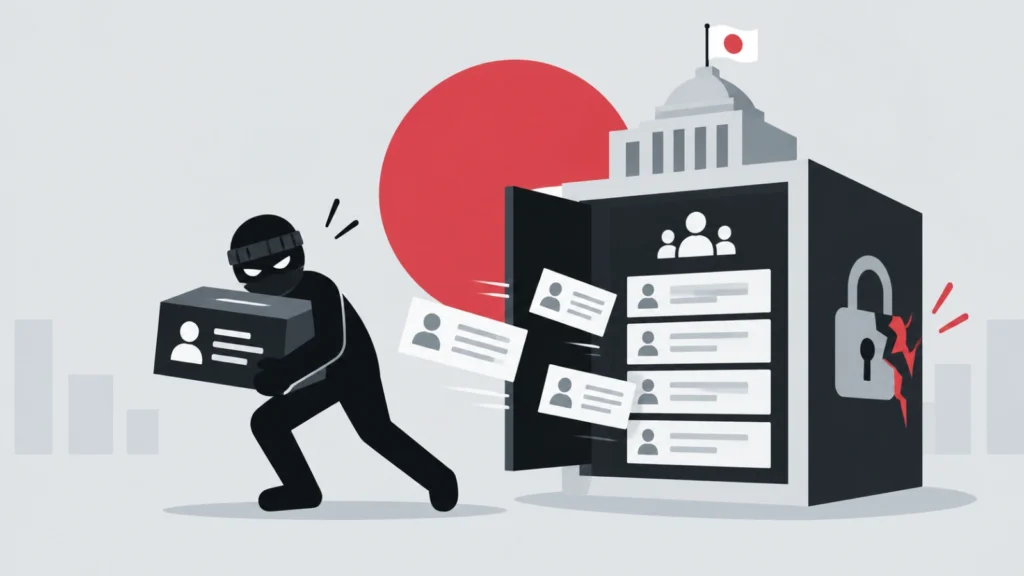
Japan’s Digital Agency has disclosed a major compromise of the Government Solution Service, a shared technology platform used by ministries and other public bodies. Investigators believe an attacker exploited a vulnerability in an internet-facing VPN appliance and reached internal servers, creating possible exposure for roughly 246,000 personal records linked mainly to government personnel and contractors.
Intrusion began weeks before detection
The first clear warning arrived on June 25, 2026, when defenders noticed that a maintenance and operations account had been used to access an unusually large collection of files. An investigation with an outside security company later determined that hostile activity had begun in late May. The intruder therefore may have remained inside the environment for close to a month before the suspicious access was identified.
Once the suspected entry point was established, the agency disabled the affected account and disconnected implicated equipment from external networks on July 9. The containment measures stopped the known route of access, but the timeline shows how stolen legitimate credentials can make malicious behavior resemble routine administrative work. Monitoring privileged service and maintenance accounts is therefore as important as watching for malware.
What information may have been exposed
The files contained contact and identity information for approximately 189,000 employees and officials at organizations using the government platform. A further 57,000 records related to contractors and businesses supporting those bodies. Because the categories overlap, the agency separately counted about 236,000 names, 231,000 email addresses, 94,000 telephone numbers and around 1,000 physical addresses.
The incident did not involve Japan’s My Number identifiers, pension information or bank account details, according to the disclosure. Records belonging to the public were also said to be outside the affected collection. Those limits reduce the likelihood of direct financial theft, but the combination of names, roles and trusted contact details is still valuable for targeted social engineering.
A patching failure with broad lessons
Reports cited in the disclosure indicate that the VPN weakness was neither a zero-day nor rated critical. A vendor fix was already available before the intrusion. That detail is important: attackers often prefer a dependable, known flaw in a forgotten perimeter device to a technically sophisticated exploit. VPN gateways are especially attractive because they sit at the boundary, handle authentication and can provide a direct route into trusted networks.
Organizations should maintain a complete inventory of externally reachable appliances, track vendor advisories and verify that updates were actually applied. Risk scores should inform priorities but should not be the only factor. Exposure, available credentials, exploitability and the value of connected systems can turn a medium-severity bug into a serious operational threat.
Phishing risk remains after containment
No misuse of the information has been confirmed. Nevertheless, affected people should expect convincing messages that impersonate the Digital Agency, a ministry or a supplier. An attacker could use the exposed details to create believable requests for password resets, document reviews or urgent payments.
- Verify unexpected requests through a known telephone number or internal directory.
- Do not disclose passwords, one-time codes or financial details in response to unsolicited messages.
- Report suspicious messages so defenders can identify coordinated campaigns quickly.
- Review authentication logs for the affected accounts and require phishing-resistant multifactor authentication where possible.
The agency says it will strengthen vulnerability management and controls around external connections while notifying affected people individually. The incident is a reminder that perimeter security depends on disciplined maintenance, rapid isolation and visibility into how privileged accounts use sensitive shared platforms.
The roughly 78-day interval between detection and public disclosure will also attract scrutiny. Investigations need time to establish scope, but organizations should prepare notification workflows before an incident occurs. Clear ownership, preserved logs and rehearsed communications help teams move from technical containment to accurate public guidance without unnecessary delay.
Leave a Reply
You must be logged in to post a comment.