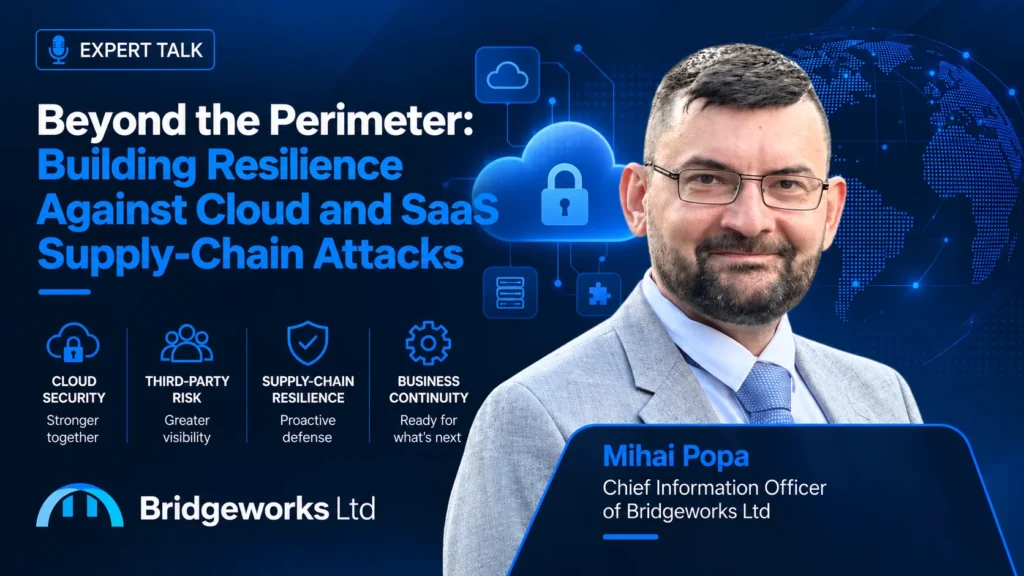
Cloud and software-as-a-service platforms have made the traditional network perimeter a poor description of where an organization’s risk begins and ends. Users, applications and sensitive data now cross providers, APIs, mobile devices and third-party systems, while a supplier may quietly depend on several suppliers of its own.
A contributed analysis published by Cyber Security News uses recent enterprise-platform attacks to illustrate the stakes and argues that identity protection and recovery capability now matter as much as perimeter controls. The practical objective is not to promise that compromise can never occur, but to keep one control failure from becoming an organization-wide catastrophe.
Every service brings inherited dependencies
A company can operate strong internal controls and still be exposed through a vendor several layers removed from its direct contract. Cloud services often share hyperscalers, identity providers, telecommunications carriers and managed-service platforms. Two products that look independent on a procurement spreadsheet may fail together because they rely on the same underlying service.
AI adoption adds another tier. Models, agent platforms, APIs and data-processing vendors create questions about where information is handled, which identities can access it and how a provider compromise would propagate. Security reviews should therefore look beyond the direct vendor and identify critical sub-processors and privileged integration paths.
Dependency mapping is the foundation. Teams need to know which suppliers support authentication, communications, customer operations, development and recovery. The map should highlight concentration points whose loss would interrupt several essential processes simultaneously.
Identity has become the practical perimeter
An attacker may not need to break through a corporate network if a privileged account, session token or API credential already provides access to cloud data and administrative functions. Multifactor authentication, privileged-access management, least privilege and monitoring are therefore core resilience measures, not optional identity enhancements.
Plans must also cover failure of the identity provider itself. Organizations should establish protected emergency access, strong oversight for those accounts and a documented way for administrators to regain control when normal authentication is unavailable or untrusted. Recovery that depends entirely on the failed service is not a workable recovery plan.
Patching must follow exposure and business impact
Automated scanning and exploit tooling have compressed the time between disclosure and mass exploitation. Publishing a patch does not reduce an organization’s risk until the update is deployed or an effective mitigation is enforced.
Internet-facing applications, identity infrastructure and known-exploited vulnerabilities deserve priority. Accurate asset discovery is essential because teams cannot patch an exposed system they do not know exists. Risk-based queues should combine technical severity with reachability, exploitation evidence, data sensitivity and the operational role of the affected service.
Backups must survive the same incident
Encrypted and geographically separated backups remain crucial, but copies should also be isolated from production credentials and administrative paths. If an attacker controlling the live environment can erase every replica, the organization has duplication rather than resilience. Immutable or offline copies are appropriate for the most critical data and configurations.
Recovery-time objectives should be set from business needs. Not every application requires restoration in minutes, while authentication, communications or revenue systems may tolerate almost no downtime. Security and IT teams can then design recovery processes around those priorities.
Regular exercises must prove more than successful file restoration. Credentials expire, replication silently stops, dependencies change and documentation becomes stale. A meaningful test demonstrates that people can restore trusted identities, configurations, data, applications and operating processes after a hostile event.
Prepare for correlated supplier failures
- Identify common infrastructure beneath seemingly separate providers.
- Maintain independent backups and alternative communication channels.
- Document manual processes for the most critical business functions.
- Define security and recovery obligations in supplier contracts.
- Include monitoring, portability and exit planning in the vendor lifecycle.
Cybersecurity and business continuity can no longer operate as separate disciplines. A cloud compromise may affect availability, integrity and trust at the same time, which makes it different from an ordinary outage. Restoring a service is insufficient if its accounts, configurations or data may still be controlled by an attacker.
The strongest response combines preventive controls with the ability to contain failure, operate through disruption and recover into a trustworthy state. Mapping dependencies, securing identities, accelerating high-risk patching and repeatedly testing isolated recovery gives organizations a defensible path through an increasingly interconnected supply chain.
Leave a Reply
You must be logged in to post a comment.