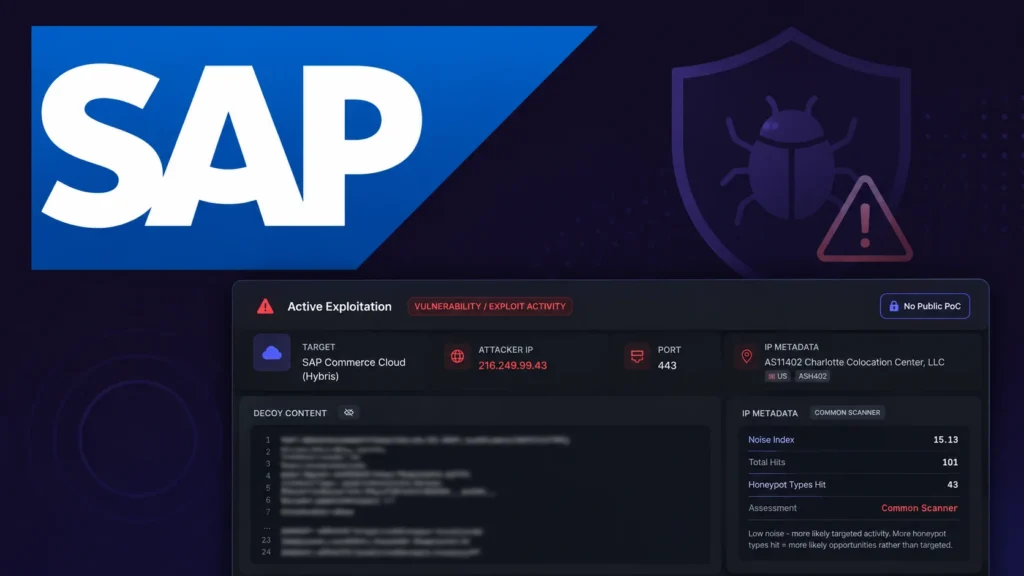
Enterprises running SAP Commerce Cloud have a very narrow window to act. Security researchers say attackers have begun probing internet-facing installations for a maximum-severity flaw only days after SAP shipped a fix for it, a turnaround that leaves little room for organizations still working through change-control processes.
A perfect 10.0 on the severity scale
The vulnerability, tracked as CVE-2026-58231, carries a CVSS score of 10.0 — the highest possible rating — because it allows an unauthenticated attacker to execute arbitrary code on a vulnerable server over the network. No user interaction and no prior credentials are required, which means any exposed instance is effectively an open door once an attacker knows where to knock.
SAP Commerce Cloud (formerly Hybris) underpins e-commerce storefronts, order management, and product catalog systems for a large number of retail and B2B organizations, making an unauthenticated remote code execution bug in the platform a high-value target for both opportunistic criminal groups and more patient intrusion actors looking to pivot into corporate networks.
Exploitation began almost immediately
According to threat intelligence firm Defused, which operates a network of honeypot sensors designed to mimic vulnerable internet-facing systems, the first exploitation attempts were observed within roughly three days of SAP’s patch going out. That timeline strongly suggests attackers obtained the fix, diffed it against the previous release, and reverse-engineered a working exploit from the difference — a common and fast pattern once a critical patch draws attention to exactly what was broken.
The attacks observed so far follow a consistent pattern: automated POST requests directed at administrative service endpoints over HTTPS, consistent with mass scanning rather than a hand-crafted, targeted intrusion. One of the earliest source addresses identified by Defused traced back to infrastructure hosted at a US colocation provider, though attackers routinely rotate through rented or compromised infrastructure, so the originating IP offers limited attribution value on its own.
Notably, no public proof-of-concept exploit code has been released at the time of writing. That distinguishes this campaign from bugs where a researcher publishes a working exploit that criminal groups then copy — here, the attackers appear to have done the reverse-engineering work themselves, which typically signals a more capable and motivated adversary rather than opportunistic script-kiddie activity.
Why the patch-to-exploit gap keeps shrinking
Security teams have watched this pattern accelerate across the industry for the past several years: the gap between a vendor patch shipping and working exploitation in the wild has compressed from weeks to, increasingly, single-digit days. For internet-facing enterprise platforms like SAP Commerce Cloud, that compression effectively eliminates the “we’ll patch it next maintenance window” approach that many organizations still rely on for less critical systems.
Part of the challenge is architectural. Commerce platforms are, by design, meant to be reachable from the open internet by customers — but administrative and management interfaces frequently do not need to be, and are one of the most common places where this class of vulnerability gets exploited first.
What defenders should do now
- Patch immediately. Apply SAP’s official update for CVE-2026-58231 without waiting for a scheduled change window, given confirmed in-the-wild exploitation.
- Audit exposure. Identify any SAP Commerce Cloud administrative or management interfaces reachable from the public internet and move them behind a VPN or equivalent access control layer.
- Hunt retroactively. Review web server and WAF logs for anomalous POST requests to administrative service paths dating back to shortly after the patch’s release date.
- Tighten access control lists. Where administrative endpoints must remain reachable, restrict access to known corporate IP ranges rather than leaving them open by default.
Given the severity rating and confirmed active exploitation, organizations running SAP Commerce Cloud should treat this as an incident-response-adjacent priority rather than routine patch management — the earlier an exposed instance is found and remediated, the smaller the chance it becomes someone’s foothold into the broader network.
Leave a Reply
You must be logged in to post a comment.