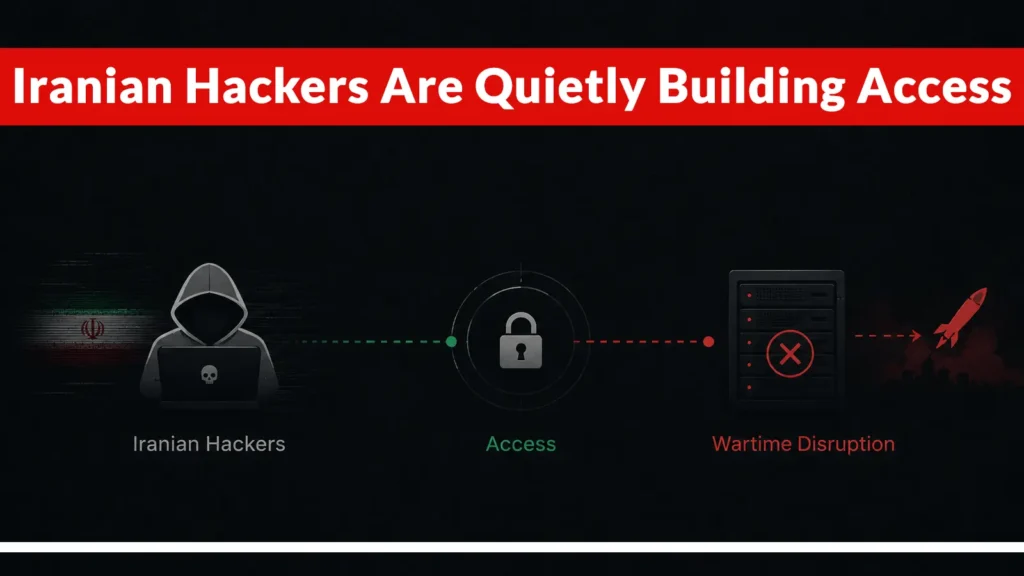
A new threat intelligence assessment suggests that Iran-linked hacking groups are increasingly playing a longer, quieter game than the public defacements and leak sites typically associated with the country’s cyber operations. Instead of racing toward visible disruption, these actors appear to be patiently accumulating footholds inside corporate networks, cloud environments, service providers, and industrial control systems — access that could sit dormant for months before being activated during a moment of political crisis.
Access as an Option, Not Just a Weapon
According to a report from SentinelOne shared with the security community, the defining feature of this activity isn’t necessarily an intent to cause immediate damage. Researchers describe the strategy as a form of “access optionality” — a compromised administrator account, a poorly secured remote management tool, or a foothold inside an IT services provider can serve espionage purposes today while remaining available as leverage for disruption tomorrow.
That framing matters for defenders because it changes the calculus of risk. An intrusion that looks like routine credential theft or a phishing campaign might, in fact, be the opening move in a much longer game — one where the attacker’s real objective is optionality: the ability to escalate quickly if conditions change.
Multiple Groups, Overlapping Missions
Importantly, researchers caution against treating Iran-linked activity as a single coordinated campaign. Several distinct groups and public-facing personas appear to operate with different targets, tools, and levels of sophistication, even when their activity seems to intersect. Among the clusters highlighted in the report is Seedworm, also tracked as MuddyWater and linked to Iran’s Ministry of Intelligence and Security (MOIS), which researchers tied to intrusions affecting a U.S. bank, an airport, several nonprofits, and the Israeli branch of a U.S. software vendor. Investigators reportedly found multiple backdoors installed across affected environments along with signs of an attempted transfer of stolen data to commercial cloud storage — consistent with the group’s documented pattern of abusing signed software to maintain long-term access.
A second cluster, referred to as Screening Serpens, has reportedly relied on tailored recruitment-themed phishing lures to trick targets into installing remote-access tools. Victims spanned the United States, Israel, the UAE, and other countries across the Middle East. These lures tend to focus on individuals in trusted roles, where a single compromised account can expose internal communications, contact networks, and connected cloud resources.
Service Providers as a Force Multiplier
The report also flags third-party service providers as a particularly effective route into target organizations. Rather than attacking a company directly, adversaries can quietly abuse access already granted to an outside IT administrator, managed support vendor, or identity provider — turning a single compromised relationship into a pipeline for reaching many downstream victims at once. Organizations that outsource remote administration are advised to treat vendor access with the same scrutiny as internal privileged accounts.
Industrial Systems Under Watch
Perhaps the most consequential dimension of the report concerns operational technology. Iranian-affiliated actors have reportedly targeted internet-exposed programmable logic controllers from vendors including Rockwell Automation and Allen-Bradley, with some incidents linked to genuine operational disruption and financial losses at water utilities, energy providers, and manufacturing sites.
Researchers were careful to note that not every claimed intrusion into industrial equipment represents full control — there’s a meaningful difference between glimpsing a login portal, interacting with a live interface, altering settings, and actually causing a physical-world effect. Public claims from hacktivist-adjacent personas should be evaluated with that distinction in mind rather than taken at face value.
What Defenders Should Prioritize
Even accounting for that caveat, exposed industrial systems remain an unnecessary and avoidable risk. The report’s recommendations echo long-standing industrial security guidance, but with renewed urgency:
- Remove direct internet exposure from engineering and control system interfaces
- Replace default or shared credentials and enforce phishing-resistant multi-factor authentication
- Segment business networks from operational technology environments
- Restrict vendor and remote-support access by time window, source address, and role
- Maintain and separately test offline backups, since recovery systems sharing identity infrastructure with production networks can fail during the same incident
Researchers expect Iran-linked operators to continue prioritizing intelligence collection while using public-facing personas to amplify claims and apply pressure, sometimes well before any technical impact is confirmed. For defenders, the practical takeaway is to map out trusted access paths now — vendor relationships, remote administration tools, cloud identity providers — before an ordinary account compromise has the chance to become leverage in a future crisis.
Leave a Reply
You must be logged in to post a comment.