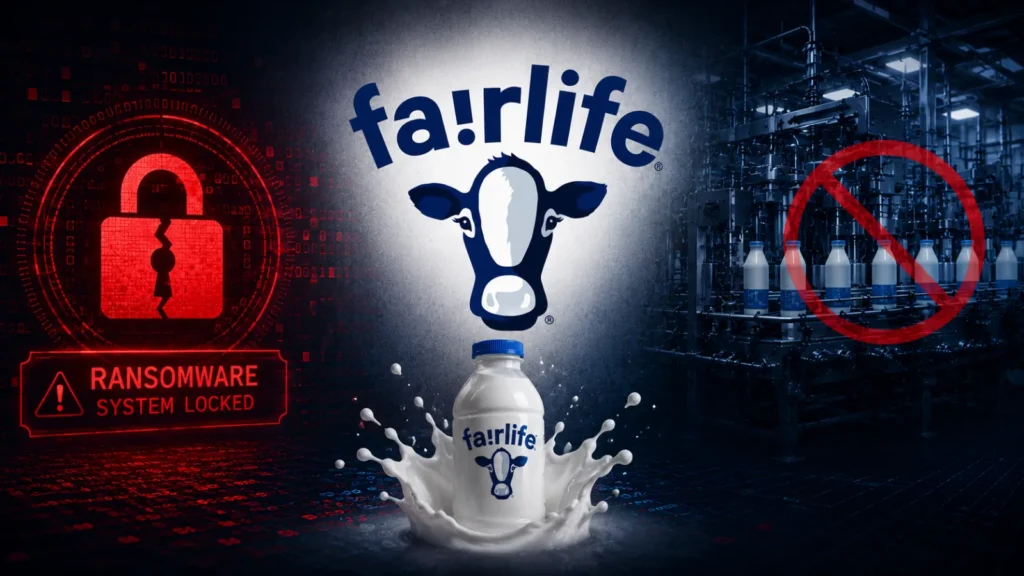
Coca-Cola has confirmed that its dairy subsidiary Fairlife was hit by a ransomware attack severe enough to force a temporary shutdown of production across the company’s US operations. The disclosure came through a Form 8-K filing with the Securities and Exchange Commission on July 16, 2026, putting the incident on the public record almost immediately after it was detected.
What Happened
According to the filing, an unauthorized third party gained access to parts of Fairlife’s internal network, including systems tied directly to manufacturing operations. Coca-Cola has classified the intrusion as a ransomware event, though it has not yet disclosed the specific strain involved or how the attackers initially got in.
Ransomware operators typically gain their first foothold through one of a small set of well-worn paths: phishing emails that trick an employee into handing over credentials, previously compromised login details bought or leaked elsewhere, or exploitation of an unpatched vulnerability in internet-facing software. Coca-Cola has not indicated which of these applies here, and that detail may not become public until the investigation concludes.
Production Impact and Containment
The most visible consequence has been operational: Fairlife’s US production lines were taken offline, a step that strongly suggests either the ransomware directly encrypted systems controlling manufacturing, or the company judged the risk significant enough to shut things down proactively as a precaution.
Modern food and beverage manufacturing tends to blend operational technology — the machinery and control systems running the factory floor — tightly with standard corporate IT networks. That convergence is convenient for efficiency but also means a ransomware infection that starts on the business side of the network can realistically reach the systems that keep production lines running, which is exactly the profile of high-value target ransomware crews have increasingly gone after in recent years.
One notable detail from the SEC filing: Fairlife’s Canadian production was not affected. That containment suggests the company’s network segmentation between geographic operations did its job, limiting what could have been a broader cross-border disruption to a single region.
What Coca-Cola Is Saying — and Not Saying
Coca-Cola has been clear on one point: the company says product quality and safety were not compromised by the incident. That is an important distinction for consumers, separating a disruption to IT and manufacturing-support systems from any suggestion that products themselves were tampered with or made unsafe.
Beyond that reassurance, though, plenty remains unknown. The company has not said whether attackers exfiltrated data before or during the attack, has not confirmed the ransomware family responsible, and has not indicated whether a ransom demand was made or whether any negotiation has taken place. Coca-Cola also stated it has not yet determined whether the incident will have a material financial impact, language commonly used in SEC filings while an investigation is still active.
The company says it has engaged external cybersecurity specialists to assist with the investigation and has activated its incident response and business continuity plans. Law enforcement has also been notified, a step consistent with the seriousness typically assigned to confirmed ransomware intrusions.
Part of a Broader Pattern
This incident fits a trend security researchers have flagged repeatedly: ransomware groups increasingly favor targets in manufacturing and food and beverage production specifically because those operations depend on continuous uptime and just-in-time logistics. A factory that cannot run for even a few days can face immediate downstream pressure — on shelf supply, on distribution schedules, and ultimately on revenue — which historically has translated into more leverage for attackers demanding payment.
For an organization the size of Coca-Cola, a subsidiary-level ransomware incident also carries regulatory and reputational weight well beyond the immediate technical disruption, which explains the speed of the SEC disclosure relative to how much technical detail has actually been confirmed publicly.
What to Watch For
As the investigation progresses, a few open questions will likely shape how significant this incident turns out to be:
- Whether attackers exfiltrated data, and if so, what categories of information (employee, customer, or proprietary manufacturing data) were exposed.
- Attribution to a specific ransomware group or affiliate, which would give defenders elsewhere useful indicators of compromise.
- How long US production remains offline, and what that means for retail supply of Fairlife products.
- Whether Coca-Cola ultimately assesses the incident as financially material under SEC disclosure rules.
For now, the Fairlife attack serves as another reminder that ransomware’s impact increasingly extends well past locked laptops and encrypted file shares — reaching directly into physical production and the supply chains that depend on it.
Leave a Reply
You must be logged in to post a comment.