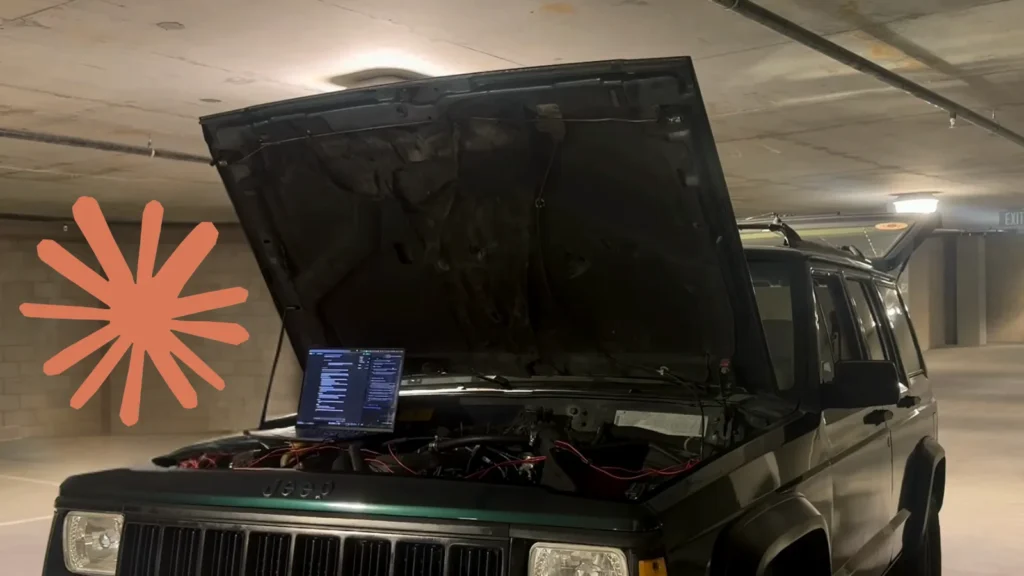
A Jeep Cherokee owner has demonstrated how far AI coding agents have come at reverse-engineering old, undocumented hardware — by using one to read, interpret, and eventually reprogram the engine computer of his 1994 Jeep, a vehicle built four years before most cars adopted the modern OBD2 diagnostic standard. Muhammad Zulali detailed the roughly week-long project in a YouTube video published November 10, and the story has since circulated widely in both automotive and AI circles.
A Smog Test Failure With No Modern Diagnostic Port
Zulali’s Jeep was failing California’s smog test at 25 mph due to elevated NOx emissions, a symptom typically associated with an engine running lean. He initially tried swapping the oxygen sensor — a reasonable first guess — but the problem actually worsened at lower speeds. With each retest costing around $100, he turned to Claude Code, an AI coding agent, to help find a cheaper and more systematic path to a diagnosis.
Translating a Thirty-Year-Old Protocol
Because the 1994 Cherokee predates OBD2, none of the common consumer scan tools could talk to its engine computer. Claude determined that the vehicle instead speaks an old, slow Chrysler-proprietary serial protocol known as SCI, whose signal polarity is inverted relative to a standard serial port. That meant a simple off-the-shelf adapter wouldn’t work — the project needed a small hardware translator. The fix was a $3 Arduino Nano wired up on a breadboard, with a total parts cost of roughly $15, tapping into just three of the six pins on the vehicle’s diagnostic connector (one of which carries 12 volts and can damage the board if touched incorrectly).
Early readings, captured at 1:30 a.m., returned basic data like coolant temperature and battery voltage. As the diagnostic session progressed, the data suggested a fuel trim that appeared to be adding roughly 22% more fuel than expected, which didn’t match the lean-running symptoms. A fuel pressure test turned up a reading of just 10 PSI — unusually low — and at one point the AI agent switched the fuel pump on by itself for about ten seconds, a moment Zulali described as the tool crossing the line from passive diagnostics to actively controlling the vehicle.
A Wrong Turn, a Correction, and a Root Cause
The project hit a snag when a parameter table sourced from an existing open-source tool, ChryslerScanner, turned out to be incorrect for this specific vehicle — it had the fuel trim direction backwards, leading the AI to initially misread fuel being removed as fuel being added. After catching the discrepancy, the agent copied the entire contents of the engine computer’s program to a laptop and found a California-specific fuel table that cut fuel delivery at exactly the engine load used during the smog test — the likely source of the elevated NOx all along.
Reflashing the chip with corrected firmware would have been the obvious fix, except the computer was manufactured in December 1993 — just months before Chrysler’s engine computers of that generation became reflashable. That’s where a second AI coding agent, OpenAI’s Codex, stepped in: it worked out how to transmit a small program over the same three wires and have the engine computer execute it directly. An initial version of the code was wiped on power-down, so Codex relocated it into EEPROM, a type of memory that persists even through a dead battery or disconnected power.
Why This Matters Beyond One Jeep
The project is open-sourced under the GPLv3 license as the “xj-scanner” repository on GitHub, which had accumulated 252 stars and 30 forks at the time of writing. Zulali is upfront that he isn’t a professional mechanic, that some of his technical conclusions may be imperfect, and that the work has been tested on exactly one vehicle.
Even with those caveats, the broader lesson for security researchers is less about cars specifically and more about what AI agents can now do to forgotten, undocumented embedded systems in general. Researchers have previously demonstrated that vehicle control systems can be manipulated through physical access to disable functions like braking — attacks that historically required specialized reverse-engineering skill and a significant time investment. Agentic AI tools appear to be compressing both.
- The same pattern — an AI agent rapidly learning an undocumented legacy protocol — applies well beyond automotive ECUs, to any embedded or industrial system running old, proprietary firmware.
- Agentic coding tools carry their own risk profile: AI coding agents have separately been shown vulnerable to hijacking via malicious files planted in a user’s Downloads folder.
- Vendors of legacy embedded systems, especially in critical sectors, should assume that the reverse-engineering cost of their undocumented protocols has dropped substantially.
Anthropic’s own guidance for Claude Code urges users to review agent-proposed commands before approving them — a caution that applies just as much to automotive diagnostics as it does to software development.
Leave a Reply
You must be logged in to post a comment.