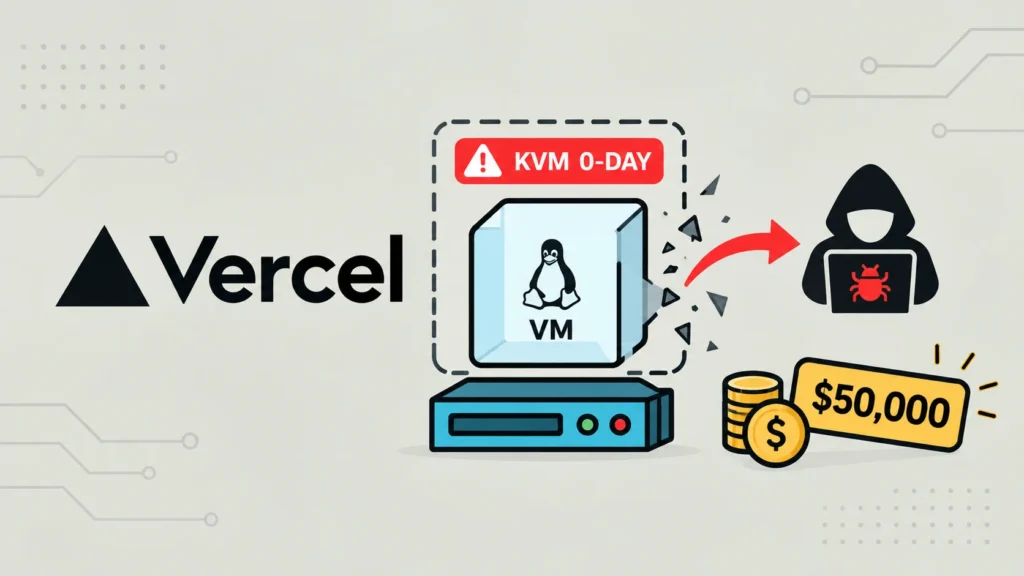
Vercel has confirmed that a security researcher reported a zero-day vulnerability involving Kernel-based Virtual Machine (KVM) technology after demonstrating what he described as a complete virtual-machine escape. The report is significant because the claimed result would allow code running inside an isolated guest to reach the underlying host with root privileges, crossing one of cloud computing’s most important security boundaries.
Researcher Paulos Yibelo disclosed the existence of the finding on October 3, while Vercel chief executive Guillermo Rauch separately confirmed that the report concerned a KVM zero-day. Vercel awarded Yibelo $50,000, the maximum payout for a single submission under its Sandbox bug bounty program. A detailed technical analysis has been promised but was not available at the time of publication.
Why a virtual-machine escape matters
KVM is the virtualization layer built into Linux and is widely used to separate guest systems from the physical or virtual host beneath them. Under the intended model, even hostile code inside a guest should remain confined. A successful escape breaks that separation, and host-level root access could potentially expose other workloads, management services or sensitive infrastructure.
Vercel’s public Sandbox architecture adds useful context. The company says each sandbox runs inside a Firecracker microVM on a bare-metal Amazon EC2 host, with a Linux container inside the microVM executing user code. In that design, the microVM—not merely the inner container—is the primary isolation boundary. Moving from a container into its own guest operating system would therefore be materially different from escaping the microVM and reaching the host.
This distinction is increasingly important as companies use sandboxes to run generated code, third-party packages and autonomous AI-agent tasks. Those workloads may be intentionally untrusted. Their safety depends on layered containment remaining effective even when malicious instructions gain control inside the environment.
What has—and has not—been established
The available information supports two conclusions: Vercel accepted a high-severity report through its bounty program, and the researcher claims the exploit reaches host root from a guest. The bounty rules reportedly required a live proof of concept rather than a code-review-only submission, giving the report more weight than a theoretical observation.
However, important details remain absent. No CVE identifier, vulnerable kernel range, processor requirement, attack precondition or patch has been published. It is also unclear whether exploitation requires administrator privileges inside the guest, whether the technique depends on nested virtualization or whether it works reliably across different KVM and Firecracker configurations.
The maximum award category covers outcomes such as escaping a microVM to an EC2 host or accessing another customer’s information. The payout itself does not prove that customer data was taken, and neither Vercel nor the researcher has publicly demonstrated cross-customer access. There is likewise no evidence of exploitation in the wild.
Do not generalize beyond the evidence
Because KVM is used across a broad ecosystem, a short announcement can easily create an impression that every Linux hypervisor is vulnerable. The current disclosure does not support that conclusion. The bug may reside in a narrowly configured component, a particular device emulation path, a kernel version or an interaction specific to one deployment.
Administrators should also avoid applying guidance for unrelated KVM vulnerabilities. Previous research, including the separate Januscape nested-virtualization issue, involved different conditions. Without a disclosed root cause, defenders cannot safely assume that an earlier patch or mitigation addresses this new report.
Practical steps while details are limited
Cloud and platform teams should treat the announcement as an early warning rather than proof of universal exposure. Useful interim actions include:
- Inventorying systems that rely on KVM, Firecracker or similar microVM isolation for untrusted workloads.
- Confirming that host kernels and virtualization packages follow supported vendor update channels.
- Restricting guest access to unnecessary devices, host interfaces and management services.
- Monitoring Vercel, Linux distribution and cloud-provider advisories for a CVE and fixed versions.
- Reviewing host telemetry for unusual guest-to-host behavior, privilege changes or management-plane access.
Operators should prioritize the systems that execute attacker-controlled or internet-supplied code, because those environments offer the clearest route to reaching a vulnerable boundary. The eventual write-up should determine whether emergency patching is needed or whether exposure is limited to specific configurations. Until then, careful inventory, layered isolation and vendor-backed guidance are more useful than speculation.
Leave a Reply
You must be logged in to post a comment.