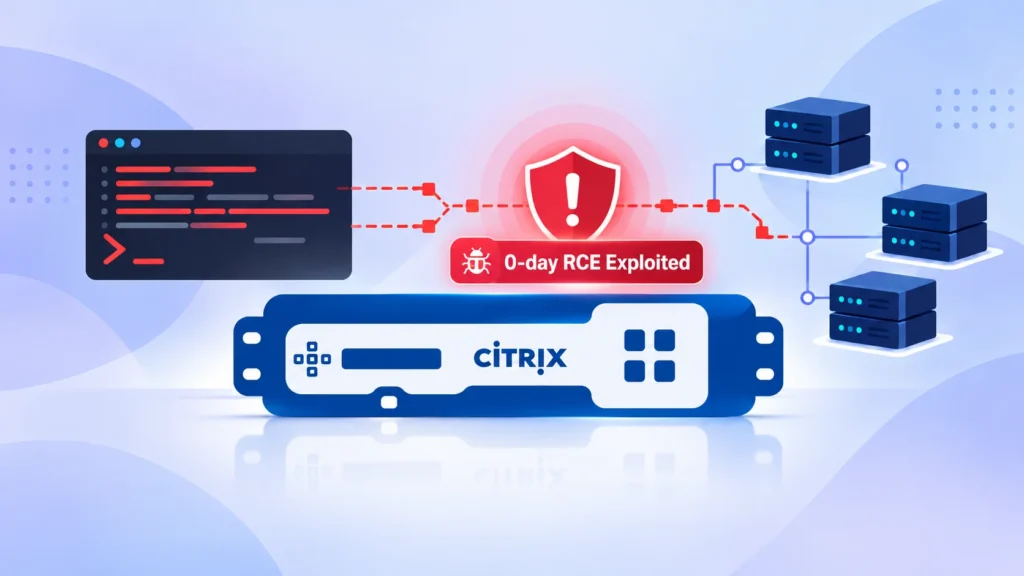
Security teams responsible for Citrix NetScaler infrastructure are facing an unusually difficult weekend decision after researchers warned that two previously undisclosed remote-code-execution vulnerabilities may already be under active exploitation. The reported flaws have not yet received CVE identifiers, public technical descriptions or vendor-issued indicators of compromise, but the intelligence was described as credible and connected to forensic investigations of real intrusions.
That combination—an internet-facing appliance, potential code execution and evidence of live attacks—creates a high-risk situation even before all facts are public. NetScaler ADC and Gateway systems commonly sit at a sensitive network boundary, handling remote access, authentication and application delivery. A successful compromise could therefore provide attackers with a valuable foothold close to internal services and user sessions.
What is known about the reported flaws
Security company watchTowr initially said it was reacting to reports of multiple unpatched NetScaler RCE vulnerabilities circulating in the wild. It later characterized the issue more specifically as two separate, unpatched flaws capable of enabling remote code execution. The warning suggests the activity is not merely theoretical, but important details remain unavailable.
No exploitation path, prerequisite, affected-version list, malicious payload or reliable forensic signature has been published. Citrix had also not released an advisory addressing these reported zero-days at the time of the source report. Organizations should consequently treat the alert as a serious and credible early warning, while recognizing that it has not yet matured into a fully documented vendor disclosure.
Some operators have reportedly removed exposed appliances from service. That can interrupt VPN connectivity, application access and authentication workflows, so it is not a trivial response. However, where an organization cannot patch, detect exploitation or accept the possibility of an edge-device compromise, temporary isolation may be the defensible choice under an approved continuity plan.
Do not confuse the alert with August fixes
The new claims are distinct from Citrix’s August 19 bulletin for CVE-2026-19490 and CVE-2026-19489. CVE-2026-19490 is a critical authentication-bypass vulnerability rated 9.3 under CVSS 4.0 and affects certain customer-managed NetScaler Gateway and AAA virtual-server configurations. Active exploitation of that flaw is established, and government security agencies have already pushed organizations toward urgent remediation.
CVE-2026-19489 is an 8.8-rated memory-overflow issue tied to a narrower configuration involving SIP ALG and Large Scale NAT. Citrix provided fixed versions for the August vulnerabilities and said no workaround was available. Those details should not be assumed to remediate the newly reported RCE issues, for which affected builds and fixes remain unknown.
Immediate defensive priorities
Until Citrix publishes authoritative guidance, incident-response preparation matters as much as patch readiness. Teams should establish exactly where NetScaler appliances are deployed, whether they are reachable from the internet, which builds they run and which business services depend on them. Management interfaces should be tightly restricted, and public exposure should be reduced wherever architecture permits.
- Preserve system, authentication and network logs before making disruptive changes.
- Review new sessions, account activity, configuration changes and unexpected administrative actions.
- Hunt for unfamiliar processes, files, persistence mechanisms and anomalous outbound connections.
- Capture forensic images from suspicious appliances rather than immediately wiping evidence.
- Prepare tested procedures for rapid patching, isolation and service restoration.
Organizations should monitor Citrix’s official security channel for affected-version data, patches and mitigation instructions. Social-media warnings can provide valuable early notice, but they cannot replace vendor documentation when teams make production changes.
A test of edge-device resilience
The episode highlights a recurring weakness in enterprise defense: remote-access infrastructure is both indispensable and highly exposed. When credible exploitation reports arrive before patches or detection rules, organizations must rely on accurate asset inventories, centralized logging, network segmentation and rehearsed emergency procedures.
Defenders should also assume that the absence of a public indicator does not equal the absence of compromise. Careful evidence preservation and retrospective hunting will be important once Citrix or researchers release more technical detail. For now, the safest posture is heightened monitoring, reduced exposure and readiness to act quickly without overstating what remains unconfirmed.
Source: Cyber Security News, published September 27, 2026.
Leave a Reply
You must be logged in to post a comment.