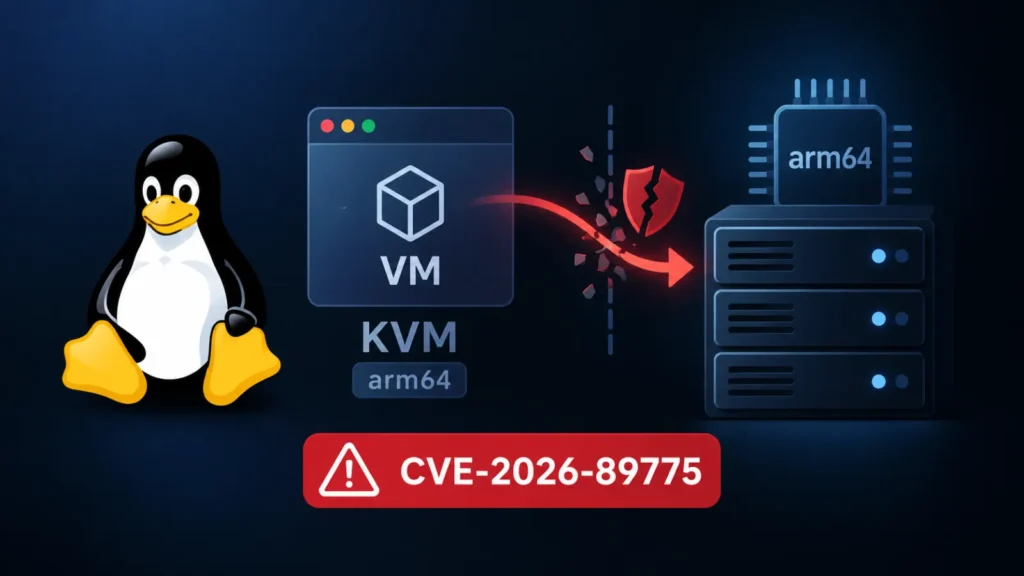
A Linux kernel flaw affecting KVM on ARM64 systems can undermine the isolation boundary between a virtual machine and its host. Tracked as CVE-2026-89775, the vulnerability may allow a malicious guest to retain writable access to a page of host memory after that page should have been invalidated. In affected environments, the primitive can provide a route to virtual-machine escape and host compromise.
The risk is concentrated in KVM/arm64 deployments with nested virtualization enabled. That configuration matters to cloud providers, development platforms and laboratories that permit tenants or local users to create virtual machines inside other virtual machines. A successful attack against a shared host could threaten workloads beyond the attacker-controlled guest.
A size-calculation error skips a required invalidation
Researcher Hyunwoo Kim traced the bug to type truncation in the KVM/arm64 stage-1 page-table walking process. KVM maintains a pseudo Translation Lookaside Buffer, or pseudo-TLB, to track memory translations used by virtual CPUs. When mappings change, stale entries must be invalidated so a guest cannot continue using memory that the host has released, moved or assigned elsewhere.
In the vulnerable code path, a calculation of the affected memory-region size can return zero. That value is supposed to indicate that the size is unknown. The VNCR pseudo-TLB logic instead handles zero as if it described a legitimate empty range. Because the range appears to contain nothing, the invalidation operation is skipped.
The result is a stale mapping that remains usable after the host’s memory-management state has changed. According to the disclosure, a freed host page can stay mapped as writable at a fixed kernel address. A malicious guest may then gain 64-bit read and write access to that page without causing a trap or virtual-machine exit, providing a foothold for direct manipulation of host memory.
Cloud hosts and local systems face different attack paths
In a public-cloud or multi-tenant setting, an attacker would first need access to an ARM64 instance where nested virtualization is available. Exploitation could then cross the boundary from that guest into the underlying host, potentially exposing the provider’s control of other workloads. The exact blast radius would depend on host architecture, scheduling and the attacker’s ability to turn the memory primitive into reliable code execution.
The flaw can also create a local privilege-escalation route. Some Linux configurations expose /dev/kvm with mode 0666, allowing unprivileged users to interact with KVM. If nested virtualization is enabled, a local account may be able to create the conditions needed to target host memory and elevate to root. Administrators should therefore examine device permissions rather than assuming the risk is limited to conventional cloud tenants.
An upstream fix is available
The affected code was introduced by Linux commit 7270cc9157f47 on May 14, 2025. The mainline correction was committed as 8053393680d4 on August 6, 2026. Organizations should install a kernel package that includes the fix from their distribution vendor rather than relying only on the date or headline version of a kernel.
Kernel updates require careful coordination because hosts commonly need a reboot before the corrected code is active. Live migration can help cloud operators drain vulnerable machines, but teams should verify the running kernel after maintenance and avoid returning workloads to an unpatched host.
Practical steps to reduce exposure
- Inventory ARM64 KVM hosts and identify which ones permit nested virtualization.
- Apply vendor kernel updates containing the upstream correction and reboot where required.
- Disable nested virtualization on hosts that do not have a documented business need for it.
- Review ownership and permissions for
/dev/kvm, limiting access to trusted users and services. - Reassess tenant placement and isolate workloads that require nested virtualization from sensitive hosts.
There was no claim in the source report that CVE-2026-89775 was being exploited in the wild. Nevertheless, flaws that provide host-memory access deserve priority because they attack the central promise of virtualization: separation between guests and the platform beneath them. Cloud operators should treat the patch as infrastructure maintenance, while enterprise defenders should verify both kernel state and configuration-based exposure.
Leave a Reply
You must be logged in to post a comment.