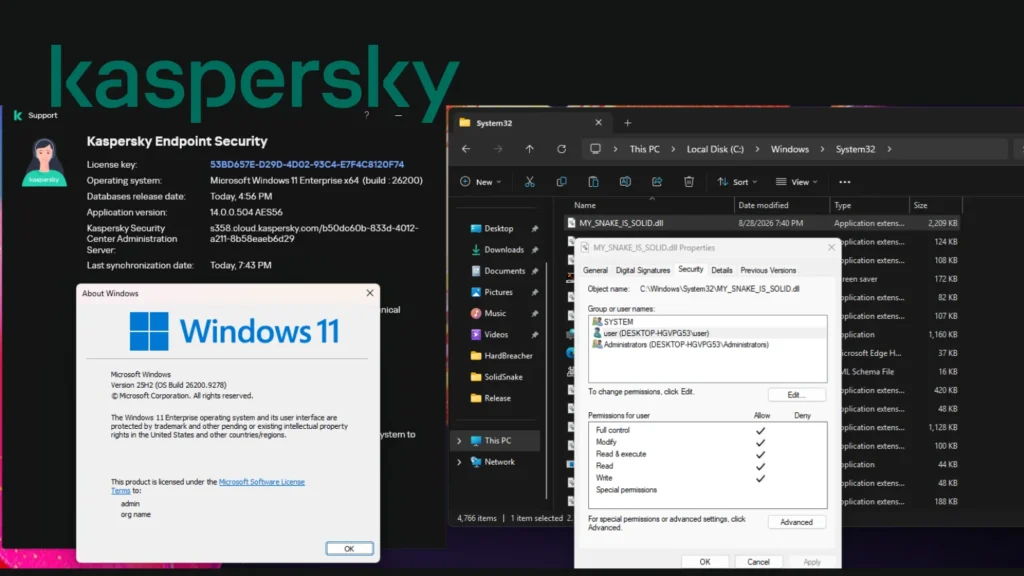
A researcher has released proof-of-concept code that allegedly exploits a local privilege-escalation weakness in Kaspersky Endpoint Security on a fully patched Windows 11 computer. The project, named HardBreacher, is potentially serious because security software operates with extensive system privileges, but the central claim has not been independently verified or publicly confirmed by Kaspersky.
The researcher using the name MSNightmare describes the issue as a zero-day affecting Kaspersky’s enterprise endpoint product. Testing was reportedly performed on Windows 11 version 25H2 with Kaspersky Endpoint Security 14.0.0.504. No CVE identifier, vendor advisory or official severity assessment was available when the report was published.
What the proof of concept claims
HardBreacher appears to manipulate an interaction involving a low-privileged local user and a Kaspersky user-interface process. According to the project documentation, successful execution can create C:\Windows\System32\MY_SNAKE_IS_SOLID.dll and grant the current user full permissions over that file.
A standard user should not be able to place and freely control files in the protected System32 directory. If the behavior is reproducible under realistic conditions, it may demonstrate a way to cross a Windows privilege boundary by inducing a more powerful security process to perform an operation on the user’s behalf.
The author also claims that interfering with the targeted user-interface process may disrupt Kaspersky’s normal enforcement behavior. In theory, that could influence decisions about whether files are blocked or allowed and could destabilize the endpoint. However, a claimed outcome in public repository documentation is not equivalent to a complete, repeatable exploit demonstrated across supported configurations.
Important uncertainty around the report
The project author acknowledges that the code is unreliable, can terminate with errors and may require several attempts. A reboot was reportedly part of testing, while the repository does not present a dependable end-to-end exploitation chain or clearly establish every prerequisite.
Those gaps affect risk assessment. A vulnerability may behave differently across product builds, Windows configurations and policy settings. Exploitation might also require additional permissions or user interaction not obvious from an early proof of concept. Until Kaspersky or independent researchers reproduce the issue, describing it as a confirmed zero-day would overstate the available evidence.
Why security-product flaws deserve attention
Endpoint protection tools have deep visibility into files, processes and operating-system activity. They often run privileged services and install components close to the kernel. That access is necessary for defense, but it also makes implementation mistakes attractive to attackers seeking to escalate from an ordinary account.
A reliable local exploit would not provide the initial entry point by itself: an attacker would first need to execute code as a user on the machine. Privilege escalation could then help the intruder disable protections, access restricted information, establish durable persistence or prepare lateral movement. This makes the alleged issue most relevant when combined with phishing, stolen credentials or another foothold.
Practical defensive steps while validation is pending
- Monitor Kaspersky security advisories and support channels for confirmation, affected versions and remediation.
- Alert on unexpected DLL creation or permission changes under System32, including the filename described by the proof of concept.
- Investigate crashes, service failures and unusual child processes involving Kaspersky components.
- Use least privilege so routine accounts cannot freely install or execute untrusted tools.
- Do not run the public code on production systems; the author warns that it can destabilize Windows.
Organizations that decide to reproduce the behavior should use an isolated laboratory with snapshots, controlled networking and proper authorization. They should record the exact Windows build, Kaspersky version, policy, privileges and reproduction rate. These details are essential for separating a genuine security boundary violation from an environmental or reliability issue.
Signal, not yet a verdict
Defenders should neither ignore the report nor assume that every Kaspersky endpoint is immediately exploitable. The proportionate response is heightened monitoring, confirmation of product support and rapid attention to any future vendor guidance. If a fix becomes available, enterprises should test and deploy it promptly, especially on systems where standard users can run downloaded software.
HardBreacher demonstrates the difficult period between public disclosure and authoritative validation. Clear labels matter during that window: the code is public, the claimed impact is meaningful, and the reported behavior warrants investigation—but exploitability, scope and remediation remain unresolved.
Leave a Reply
You must be logged in to post a comment.