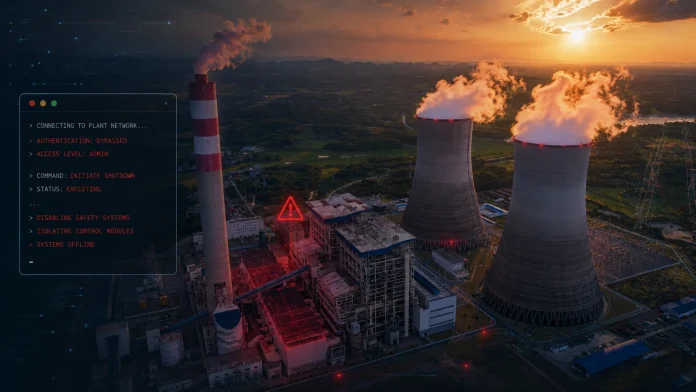
A cyberattack linked to Iran forced a British power generation facility completely offline for four consecutive days last month, in what officials are calling the first confirmed instance of a cyberattack successfully shutting down a UK power plant. The incident, first reported by The Telegraph and covered here based on that reporting, has quietly reshaped conversations inside the UK’s energy sector about the real-world reach of state-linked hacking groups.
A Small Plant, A Big Signal
The affected site has been described only as “a small-scale energy generator,” with the UK’s Department for Energy Security and Net Zero confirming the impact while declining to name the facility, citing security concerns. Officials have been careful to stress that the plant’s output represents, in their words, “less than a rounding error compared to grid capacity,” and that it fell below the legal threshold that would normally require formal cyber incident reporting.
That framing matters. The attack didn’t threaten blackouts or put the broader national grid at risk, according to government statements, and the UK has publicly reiterated that its energy system remains highly resilient. But the fact that a facility was taken fully offline for four days, rather than merely disrupted at the edges, is being treated as a meaningful escalation regardless of the plant’s size.
Who’s Behind It
Attribution points to hackers “linked to Iran” and specifically affiliated with the Islamic Revolutionary Guard Corps (IRGC), according to the reporting, though no specific named threat group has been publicly confirmed. The UK’s National Cyber Security Centre (NCSC), part of GCHQ, has not publicly detailed the incident or confirmed the facility involved.
What has been said publicly carries weight on its own. NCSC chief Richard Horne has noted that his agency now handles at least four “nationally significant” cyberattacks every single week, a figure that underscores just how routine serious intrusion attempts against UK infrastructure have become, even if most never reach public attention.
Part of a Wider Pattern
The timing of the disclosure lines up closely with parallel warnings from US agencies about Iran-linked actors targeting water utilities in the United States, suggesting to analysts that this was not an isolated event but one data point in a broader, coordinated campaign against Western critical infrastructure. Security researchers who track state-linked activity increasingly view attacks like this less as attempts to cause immediate, large-scale damage and more as demonstrations of capability, a way of testing access and response times against real operational technology (OT) environments without triggering a full-scale crisis.
Framed that way, a four-day outage at a small plant reads less like an isolated failure and more like a proof of concept: evidence that a threat actor can reach into physical energy infrastructure and hold it offline for a meaningful stretch of time, even if the target itself is modest.
What Comes Next
In the wake of the incident, UK officials have said they are updating cybersecurity regulations for the energy sector and briefing industry executives directly on how to strengthen their defenses. Neither the specific intrusion vector nor the technical details of the attack have been disclosed publicly, which limits how precisely other operators can defend against the exact same technique. That gap is itself a useful reminder for critical infrastructure operators everywhere.
Why It Matters for Critical Infrastructure Operators
- Facility size is not a reliable predictor of attacker interest. Smaller, less-monitored sites can be attractive precisely because they are less hardened than flagship national assets.
- Reporting thresholds built around generation capacity may leave a blind spot around smaller but still operationally significant facilities.
- State-linked actors appear willing to accept detection in exchange for demonstrating reach into OT environments, which should inform how defenders prioritize monitoring around industrial control systems, not just corporate IT networks.
- Coordinated warnings across multiple countries, in this case the UK and the US, are a strong signal that a threat actor’s targeting of critical infrastructure is systematic rather than opportunistic.
For now, the precise “how” behind this attack remains under wraps. But the “what” is clear enough: a cyberattack, attributed to Iran-linked actors, physically shut down a piece of UK energy infrastructure for four days, and officials are treating it as a warning rather than a footnote.
Leave a Reply
You must be logged in to post a comment.