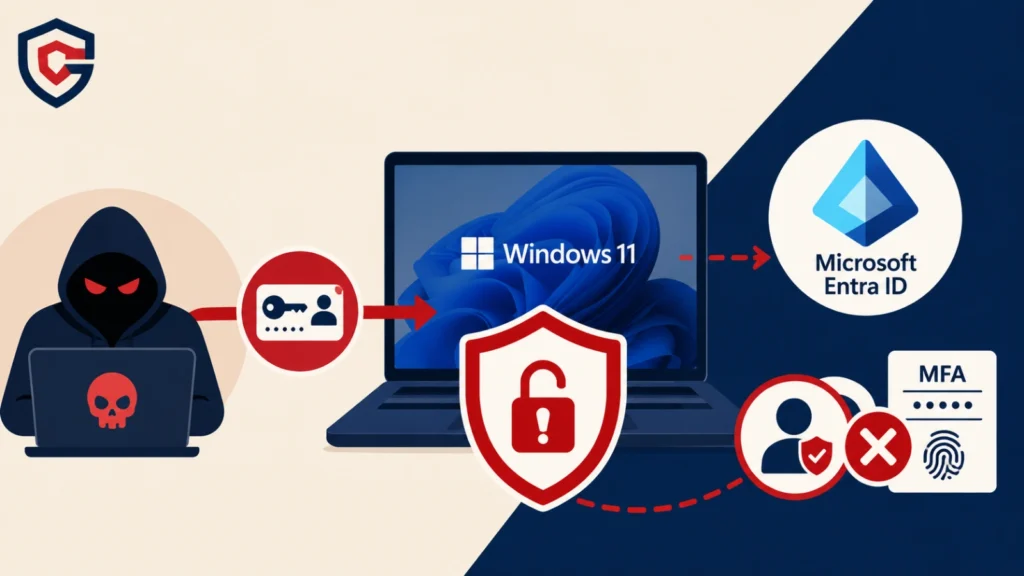
Passkeys are widely marketed as a phishing-proof replacement for passwords, since the cryptographic private key never leaves the secure hardware it was generated on. New research from SpecterOps shows that promise can still break down at the implementation layer. The firm’s analysis identifies more than 20 distinct attack techniques, grouped under the name “Pass-the-Passkey,” that affect Windows 11, Microsoft Entra ID, browsers, and password managers, without ever requiring an attacker to extract a single private key.
The Weak Link Wasn’t the Key — It Was the Log
The primary attack chain starts with a surprisingly mundane flaw: Windows 11 was writing complete, untruncated WebAuthn assertion responses into its Event Logs during ordinary passkey sign-ins. Those assertions include the cryptographic signature and authenticator data generated at the moment of login. Anyone with local or delegated access to a shared or already-compromised machine could harvest this logged material and replay it against services that don’t rigorously check for reuse. When a privileged administrator happened to authenticate from a compromised endpoint, an attacker could lift their logged assertion and use it to impersonate that identity later, all without needing the underlying hardware key.
Entra ID Made the Problem Worse
On its own, assertion logging would be a serious but containable issue if the receiving service enforced strict anti-replay checks. SpecterOps found that Microsoft Entra ID did not. According to the published whitepaper, Entra ID’s server-side validation failed to verify that authentication challenges were unique, failed to bind challenges to a specific user session, and did not track the signature counter that WebAuthn uses to detect replayed assertions. Put together, these two gaps, permissive logging on the client and weak validation on the server, meant a stolen assertion could be replayed to gain unauthorized access to privileged Microsoft cloud accounts while technically satisfying phishing-resistant MFA requirements.
Beyond Replay: Abusing the WebAuthn API Directly
SpecterOps also documented a second class of attacks that doesn’t rely on stolen assertions at all. Because WebAuthn exposes legitimate browser APIs for triggering authentication prompts, local malware can call those APIs directly to stage convincing, repeated credential prompts. Two techniques stood out in the research:
- Prompt flooding — repeatedly firing authentication requests until a user, worn down by the interruptions, approves one out of fatigue.
- Application impersonation — pairing WebAuthn API calls with spoofed application context so a prompt appears to originate from a trusted process.
Neither technique requires touching the hardware-protected private key; both rely on manipulating the human or the software layer that sits in front of it.
What’s Been Fixed, and What Hasn’t
Microsoft addressed the logging half of the problem, tracked as CVE-2026-34348, in its July 14, 2026 security release. Patched systems now truncate the signature field in logged assertions to just six bytes, enough for diagnostic purposes but not enough to reconstruct a usable replay. That closes the most direct path to assertion theft on updated machines, but it does not by itself fix the validation gaps SpecterOps identified on the Entra ID side, nor does it prevent prompt-flooding or impersonation attacks that operate independently of logging.
Recommendations for Defenders
Organizations relying on passkeys as their primary phishing-resistant MFA method should treat this research as a reminder that the surrounding infrastructure matters as much as the cryptography itself:
- Apply the July 2026 Windows security update across all endpoints, particularly those used by privileged administrators.
- Audit Event Log retention and access controls, since historical logs generated before patching may still contain replayable assertion data.
- Push for server-side anti-replay enforcement, including challenge uniqueness checks and signature counter validation, on any WebAuthn relying party.
- Train users to recognize and report unusual repeated authentication prompts rather than approving them reflexively.
Passkeys still represent a meaningful security upgrade over passwords, but this research is a useful case study in how systemic implementation gaps, not cryptographic weaknesses, tend to be where real-world attackers find their opening.
Leave a Reply
You must be logged in to post a comment.