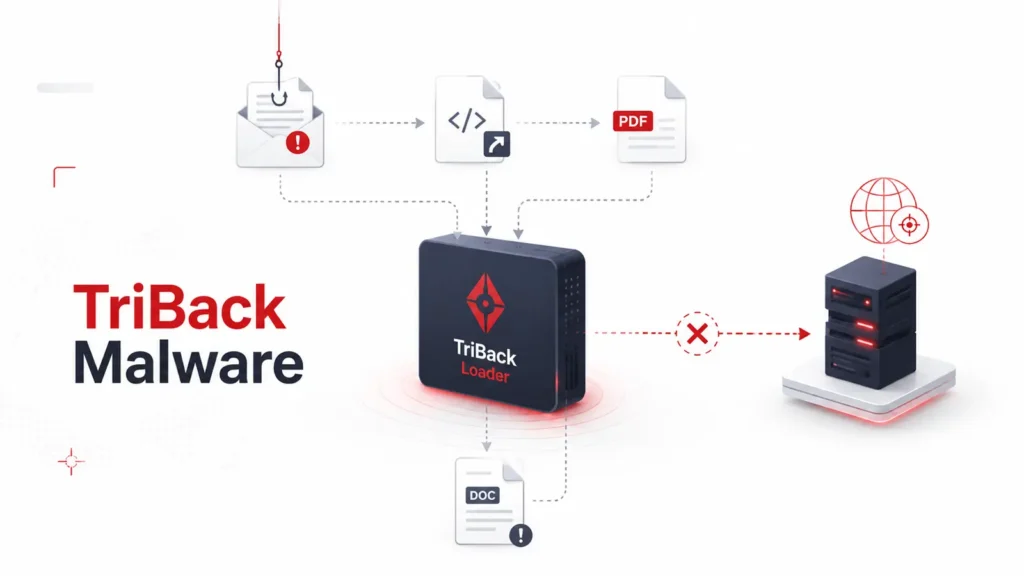
Espionage operators generally go to great lengths to stay invisible, which is what makes this discovery notable: a wide-ranging spying campaign was exposed largely because its own operators forgot to lock down a server. Group-IB analysts found a staging host with directory listing enabled, exposing command history, phishing kits, and post-exploitation tools in plain view. That single oversight let researchers map an active operation now tracked as JadeProx, built around a newly identified loader called TriBack.
A Wide and Unusual Victim Spread
The campaign’s target list, pieced together from logs on the exposed server, spans an unusually broad geography for a single operation. Confirmed or attempted targets include a Vietnamese public hospital’s medical imaging system, Malaysia’s Ministry of Foreign Affairs, several education-sector sites in Hong Kong, and organizations in Honduras. A fake portal impersonating a Venezuelan municipal tax system was also found running on the same infrastructure, apparently built to harvest credentials from unsuspecting visitors.
The Honduras intrusion attempt used a lure styled as a statement from a well-known local beverage company, sent toward the country’s National Congress — a level of social-engineering tailoring that suggests deliberate targeting rather than opportunistic spam. Researchers note the geographic pattern, stretching from Southeast Asia into Latin America, is consistent with tactics often associated with China-nexus espionage actors, though attribution to a specific known group has not been finalized.
How the Operators Slipped Up
The exposure traces back to an Alibaba Cloud server running a Python web server with directory listing turned on — essentially leaving an open folder accessible to anyone who found it. Inside sat port forwarders, SOCKS tunnels, network scanning scripts, and even tools apparently intended to hide the server’s activity from cloud-host monitoring. Command logs captured on that host showed tunneled connections reaching into the Vietnamese hospital’s imaging network and access attempts against Malaysian government systems, giving investigators an unusually direct window into the operation’s internal workings.
Inside the TriBack Loader
TriBack itself is a compact but evasive piece of tradecraft. It arrives as a small bundle: a legitimate signed executable, a malicious DLL, and an encrypted data file, a setup commonly known as DLL sideloading. Once running, the loader decrypts its payload using a byte-reversal step combined with a rolling key, then executes the resulting shellcode through uncommon Windows callback functions rather than the thread-creation patterns most endpoint security tools are tuned to watch for.
Researchers identified four distinct TriBack builds released over roughly two months, each swapping out the host binary or callback technique while retaining a consistent builder fingerprint. Two of the variants deployed AdaptixC2 beacons, complete with recoverable configuration details such as sleep intervals and HTTP communication profiles. A third infection path instead used shellcode to launch a separate backdoor called Beagle. A related Honduras-targeted archive relied on a signed Microsoft binary to sideload its malicious DLL, and similarly themed packages exploited other trusted vendor programs — including some using fake Claude-branded software lures — to stage later payloads without tripping typical alerts.
Why the Detection Evasion Works
The consistent thread across TriBack’s variants is an effort to avoid the most commonly monitored behaviors on Windows endpoints. By routing execution through callback functions instead of conventional thread starts, and by hiding behind signed, trusted binaries, the loader reduces the number of obvious red flags a security product would typically catch. Combined with C2 domains that follow consistent registration patterns — several of which impersonate legitimate security and AI brands — the campaign was built for a long, quiet run rather than a smash-and-grab intrusion.
What Defenders Should Do
Group-IB’s findings give network defenders concrete hunting leads. Recommended actions include:
- Blocking known JadeProx-linked IP addresses and domains at the DNS and network edge
- Hunting for nested folder naming patterns associated with the campaign’s staging infrastructure
- Flagging signed vendor binaries launched from user-writable paths, especially alongside a companion data or log file
- Reviewing Startup folder entries and monitoring for double-extension cleanup scripts
- Prioritizing patches for internet-facing Java applications and other known unpatched critical flaws, which the operators have used as alternate entry points
Because loaders and tunneling tools are frequently reused across related China-nexus operations, the indicators tied to TriBack and JadeProx should remain useful hunting anchors even as the operators rebuild their infrastructure following this exposure.
Leave a Reply
You must be logged in to post a comment.