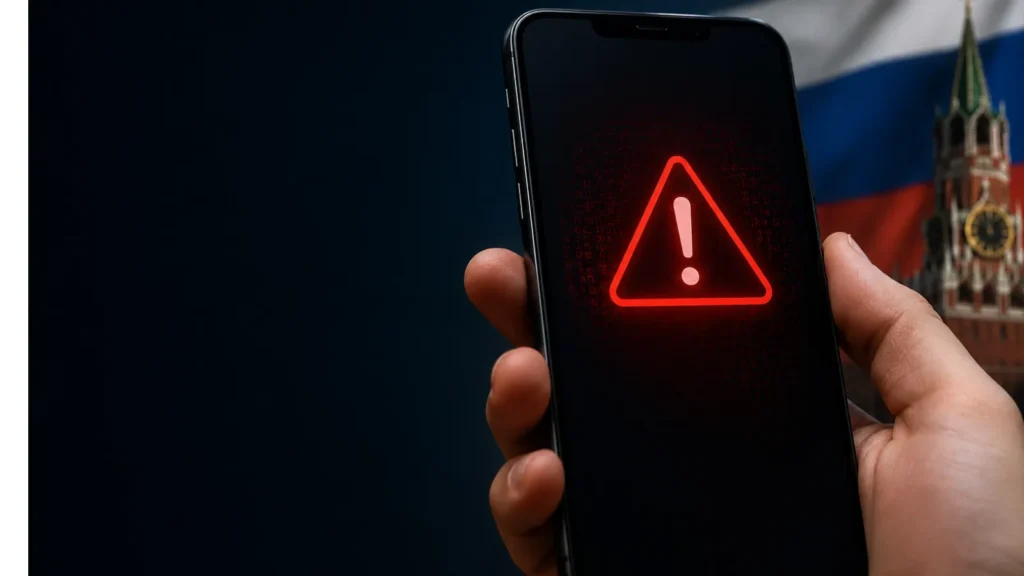
Russia’s Federal Security Service (FSB) announced on June 2, 2026, that it has disrupted a large-scale cyber-espionage campaign in which foreign intelligence services implanted advanced spyware on mobile devices belonging to high-ranking Russian government officials. The agency stated the operation was aimed at covert surveillance and systematic exfiltration of sensitive government data.
What the FSB Claims Was Found
According to the FSB, the spyware was capable of a broad range of covert activities on targeted devices:
- Extracting sensitive documents and communications stored on target devices
- Intercepting encrypted messaging application traffic
- Conducting unauthorized audio and video recordings via device microphones and cameras
- Enabling persistent, silent surveillance without any visible signs of compromise
The agency noted that attackers leveraged technical infrastructures associated with major international IT and telecommunications providers to facilitate data collection without directly compromising devices through conventional malware delivery. This suggests the use of supply-chain access, network-level interception, or zero-click exploit delivery — all hallmarks of nation-state-grade spyware operations.
Technical Characteristics of the Spyware
While the FSB did not disclose specific indicators of compromise or name a malware family, the described capabilities are consistent with known commercial spyware platforms such as Pegasus (NSO Group) and Predator (Intellexa). These tools share key technical traits:
- Zero-click delivery: Exploitation of vulnerabilities requiring no user interaction, often via malicious messages or baseband protocol exploits.
- Baseband vulnerabilities: Attacks targeting the cellular modem firmware layer, which operates below the OS and is notoriously difficult to audit or patch.
- Modular architecture: Spyware components can be updated remotely, allowing operators to expand capabilities after initial implantation.
- Anti-forensic measures: Sophisticated evasion of standard forensic analysis tools and mobile threat detection products.
Attribution and Geopolitical Context
The FSB did not attribute the campaign to a specific country or intelligence service, stating only that “foreign” actors were responsible. Russia has historically accused Western intelligence services of conducting espionage via mobile devices. The timing of this announcement, amid ongoing geopolitical tensions, makes independent verification challenging. A criminal investigation has reportedly been launched, and forensic analysis of affected devices is underway.
The FSB also issued a public advisory warning officials about the risks of discussing sensitive matters near mobile devices, even when those devices appear uncompromised — a recognition that passive audio capture can occur even without an active display of infection indicators.
Why This Matters for Global Security Professionals
This incident reinforces persistent truths about mobile security in high-stakes environments. Mobile devices remain one of the most attractive and hardest-to-defend attack surfaces. Their constant connectivity, access to encrypted communications, and deep integration with enterprise systems make them high-value targets for intelligence operations worldwide — across all geopolitical divides.
Recommended Mitigations for High-Risk Environments
- Deploy Mobile Threat Defense (MTD) solutions capable of detecting behavioral anomalies, unexpected network connections, and privilege escalation.
- Apply OS updates immediately — iOS and Android patches regularly address zero-click exploit vectors used by commercial spyware vendors.
- Segment sensitive communications to dedicated hardened devices with strict app installation controls.
- Consider periodic device reboots to disrupt in-memory-only implants that lack persistent installation.
- For the highest-risk environments, evaluate air-gapped communication channels or purpose-built secure phones.
Leave a Reply
You must be logged in to post a comment.