

The underground cybercriminal ecosystem has witnessed a worrisome development – the rise of a highly sophisticated remote access trojan (RAT) known as K.G.B. RAT. This weaponized software, now readily available on forums frequented by threat actors, poses a significant risk to organizations across various sectors. The K.G.B. RAT package is more than just a standard RAT; it’s a meticulously crafted toolkit boasting advanced evasion techniques and robust capabilities for covert attacks.
Recent reports indicate that this malware has become the talk of the underground forums, with security researchers worldwide keenly observing its emergence. The presence of a crypter and HVNC (Hidden Virtual Network Computing) functionality within the package elevates the K.G.B. RAT to a potent tool for launching sophisticated attack campaigns. This isn’t just about malware; it’s about an entire ecosystem designed to facilitate undetectable attacks against vulnerable systems.
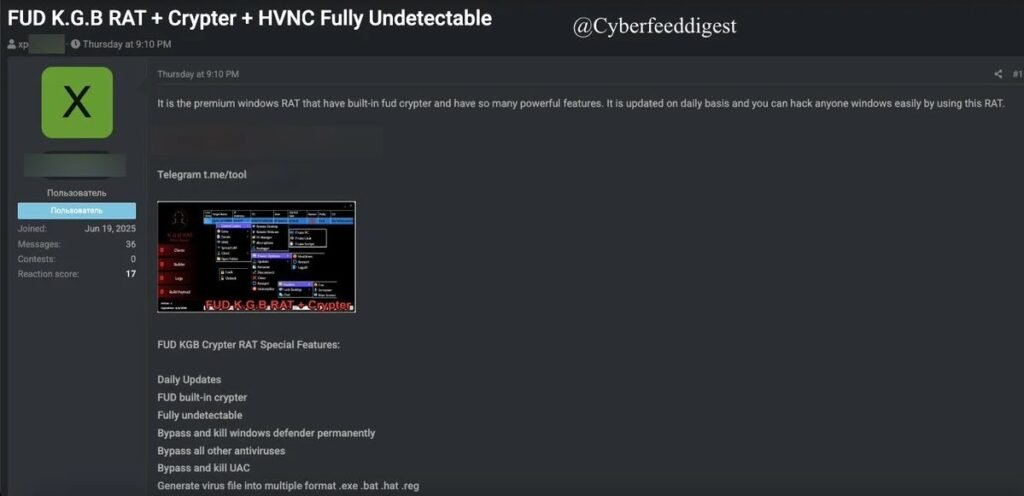
One particularly noteworthy aspect of this threat is its ability to bypass traditional security measures and antivirus solutions through advanced evasion techniques. K.G.B. RAT employs obfuscation techniques to disguise its true functionality from security scanning engines, further obscuring its trail. The malware utilizes encrypted channels to communicate with command-and-control servers, preventing standard detection mechanisms from catching it in the act. Additionally, its payload is encoded using a crypter that continuously shifts its binary signature during compilation. This ensures that even advanced detection techniques, such as hash-based checks, are rendered ineffective.
The presence of HVNC adds another layer of complexity to the threat landscape. Attackers can utilize this functionality to interact with infected systems through a hidden virtual desktop environment. This enables them to carry out credential theft and lateral movement while remaining undetected by traditional endpoint monitoring tools.
The ease with which this malware has been distributed online signals a shift in the dynamics of cyberattacks. This is not just about finding skilled hackers; it’s about providing them with readily accessible, highly effective tools for conducting sophisticated attacks.
To combat this emerging threat, organizations must prioritize proactive security assessments to identify and mitigate potential vulnerabilities across their networks. Traditional signature-based detection methods will only go so far in the face of such advanced evasive techniques. Instead, implementing a more comprehensive approach that emphasizes behavioral analysis and network traffic inspection is crucial for effectively defending against attacks like this one.
The emergence of K.G.B RAT underscores the continuous need for vigilance and adaptation within the cybersecurity landscape. Organizations must remain informed and prepared to face new threats as they emerge, utilizing their resources to stay ahead of the curve and ensure data security remains paramount in today’s digital age.