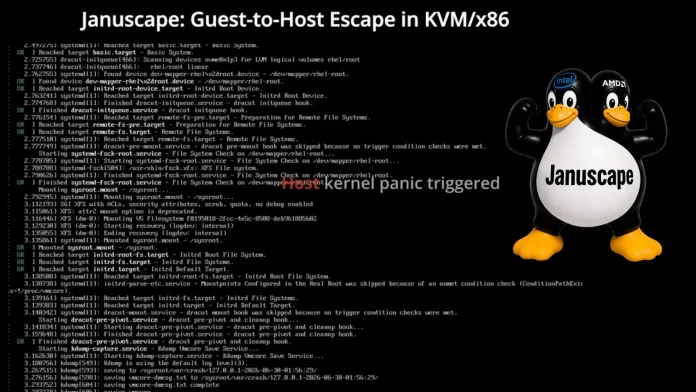
A newly disclosed vulnerability in the Linux Kernel-based Virtual Machine (KVM) hypervisor has been sitting undiscovered for roughly 16 years. Tracked as CVE-2026-53359 and nicknamed Januscape, the flaw allows a malicious guest virtual machine to corrupt host kernel memory, undermining one of virtualization’s core security promises: isolation between guest and host.
Where the Bug Lives
The vulnerability resides in KVM’s shadow MMU (Memory Management Unit), specifically in code handling nested virtualization — the scenario where a guest hypervisor (L1) runs its own nested guest (L2). Modern systems typically avoid this fragile path by using hardware-assisted paging such as Intel EPT or AMD NPT. But when nested virtualization is in play, the host (L0) has to emulate second-level address translation in software using shadow paging, exposing legacy code that has gone largely unaudited for years.
The flaw affects KVM’s x86 implementation on both Intel and AMD platforms, making it relevant across the large majority of production virtualization deployments that support nested guests. Nested virtualization has become increasingly common as cloud providers and CI platforms let customers run their own hypervisors or sandboxed VMs on top of already-virtualized infrastructure.
From Broken Invariant to Memory Corruption
A subtle logic mismatch in this shadow-paging path breaks internal invariants in KVM’s reverse-mapping (rmap) system, which tracks how guest memory maps to host physical pages. Over time, that inconsistency produces a use-after-free condition: a shadow page structure that has already been freed is still referenced elsewhere in the code.
When the kernel later attempts to clean up that structure, it can end up writing to memory that has since been reallocated for something else entirely — corrupting host kernel memory in the process. Use-after-free bugs of this kind are notoriously difficult to trigger reliably, which likely explains why this particular code path survived more than a decade and a half of kernel review without anyone spotting the flaw.
Proof-of-Concept: Denial of Service, With Worse Possible
A publicly released proof-of-concept demonstrates a reliable denial-of-service attack: by carefully sequencing nested page table operations inside a guest VM, an attacker can trigger the memory corruption, which is caught by KVM’s internal integrity checks and results in an immediate host kernel panic — crashing the entire physical machine, not just the guest.
On systems with strict corruption detection enabled, such as those built with CONFIG_BUG_ON_DATA_CORRUPTION, the crash is fast and reliable. Researchers caution that the same underlying primitive could potentially be extended beyond a crash into a full guest-to-host escape, though the public PoC currently stops at denial of service. A successful escape would let a malicious tenant VM read or write arbitrary host memory, effectively breaking out of its sandbox entirely — a far more severe outcome than a crash.
Who Is Exposed
The risk is highest for environments that expose nested virtualization to untrusted or semi-trusted guest users — a configuration common in cloud platforms, CI/CD pipelines that spin up VMs inside VMs, and virtualization testing labs. Systems that don’t enable nested virtualization for guest workloads are not exposed to this specific code path, which narrows the practical blast radius somewhat, but any host offering nested virtualization as a feature to tenants should treat this as an urgent patching priority.
Multi-tenant cloud environments carry the highest stakes here: a single malicious or compromised customer VM could, in the worst case, threaten the stability or integrity of the physical host running dozens or hundreds of other tenants’ workloads.
Mitigation
- Apply the kernel patch addressing CVE-2026-53359 as soon as it is available for your distribution.
- Where nested virtualization isn’t required, disable it to eliminate exposure entirely.
- Audit which tenants or workloads currently have nested virtualization enabled.
- Monitor for unexpected host kernel panics correlated with guest VM activity.
- Track vendor advisories from major distributions and cloud providers for backported fixes.
Januscape is a pointed reminder that even mature, heavily reviewed infrastructure like KVM can harbor subtle memory-management flaws for over a decade — and that legacy code paths deserve the same scrutiny as newly written features, especially as nested virtualization becomes a more mainstream feature rather than a rarely used edge case.
Leave a Reply
You must be logged in to post a comment.