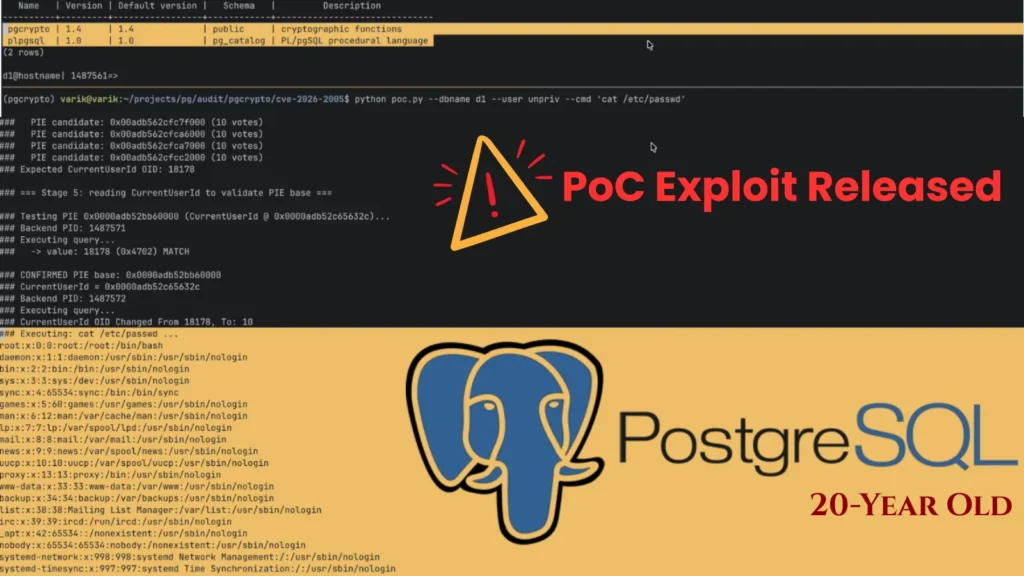
A working proof-of-concept (PoC) exploit has been publicly released for CVE-2026-2005, a critical remote code execution vulnerability affecting PostgreSQL’s widely used pgcrypto extension. The flaw is rooted in legacy code dating back nearly two decades, serving as a stark reminder that even mature, battle-tested software can harbor high-severity security defects for years before discovery.
Vulnerability Overview: A 20-Year-Old Flaw
The vulnerability exists in the PGP session key parsing logic within the pgcrypto module, a popular PostgreSQL extension that provides cryptographic functions including symmetric encryption, public-key encryption, and hashing. A heap-based buffer overflow can be triggered by submitting a specially crafted PGP message to vulnerable functions within pgcrypto.
Successful exploitation of this buffer overflow enables arbitrary memory read and write operations within the PostgreSQL process. An attacker with the ability to interact with the database — even as a low-privileged user — can leverage this primitive to escalate privileges to the PostgreSQL superuser role and subsequently execute arbitrary operating system commands on the underlying host system.
Technical Exploitation Details
Security researcher Varik Matevosyan (var77) published the full PoC exploit on GitHub, demonstrating a complete exploitation chain from initial memory corruption to OS-level command execution. The exploit targets PostgreSQL instances compiled from a specific vulnerable commit and leverages predictable memory offsets to bypass Address Space Layout Randomization (ASLR).
The attack chain proceeds through several stages:
- Heap corruption: The crafted PGP message triggers a buffer overflow in the PGP session key parsing routine, corrupting adjacent heap memory structures.
- Pointer leak: When PostgreSQL attempts to free the manipulated memory chunks, a controlled pointer is leaked, revealing the heap layout to the attacker.
- ASLR bypass: The leaked pointer is used to perform arbitrary memory reads, enabling the attacker to locate executable memory regions and calculate the base address of the PostgreSQL binary using symbol offset matching.
- Privilege escalation: The attacker overwrites the critical
CurrentUserIdinternal variable, setting it to match PostgreSQL’s bootstrap superuser identifier — effectively granting full superuser privileges within the database context. - OS command execution: With superuser privileges acquired, the exploit abuses PostgreSQL’s
COPY FROM PROGRAMfeature to execute arbitrary commands on the host system under the PostgreSQL service account.
The PoC relies on Python-based tooling, including psycopg2 and pwntools, to deliver the payload and interact with the database during exploitation. Researchers note that while successful exploitation requires matching the specific vulnerable PostgreSQL build, the public release of a working PoC significantly lowers the barrier for threat actors to weaponize this flaw.
Affected Systems and Risk Assessment
PostgreSQL is one of the most widely deployed open-source relational database systems in the world, powering applications across enterprises, cloud platforms, and government infrastructure. The pgcrypto extension is commonly enabled in deployments that require encryption-at-rest or encrypted data exchange between services.
Systems most at risk include PostgreSQL deployments that have pgcrypto enabled and are accessible to potentially untrusted users — including multi-tenant environments, cloud-hosted databases with external-facing connection strings, and applications that pass user-controlled data through pgcrypto functions. The release of a public PoC means exploitation attempts should be expected in the near term as threat actors adapt the technique for automated attacks.
Recommended Mitigation Steps
Organizations running PostgreSQL with the pgcrypto extension should take the following actions immediately:
- Apply all available PostgreSQL security patches as they are released by the PostgreSQL Global Development Group
- Disable pgcrypto on any instance where it is not strictly required
- Restrict database access using the principle of least privilege, ensuring no untrusted users have direct query execution access
- Monitor database logs for anomalous PGP-related function calls, unexpected error patterns in pgcrypto operations, or suspicious uses of
COPY FROM PROGRAM - Segment database servers from internet-accessible services and enforce strict network-level access controls
The disclosure of CVE-2026-2005 highlights the long-term risks posed by aging cryptographic library code that was written before modern memory-safe programming practices became standard. As public PoC exploits continue to emerge for legacy vulnerabilities, organizations must prioritize continuous security auditing of critical database infrastructure and establish rapid patch deployment workflows to stay ahead of active exploitation.
Leave a Reply
You must be logged in to post a comment.