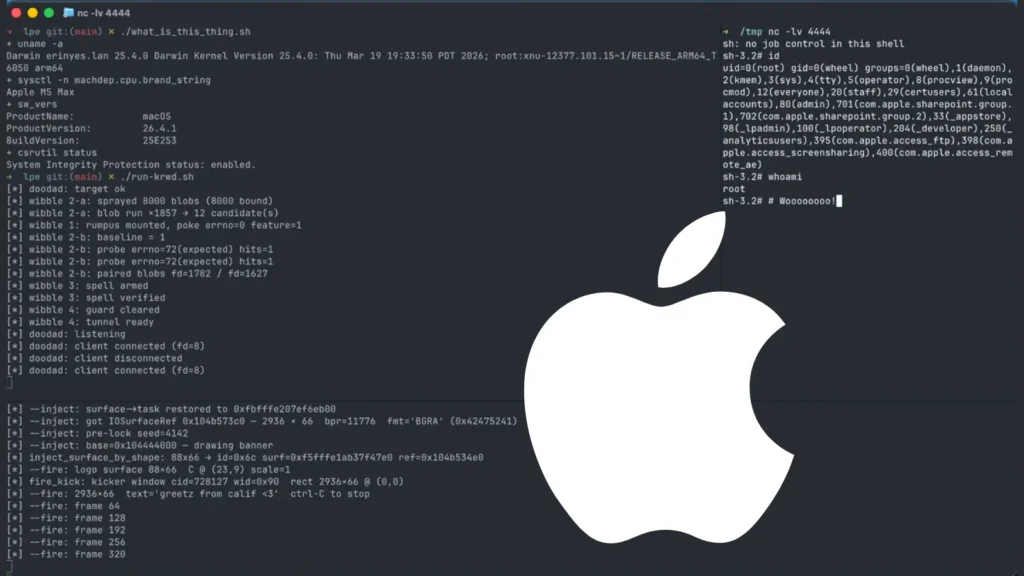
In a landmark demonstration of AI-assisted offensive security research, a team of researchers has developed what is reportedly the first publicly disclosed macOS kernel exploit targeting Apple M5 hardware — successfully bypassing Apple Memory Integrity Enforcement (MIE), a hardware-level memory protection system the company spent five years and reportedly billions of dollars developing. Remarkably, the working exploit was developed in just five days.
The Exploit: What Was Achieved
Researchers Bruce Dang, Dion Blazakis, and Josh Maine from security firm Calif developed a working kernel local privilege escalation (LPE) exploit targeting macOS 26.4.1 (build 25E253) on bare-metal Apple M5 hardware. The exploit chain delivers a full root shell from an unprivileged local user account, uses only standard system calls, and achieves all of this while Apple Memory Integrity Enforcement is fully active.
The two underlying vulnerabilities were discovered on April 25, 2026. The team joined forces two days later and had a working exploit running by May 1 — a five-day total development timeline against a security system that took Apple half a decade to build.
What Is Memory Integrity Enforcement?
Memory Integrity Enforcement (MIE) is Apple hardware-assisted memory safety system built on ARM Memory Tagging Extension (MTE) architecture. Introduced as the signature security feature of the M5 and A19 chips, MIE works by tagging memory allocations and detecting invalid memory access at the hardware level — specifically designed to defeat kernel memory corruption exploits.
According to Apple own published research, MIE disrupts every known public exploit chain targeting modern iOS and macOS, including leaked commercial exploit kits that have been used by nation-state actors. MIE represents the current state of the art in hardware-assisted kernel protection for consumer devices.
The Role of AI in the Discovery
The breakthrough was enabled in part by Anthropic Mythos Preview model, which assisted the research team in identifying the two underlying vulnerabilities and throughout the exploit development process. The Calif team describes Mythos as capable of generalizing attack patterns across entire vulnerability classes once it has learned a problem type — dramatically accelerating the bug-finding phase of research.
The bugs were discovered quickly because they fall within known vulnerability classes. However, autonomously bypassing MIE still required significant human expertise — making this a showcase for human-AI pairing rather than fully autonomous exploitation. The researchers frame this as an early example of what they call the AI bugmageddon era: a period where small, AI-augmented security teams can achieve research outcomes that previously required large, well-funded organizations.
Responsible Disclosure Approach
Rather than submitting through the standard bug bounty pipeline — which can have slow response times, especially during high-volume periods like Pwn2Own — the Calif team took an unusual approach: they printed the 55-page technical report and delivered it directly to Apple Park in Cupertino. This ensured timely, unambiguous disclosure directly to Apple security engineering leadership, bypassing submission queues.
Full technical details of the vulnerability chain will only be published after Apple ships a patch. No exploit code has been released publicly.
Current Risk Assessment
Until Apple releases a fix, systems running macOS 26.4.1 on M5 hardware are theoretically at risk from local privilege escalation. Importantly, this attack requires local access — an attacker must first have a foothold on the target system. It cannot be exploited remotely without a separate initial access vector such as a phishing attack or another vulnerability.
Interim mitigations recommended by the security community include:
- Restricting physical and remote access to M5-based Mac systems.
- Avoiding running untrusted code or applications on sensitive M5 systems until a patch is available.
- Monitoring system logs for unusual privilege escalation events.
- Applying Apple security updates as a priority immediately upon release.
Broader Implications for Hardware Security
This exploit signals a meaningful shift in the economics of hardware security. Memory corruption remains the most prevalent vulnerability class across all modern platforms, and hardware mitigations like MIE are designed to raise the cost of exploitation. But as AI models become more capable at surfacing unknown bugs in known classes, even best-in-class hardware defenses face a narrowing window of effectiveness.
The five-day development timeline against five years of engineering is being widely cited in the security community as a benchmark for what AI-assisted research can now achieve. Apple is reportedly working on a patch, and the community is watching closely for both the fix and the full technical disclosure that will follow.
Leave a Reply
You must be logged in to post a comment.